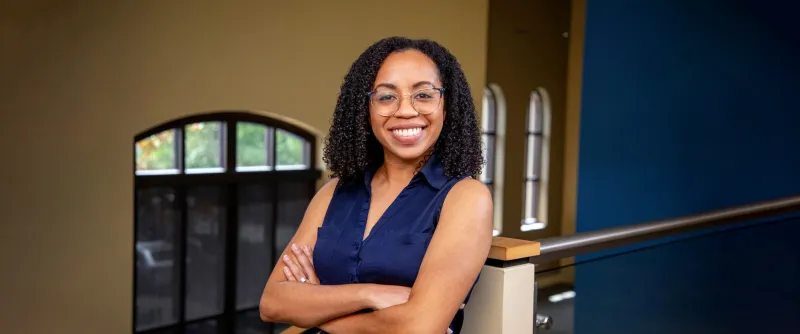
We recently caught up with Janine Stewart, an architectural designer at Charlan Brock and co-founder of the small practice Quilted Designs. After growing up in Trinidad and Tobago, Janine came to the U.S. in 2012 to complete her master’s degree in architecture and pursue U.S. licensure. Now with nearly 10 years of experience honing her craft at firms across Northern Virginia and Florida, Janine shares how her early childhood experiences shaped her curiosity for human-centered design and how she navigated challenges on her journey to U.S. licensure as a Trinbagonian immigrant.
What inspired you to pursue a career in architecture?
Both of my parents had a hand in planting that seed for me. My father designed our family home when I was a child. He was not a design professional, but I vividly remember him drawing out plans on small, notecard-sized pieces of paper with great care and intention.
My mother has had a lifelong commitment to the constant improvement of that home. It has gone through many different eras over the years, evolving along with our family. I love our family home—it is the backdrop and context for so many of my formative memories.
That experience made me reflect on how deeply tied our memories are to place.
The locations of our lives, at home and elsewhere, become so ingrained that they are almost characters themselves. I wanted to be the person who could create that for others.
Whether it’s the safe, cozy memories of one’s home, the formative experiences that happen in a school, or the thrill of travel, I wanted to create spaces that would be imprinted on people’s memories and live on in their stories.
Tell us a little bit about your path to licensure—what did the process look like for you?
My path to licensure was shaped by a number of factors outside of my control, both positive and challenging. I am originally from Trinidad and Tobago, and during the processing of my permanent residency status in the U.S., I was unable to work for a period of time. I was determined not to let that time go to waste and instead looked for ways to continue moving my career and personal goals forward.
During that time, I completed my first four licensure exams and earned an MBA from the University of Central Florida. I have always had aspirations of owning and running my own firm or serving in a leadership role, and this felt like a meaningful way to align my long-term goals with the moment I was in. Once I was able to return to work, I continued taking exams, usually studying early in the mornings before work and on weekends.
After a brief pause to relocate to another state with my husband, I took my final exam in Richmond, Virginia. I’m proud to say that I passed all of my exams on the first try. However, the final exam coincided with one of the most difficult periods of my life. In the final weeks of preparation, my father was diagnosed with a very aggressive cancer and passed away just two days after I took my last exam.
Reconciling the relief of completing licensure with the shock and grief of losing my amazing dad—the person who inspired me to become an architect in the first place—was incredibly hard. I take comfort in knowing that I was able to give him one of his last moments of joy and pride by sharing that I had passed my exam and would finally earn my architecture license.
What does a typical day at work look like for you? Do you have any favorite projects you’ve worked on?
As part of the design studio department at Charlan Brock, my days are often filled with creative sprints. We work at the very beginning of projects, helping clients imagine what their projects could become. It’s fast-paced and highly iterative, but that early stage is what I enjoy most—when ideas are still taking shape and the focus is on creating spaces that feel thoughtful and human from the start.
One of my favorite projects I’ve worked on is the Rose Arts Phase 1 project. It’s part of a large mixed-use, placemaking development within an opportunity zone that includes over 1,000 residential units, along with retail and park spaces. Being involved in such a large-scale project that is meant to support daily life and community has reinforced my interest in designing places where people can truly live, work, and gather.

That same interest carries over into my work outside of the office. After graduating from college, my best friend, Sheldyn Merrell, and I founded Quilted Designs because we genuinely enjoy working together and wanted a space to explore ideas and grow through doing. It has become a kind of personal lab for us, where we’ve worked on everything from a bathroom remodel to triplexes in Minneapolis, Minnesota, to early visioning for a mixed-use development in Colorado. Like many small practices, we’ve experienced different seasons as life events and COVID unfolded, but we continue to value the collaboration, the learning, and the long-term goal of building something meaningful together.
What advice or resources would you recommend to someone still on their licensure journey?
One of the most important things for me was booking the exam before I started studying. I personally need a date to work backward from to plan my preparation, and having that deadline helped me stay focused. Depending on the exam, I typically gave myself six to 10 weeks to study so I could get through all the material, leave time for practice testing, and feel confident going in.
The week before the exam, I would intentionally assess my readiness. If I ever felt like I had more preparation left than time to do it, I would reschedule rather than go in under-prepared and stressed. Practice tests were a key part of that process, helping me identify areas where I felt confident and areas that still needed attention. I used a mix of resources, including WeARE and Designer Hacks, but the NCARB practice exams were by far the most valuable. They helped me understand the format, the types of questions being asked, and how to use the tools and resources available during the actual exam, all under realistic testing conditions.
Finally, don’t underestimate the basics. I always aimed to get a good night’s sleep and scheduled my exams in the morning so I could be well rested and reduce the chances of unexpected distractions throwing me off. Sometimes preparation is just as much about setting yourself up mentally and physically as it is about studying the content.
What do you see as the most pressing issues facing the profession right now?
The main issue I see in architecture today is that the profession is undervalued, and that undervaluation has real consequences. Starting with education, the reclassification of the graduate architecture degree as a non-professional degree limits financial access and could narrow the pipeline of future architects.
Beyond education, the stakes of our work are high. Architects are responsible for protecting the health, safety, and welfare of the public. When buildings fail or underperform, the consequences can be severe.
Architecture shapes the way people live, work, and interact, and it deserves recognition for that responsibility.
At the same time, many architects face compressed timelines, expanding expectations, and limited compensation. This can lead to burnout, talented professionals leaving the field, or new architects entering without the time and support to be fully prepared. Combined with a shrinking pipeline, these challenges threaten the long-term sustainability of the profession.
I don’t have all the answers, but as my career develops, I’m curious to explore solutions. I do know that we need collaboration—between firms, peers, and industry bodies—to establish standards and support systems that help the architectural profession thrive. If we keep competing for the bottom, meaningful progress will be difficult. By working together, we can create a profession that values the work, the people doing it, and the communities we serve.
Want to hear more from architects across the U.S.? Check out more stories from NCARB's Architect Spotlight series.