Over the past several years, NCARB has been working toward Pathways to Practice, an initiative that is evolving the licensure process to expand access to licensure programs and increase opportunities to pursue a career in architecture. Learn more about the current planned updates to the licensure process, as well as our timeline for implementation.
What Are the New Assessment Methods?
NCARB’s Competency Standard for Architects outlines the 16 competencies that are essential for initial licensure—it is the foundation for the future licensure process. Some of the 16 competencies can be gained and validated through formal education, while others are best gained through professional work experience and validated through standardized assessments. Many of the competencies can be demonstrated through these and other substantially equivalent assessment methods, providing candidates options in how to complete their path to licensure.
Education
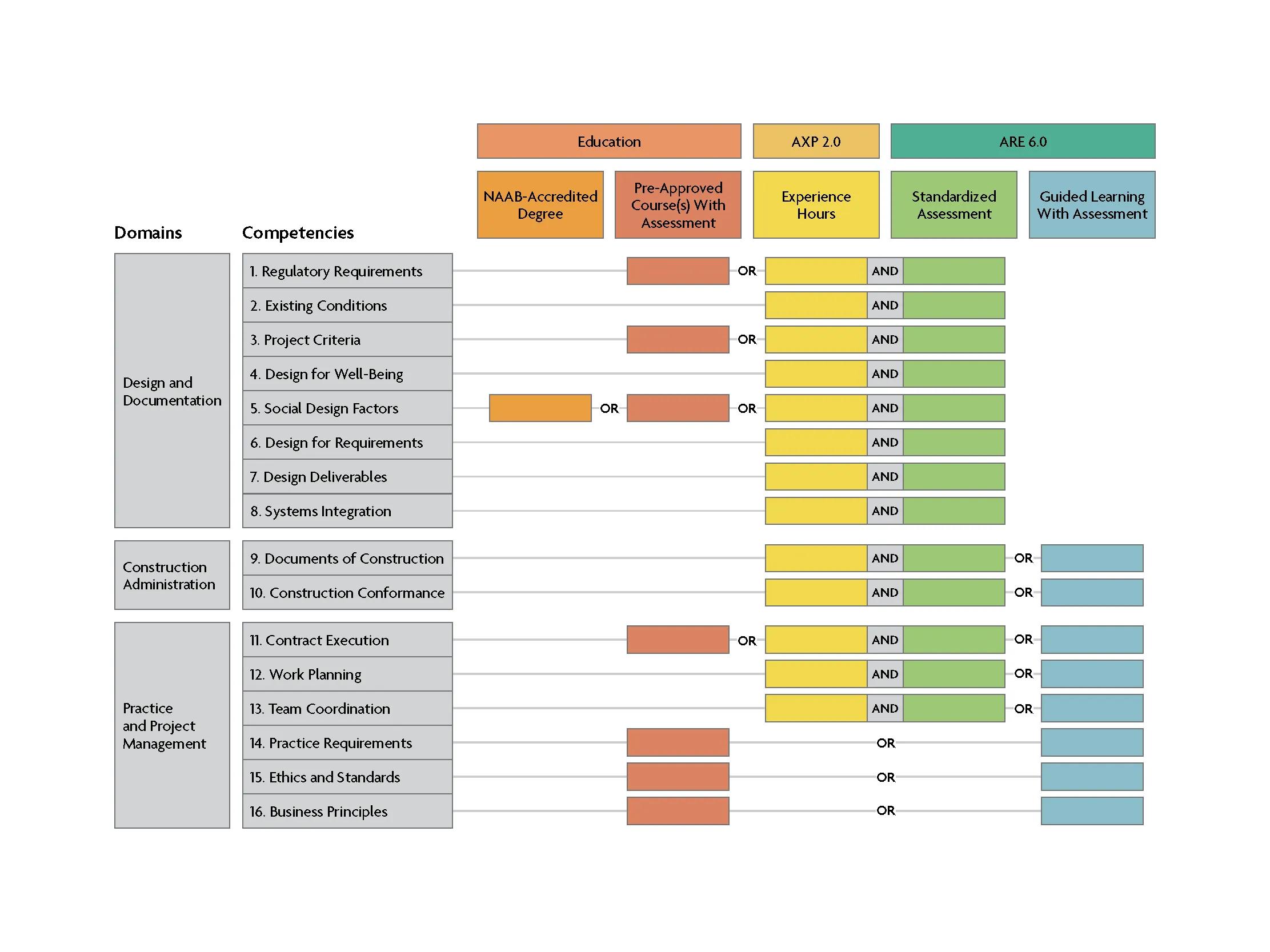
NCARB’s education requirements recognize architecture programs accredited by the National Architectural Accrediting Board (NAAB) as the primary means by which candidates enter the profession. Individuals with a degree from a NAAB-accredited program will be given appropriate credit at the competency level, as well as credit toward NCARB’s experience requirement. Currently, competency five—social design factors—is fulfilled through a degree from a NAAB-accredited program. NCARB is working with NAAB to determine if additional competencies can be attained through NAAB-accredited programs.
NEW: NCARB is developing an option called pre-approved courses that allows any higher learning institution to have courses within their curricula approved to fulfill some competencies. To participate, accredited academic institutions will submit their course curricula and testing criteria so NCARB can assess competency alignment. If approved, students passing the course and its associated assessment will earn credit toward licensure.
This new assessment method will open pathways for students who attend four-year architecture or community college programs to make licensure progress while they’re in school. NAAB-accredited programs will be able to include pre-approved courses to help their students fulfill additional competencies, if the program chooses to do so. Currently, seven competencies may be fulfilled through the pre-approved courses option.
None of the competencies will include a degree requirement for licensure, so that the small number of candidates without higher education will be able to pursue licensure by fulfilling all 16 competencies through other assessment methods.
Experience
The Architectural Experience Program® (AXP®) will evolve to become AXP 2.0, a more targeted program that focuses on earning experience hours in the areas of practice where practical experience and learning are essential. The evolved AXP will provide a framework for gaining experience aligned with the competencies in the Competency Standard.
The total number of experience hours required will adjust to reflect real-world practice. NEW: NCARB is exploring opportunities to provide experience credit for prior learning, recognizing that formal learning can complement the experience candidates gain in professional settings. Currently, five competencies will require an experience component for licensure, and candidates may also document experience gained in eight other competencies. All competencies that can be gained through experience will have an accompanying standardized assessment.
Examination
The Architect Registration Examination® 5.0 (ARE® 5.0) will evolve to become ARE 6.0, which will be delivered in test centers or through online proctoring, much like today’s exam. ARE 6.0 would include two forms of assessment:
- Standardized assessments that will be delivered similarly to today’s ARE 5.0. These focused exams will be paired with the related experience component. This assessment will be required for five competencies and offered for eight other competencies.
- NEW: Guided learning with standardized assessments that will include both formative assessments—similar to knowledge checks—throughout the content delivery and a final, standardized assessment. The guided learning with standardized assessment will be an option for eight competencies.
The evolved ARE will have more total assessments, with each assessment focused on individual competencies rather than the broad content areas in ARE 5.0 exam divisions. Each individual assessment is expected to take less time and cost less than the current ARE 5.0 exam divisions, though the total time and cost will be roughly equivalent to today’s ARE.
Future Licensure Framework
To ensure its validity and rigor, the next licensure model will apply the traditional components of licensure—education, experience, and examination—at the individual competency level. We have created an initial graphic to illustrate how the assessments will align to the Competency Standard. Note: This graphic may evolve as we move closer to launch to either provide additional clarity of the future process or add more opportunities for candidates to demonstrate competency through one of the assessment methods. For example, additional competencies may be satisfied by completion of a degree from a NAAB-accredited program prior to launch.
Timeline
Pathways to Practice will launch in late 2028 or early 2029 at the earliest, with an approximate two-year overlap with today’s programs. Candidates who are working toward licensure today have at least another four years to complete the path in the current system. NCARB is committed to sharing information related to Pathways to Practice early and often with our licensure candidate community. As the licensure process continues to evolve, we will share more details. In addition, the methods used to assess licensure readiness may continue to change based on feedback from our member licensing boards. Learn more about our current timeline toward the launch of Pathways to Practice:
Late summer or early fall 2027: More detailed information about program updates will become available, including required experience hours depending on level of education, as well as the transition from AXP to AXP 2.0 and from ARE 5.0 to ARE 6.0 so that current candidates have ample time to plan their path forward.
2028: New AXP 2.0 Guidelines, ARE 6.0 Guidelines, and Education Guidelines will become available.
Late 2028 or early 2029: EARLIEST launch of new assessment methods.
2030 or 2031: Earliest retirement of current assessment methods.
Learn more about Pathways to Practice.