
Gayathree Singhal Vinod, AIA, NCARB, LEED AP BD+C, is a project manager at Jacobs, where she specializes in mission-critical facilities, particularly Artificial Intelligence (AI) infrastructure. Gayathree earned a Master of Architecture from the University of Southern California and a Bachelor of Architecture from Anna University, Chennai. We asked the San Francisco-based architect to share how working abroad built the professional resilience that drives her design leadership, advice for navigating licensure setbacks, and the importance of protecting your “inner fire.”
What inspired you to pursue a career in architecture?
My passion wasn't initially tied to buildings—it was rooted in logic, science, and problem-solving. From an early age, I loved physics, math, and solving complex puzzles. I was always drawn to the intersection where creativity meets analytical thinking. Architecture wasn't a childhood dream that I had planned out; rather, it became the perfect destination for these strengths later in life.
When the time came to choose a college major, my father suggested I give architecture a try, alongside my other engineering entrance exams in India. I quickly realized how naturally the discipline fit my skill set. I emerged as one of the top performers at my institute, and that momentum officially launched my architectural journey.
Once I entered the field, my relationship with space completely transformed. I became deeply captivated by the built environment—first by the rich, varied, and complex architectural heritage across India, and eventually by the diverse built environments I encountered abroad. What began as a love for logic and creative problem-solving evolved into a passion for shaping the world around us.
What began as a love for logic and creative problem-solving evolved into a passion for shaping the world around us.
You were in India and Malaysia briefly before moving to the United States. How did this experience shape your approach to design?
I had short work stints in India and Malaysia and have been practicing in the United States for six years now. Each experience taught me that design must adapt to its environment. Every region requires a different set of skills. In India and Malaysia, I learned how culture, local context, and climate directly shape architecture, which taught me resourcefulness and climate-responsive design. Moving to Los Angeles shifted my focus toward advanced building technology, codes, regulations, and construction methodologies. This built a strong technical and design-thinking foundation. Ultimately, this global path showed me how to balance cultural and environmental context with rigorous technical precision.
What were the biggest challenges to earning a license, and how did you navigate setbacks?
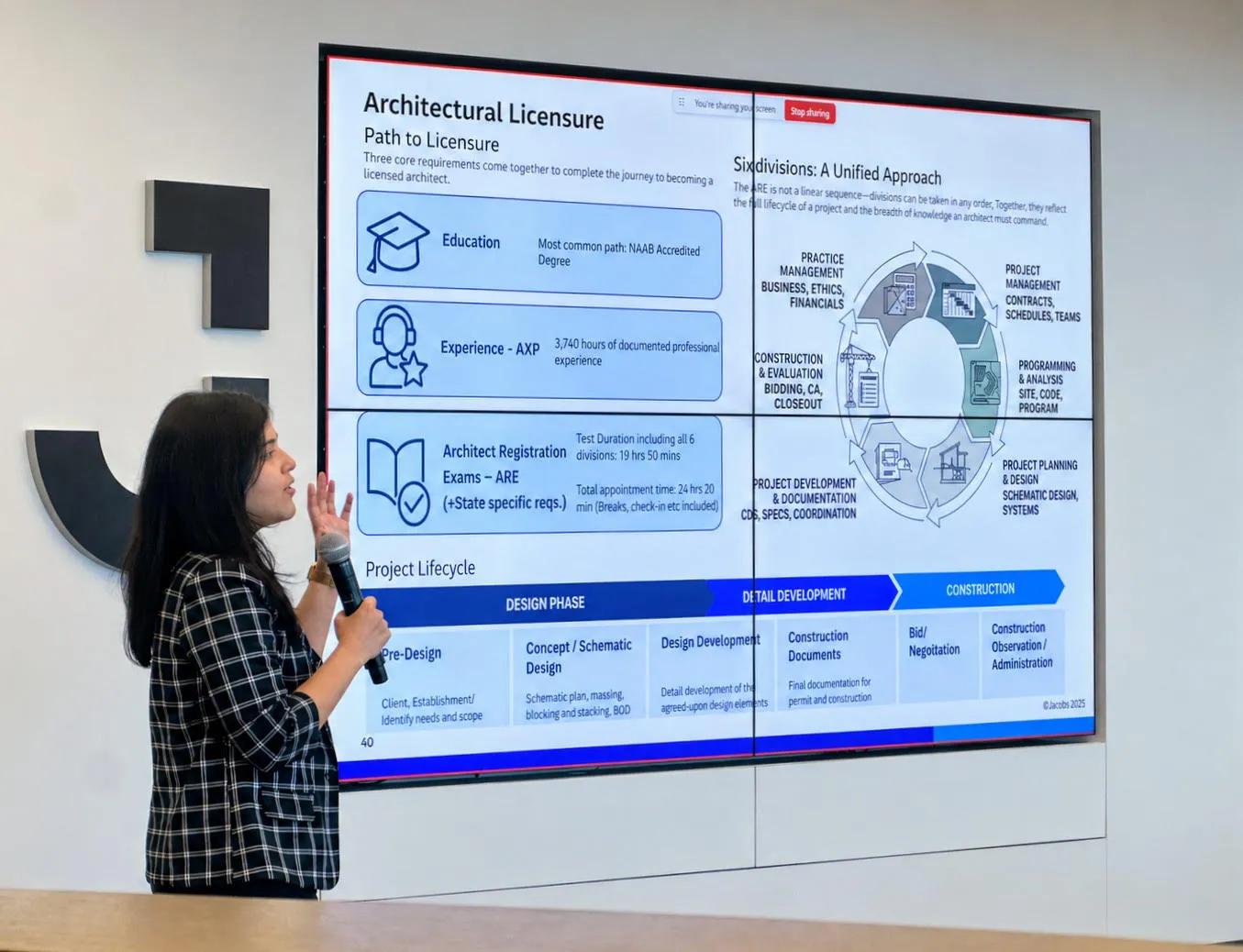
The biggest challenge wasn't a single exam; it was the relentless test of endurance. Balancing a high-stakes, fast-paced professional role while systematically tackling all six divisions of the Architect Registration Examination® (ARE®) felt like working two full-time jobs. There were exhausting weeks, self-doubt, and breakdowns at times. And yes, there were setbacks. But I realized early on that a failed division isn't a dead end—it’s just a data point. I stopped letting a score define my worth. I analyzed my gaps, adjusted my strategy, and kept showing up. To anyone staring down a failing score report right now: That deficit does not measure your potential as an architect. Resilience is a muscle. Passing my final division proved that perseverance and self-belief will carry you through what talent alone cannot.
What do you wish others knew about the path to becoming an architect?
I wish people understood just how long and grueling the path is. Between rigorous degree programs with long nights at design studios (making drawings and physical models), thousands of Architectural Experience Program® (AXP®) hours, and six comprehensive licensing exams, it’s a marathon that tests your endurance at every step. Talent alone won't get you across the finish line. That said, you don't have to navigate the grind in isolation. The key to pushing through is building a solid network of peers who understand the late nights, finding mentors who advocate for you, and using the available resources. It’s a demanding road, but staying resilient and leaning on a strong professional community makes all the difference.
How has your role at Jacobs evolved over the last five years, and what projects are you most proud of?
My role has undergone a significant transformation—transitioning from individual architectural production to leading multidisciplinary teams in project management. Throughout this time, I’ve had the opportunity to work across a wide variety of sectors and typologies, including gigafactories, manufacturing facilities, transportation hubs, laboratories, and commercial office spaces. Currently, I am proud to spearhead projects in the mission-critical sector, specifically next-generation AI data centers. These facilities represent the high-stakes, invisible infrastructure powering modern society. Navigating the intersection of cutting-edge technology, extreme technical requirements, and architectural efficiency has been incredibly rewarding.
Crucially, this work also demands a rigorous approach to sustainability, ensuring that as we build these high-demand facilities, we are actively mitigating their environmental footprint and thoughtfully integrating them into local communities. It’s proof that our core training as architects equips us to manage complex teams, balance technical goals with environmental stewardship, and lead at the highest levels of the industry.
Resilience is a muscle. Passing my final division proved that perseverance and self-belief will carry you through what talent alone cannot.
Looking back on your journey, what advice would you give to your younger self?
I would look at myself during those stressful all-nighters or during the terrifying moments of transitioning my career across continents, and I would say: "Trust the friction." Every single challenge, every doubt, and every uphill battle is quietly forging the resilience, technical authority, and unique perspective you'll need down the road. Set goals, but stop worrying too much about the timeline. Just keep showing up, stay curious, and protect your inner fire. You belong in this industry, and the work you're putting in now is setting you up for more than you can imagine.
Want to hear more from architects across the U.S.? Check out more stories from NCARB's Architect Spotlight series.