In 2023, NCARB launched Pathways to Practice, a multi-year research and development effort to study how to better ensure qualified applicants can enter the profession by evolving the current licensure process to be more accessible yet equally rigorous.
Our goal is to offer a competency-based approach to licensure that fairly and accurately assesses an individual’s ability to practice architecture safely and independently. By evolving our programs to focus on individual competencies, NCARB can ensure that individuals of all educational and career backgrounds have a pathway to architectural practice—while still maintaining the level of rigor needed to protect the public.
Why evolve licensure?
In the current licensure system, candidates often interrupt their career progress to become licensed. Gaining a professional degree can help prepare candidates for a successful career in architecture, but it can also be a barrier for some, due to the cost and time involved. Some candidates must return to school to complete an architecture degree from a program accredited by the National Architectural Accrediting Board (NAAB). Others may need to work at multiple architecture firms to gain experience in certain areas of the Architectural Experience Program® (AXP®).
No matter someone’s education background or career progression, NCARB believes you should have a pathway to licensure. Assessing the 16 competencies individually ensures that the licensure system remains valid and rigorous. Through Pathways to Practice, NCARB intends to:
- Increase consistency across jurisdictional requirements for experience based on the level of applicants’ education
- Integrate levels of work experience into the next version of the AXP
- Maintain a similar or lower number of required experience hours to today, depending on educational background
- Maintain similar fees across programs, including both the AXP and the ARE, to ensure that candidates can smoothly transition to the new licensure model
Does the data justify Pathways to Practice?
Our data shows that a single path to licensure creates unintended social and financial barriers. The 2026 edition of NCARB by the Numbers digs into the licensure pinch points that Pathways to Practice is working to address.
Of individuals who started reporting their NCARB Record in 2012, approximately 37% have stopped pursuing licensure—most often after completing one of NCARB’s core programs (typically the AXP). Black or African American candidates were most likely to stop pursuing licensure before making any progress on the AXP or ARE, which could be due to difficulty finding a firm that supports their licensure progress.
Individuals without a degree from a NAAB-accredited program must typically demonstrate additional years of experience to qualify for initial licensure, resulting in longer times to licensure than their peers. In 2025, new architects without a degree from a NAAB-accredited program took 18.8 years, on average, to earn a license—six and a half years above the national average.
In a 2026 survey, NCARB found that only 24% of respondents would pursue a master’s degree if it wasn’t required for licensure, including just 41% of respondents who indicated they already held a master’s degree. This suggests that most licensure candidates who hold a master’s degree do so out of necessity, not interest.
NCARB also conducted a study on student debt in 2026. This revealed that graduates with a Master of Architecture (M.Arch.) degree typically accrued a higher level of debt in pursuit of their M.Arch. degree than B.Arch. or four-year degree students. 18% of M.Arch. graduates between 2024-2026 accrued over $100,000 in student debt.
What will the new licensure process look like?
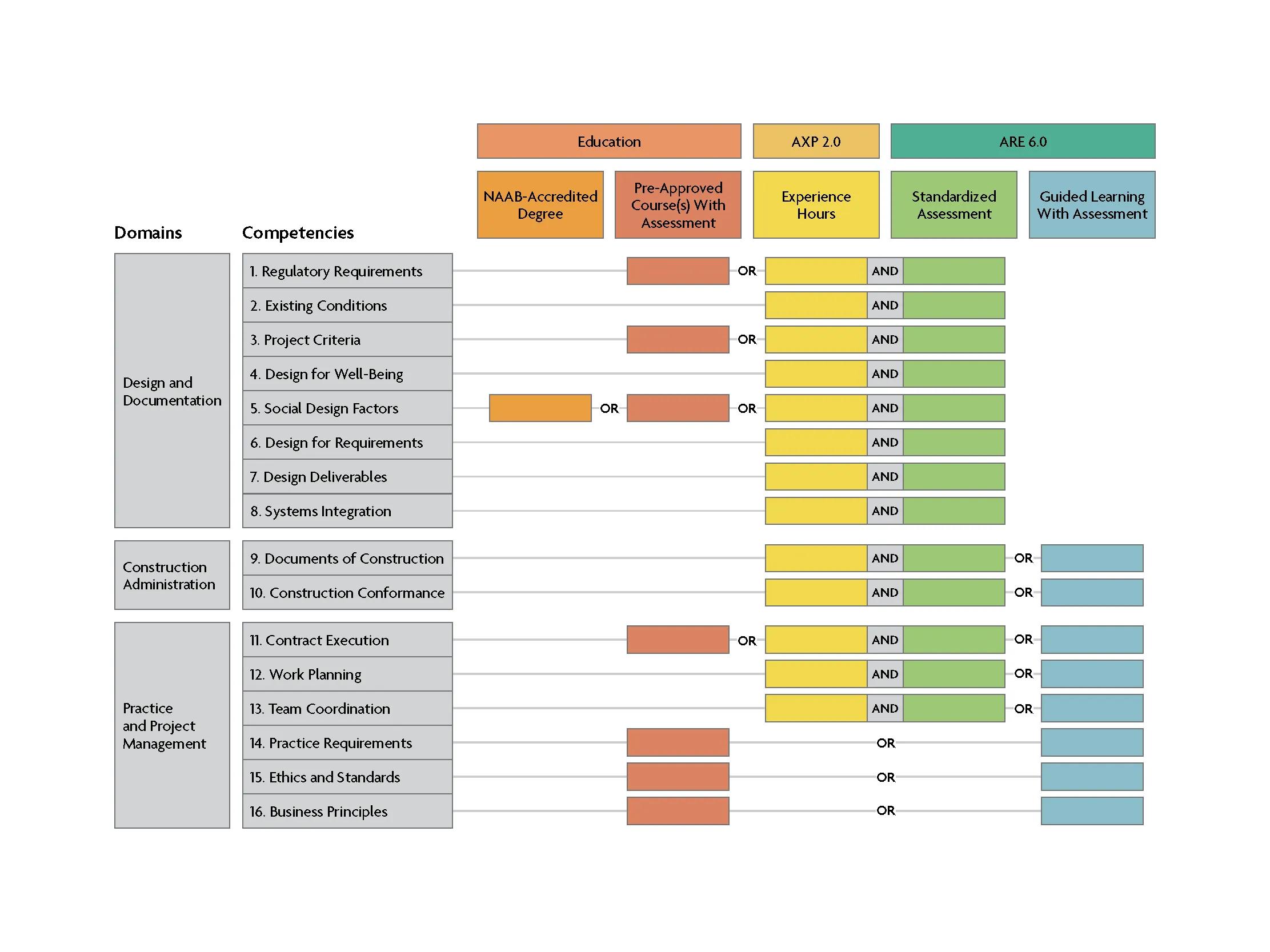
NCARB’s Competency Standard for Architects outlines the 16 competencies that are essential for initial licensure and serves as the foundation for the future licensure process. Some of the 16 competencies can be gained and validated through formal education, while others are best gained through professional work experience and validated through standardized assessments. Many competencies can be demonstrated through multiple substantially equivalent assessment methods, giving candidates options for how they meet licensure requirements.
To ensure its validity and rigor, the next licensure model will apply the traditional components of licensure—education, experience, and examination—at the individual competency level.
We have created an initial graphic to illustrate the current proposal on how the assessments will align to the Competency Standard. Note: This graphic may evolve as we move closer to launch to either provide additional clarity of the future process or add additional opportunities for candidates to demonstrate competency through one of the assessment methods. For example, additional competencies may be satisfied by completing a degree from a NAAB-accredited program prior to launch. Learn more about individual program updates.
We’ll share more updates on what a modular licensure process will look like in the months and years ahead, so stay subscribed to NCARB’s newsletters to learn more.