
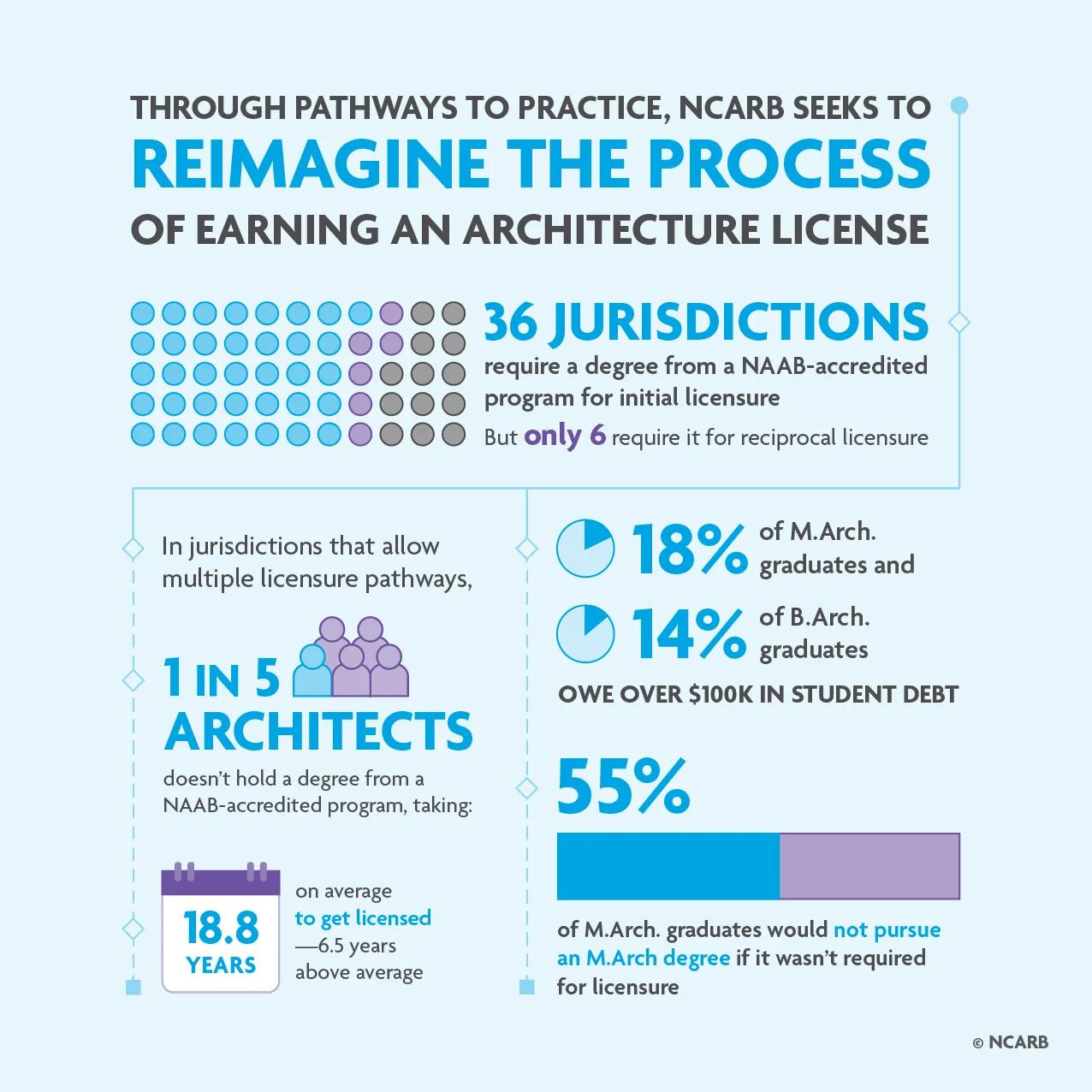
Currently, most candidates go through the same licensure path: earning a degree from a program accredited by the National Architectural Accrediting Board (NAAB), documenting experience through the Architectural Experience Program® (AXP®), and passing the Architect Registration Examination® (ARE®). But the practice of architecture is evolving, and the licensure path must evolve as well.
Through Pathways to Practice, NCARB is working to ensure qualified applicants can enter the profession by creating an accessible yet equally rigorous licensure process. NCARB’s data shows that the current “single path” approach to the licensure process creates a variety of pinch points that can impact candidates based on a range of factors, including their career, education, and socio-economic background.
For example, candidates without a degree from a NAAB-accredited program take over 7 years longer to earn a license, while those with a NAAB-accredited degree accrue higher levels of debt. Over a third of candidates who fall off the path to licensure do so during the experience program, when factors like project availability and supervisor relationships have a significant impact on AXP progress. When it comes to the exam, nearly a third of candidates pass all 6 ARE divisions on the first try—but those who fail experience diminishing pass rates with each subsequent division attempt.
By offering more flexibility in how candidates demonstrate their competency, NCARB can reduce the impact of these impediments and ensure that individuals of all educational and career backgrounds have a pathway to architectural practice, while still maintaining the level of rigor needed to protect the public.
Understanding licensure progress at the point of attrition.
Understanding where licensure candidates typically fall off the path to licensure helps NCARB better assess pinch points on the path to licensure, as well as opportunities to create greater flexibility. Because the average time to licensure in 2025 was 12.3 years, the average architect who earned their license in 2025 started the path to licensure in 2012. Of individuals who started their NCARB Record in 2012, approximately 37% have since stopped pursuing licensure.
Licensure Progress by Race and Ethnicity
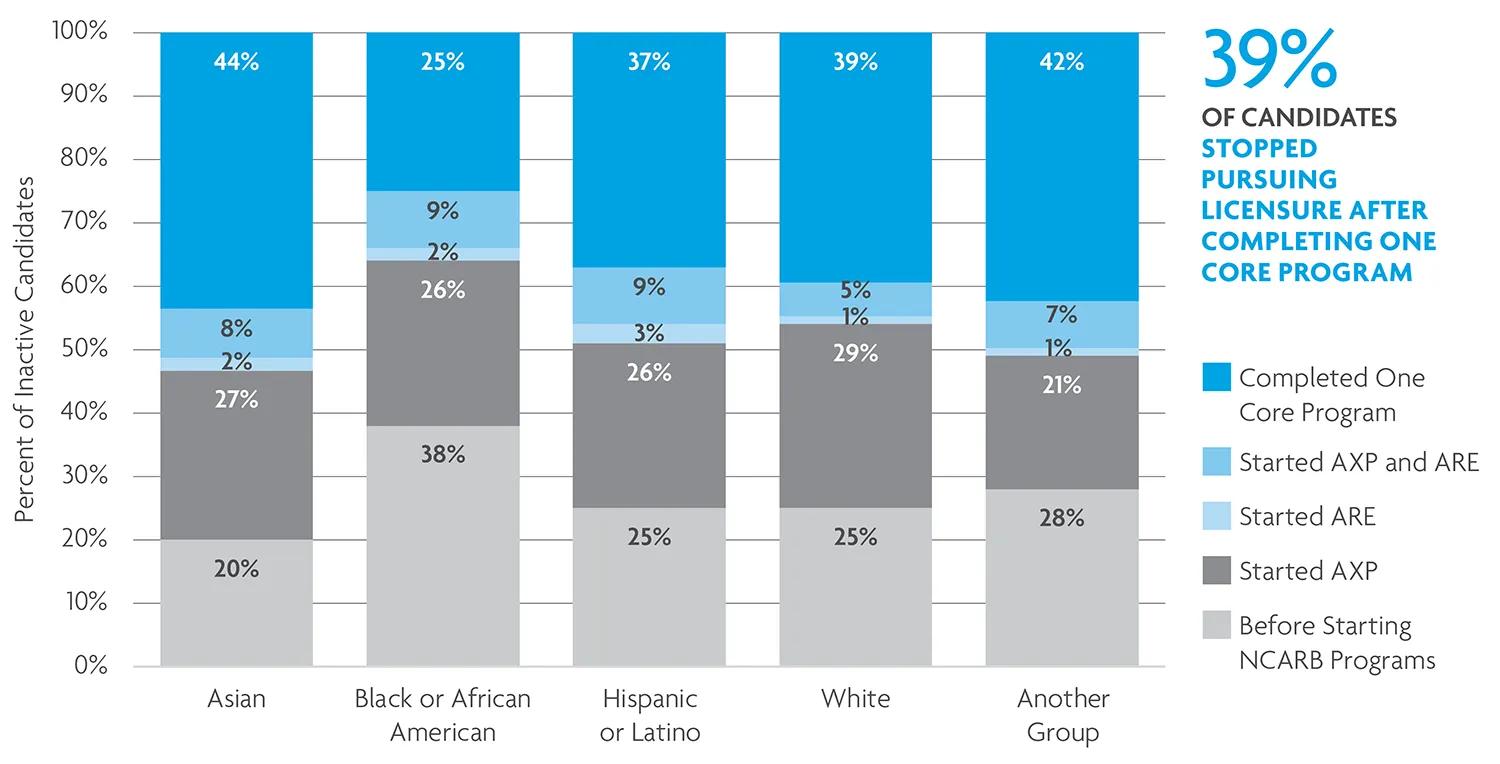
For most racial and ethnic groups, inactive candidates were most likely to fall off the path to licensure after completing one of NCARB’s core programs (typically the AXP). But NCARB’s data shows that Black or African American candidates were most likely to stop pursuing licensure before making any progress on the AXP or ARE. This disparity could be a result of factors such as not being encouraged to pursue licensure or difficulty finding a supportive firm—barriers that NCARB and the National Organization of Minority Architects’ (NOMA) joint Baseline on Belonging study shows are more likely to impact Black candidates.
Licensure Progress by Gender
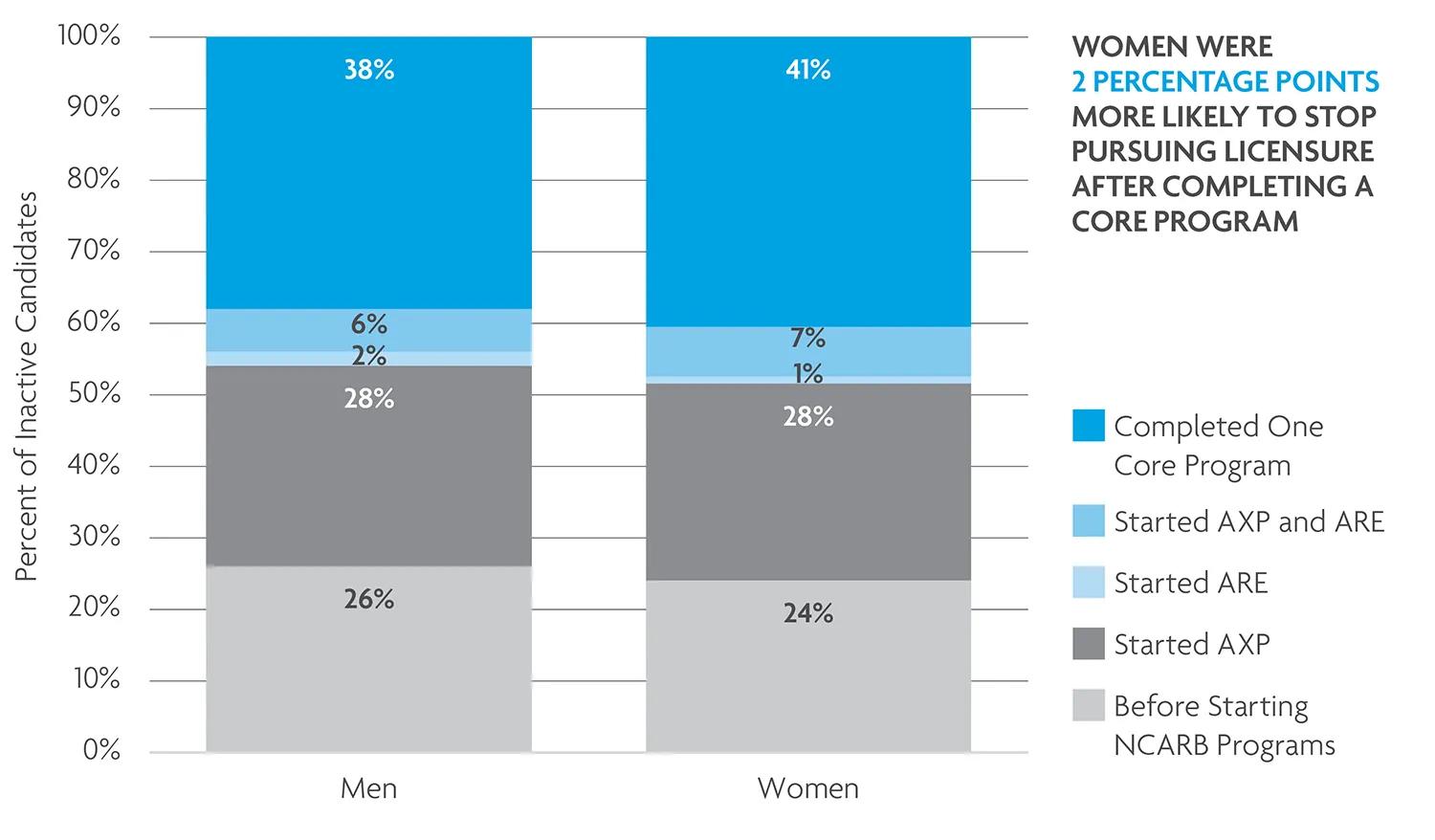
Men and women who started their path to licensure in 2012 and have since stopped pursuing licensure displayed relatively similar levels of licensure progress. Women were slightly more likely than men to stop pursuing licensure after completing a core program, while men were slightly more likely than women to stop pursuing licensure before making any AXP or ARE progress.
Because women demonstrate lower ARE pass rates than men, this disparity could be a result of female candidates facing greater challenges completing the ARE. NCARB’s Pathways to Practice effort can help ensure that candidates have the opportunity to navigate potential barriers throughout the licensure path by demonstrating an equal level of competency through an alternative assessment method.
WHAT’S A CORE PROGRAM? The core programs required for licensure across the 55 U.S. jurisdiction are the AXP and ARE.
Most new architects held a degree from a NAAB-accredited program.
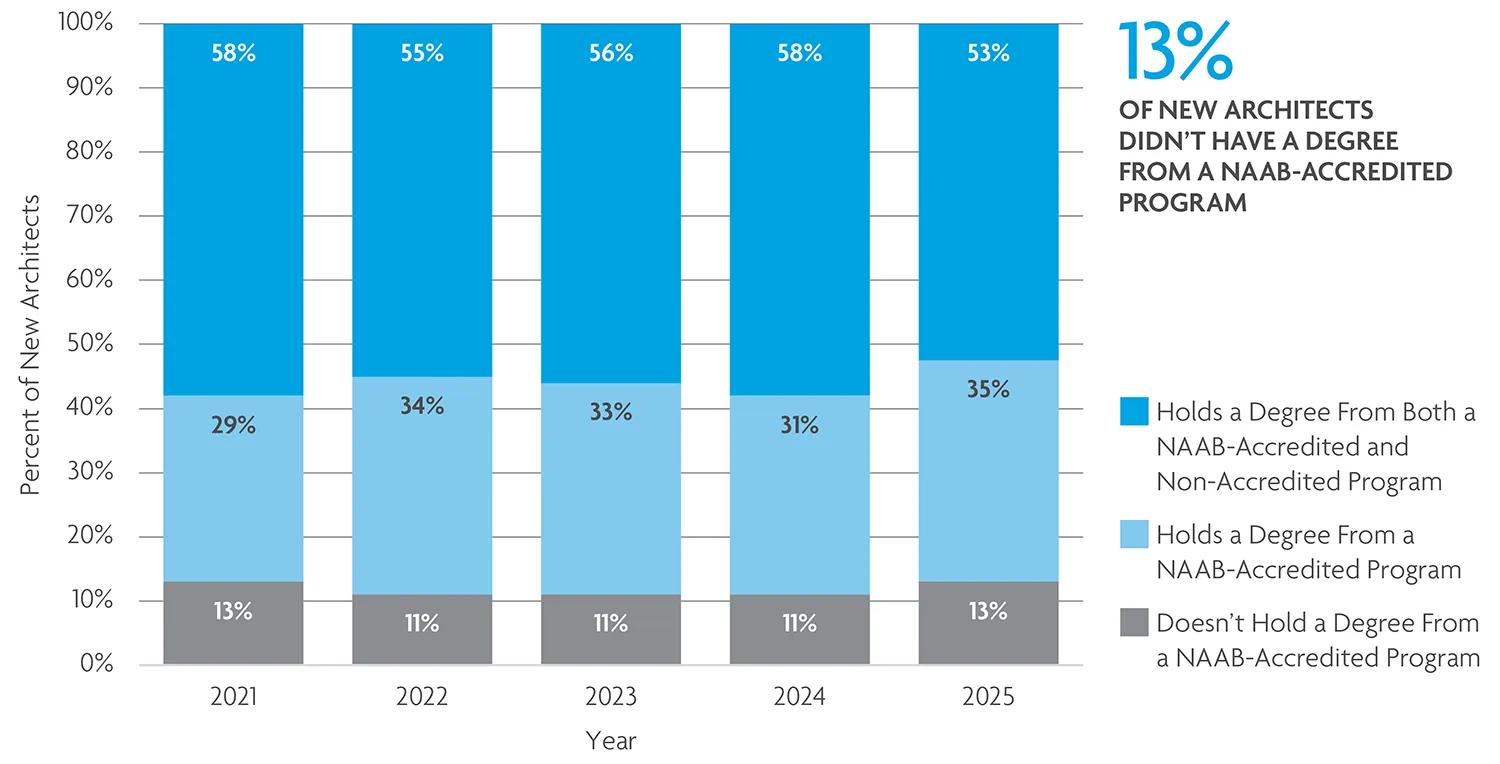
Because the 36 out of the 55 U.S. jurisdictions required licensure candidates to have a degree from a NAAB-accredited program for initial licensure in 2025, it’s not surprising that 88% of new architects hold a professional degree. Despite this common requirement, the proportion of new architects without a degree from a NAAB-accredited program rose to 13% in 2025, up 2 percentage points from 2024.
Earning a degree from an accredited program typically takes 5 – 7 years. Often, candidates graduate from a non-accredited, 4-year program and then return to school for a Master of Architecture degree, an investment of time and resources that can create a significant burden on early career professionals. Through Pathways to Practice, NCARB seeks to offer a modular, competency-based approach to licensure that removes the burden of a single education pathway—while still maintaining the level of rigor needed to protect the public.
Note: This chart is also found on page 65 in the Building Toward Competency section of this report.
In states with multiple pathways, 21% of new architects didn’t hold a NAAB degree.
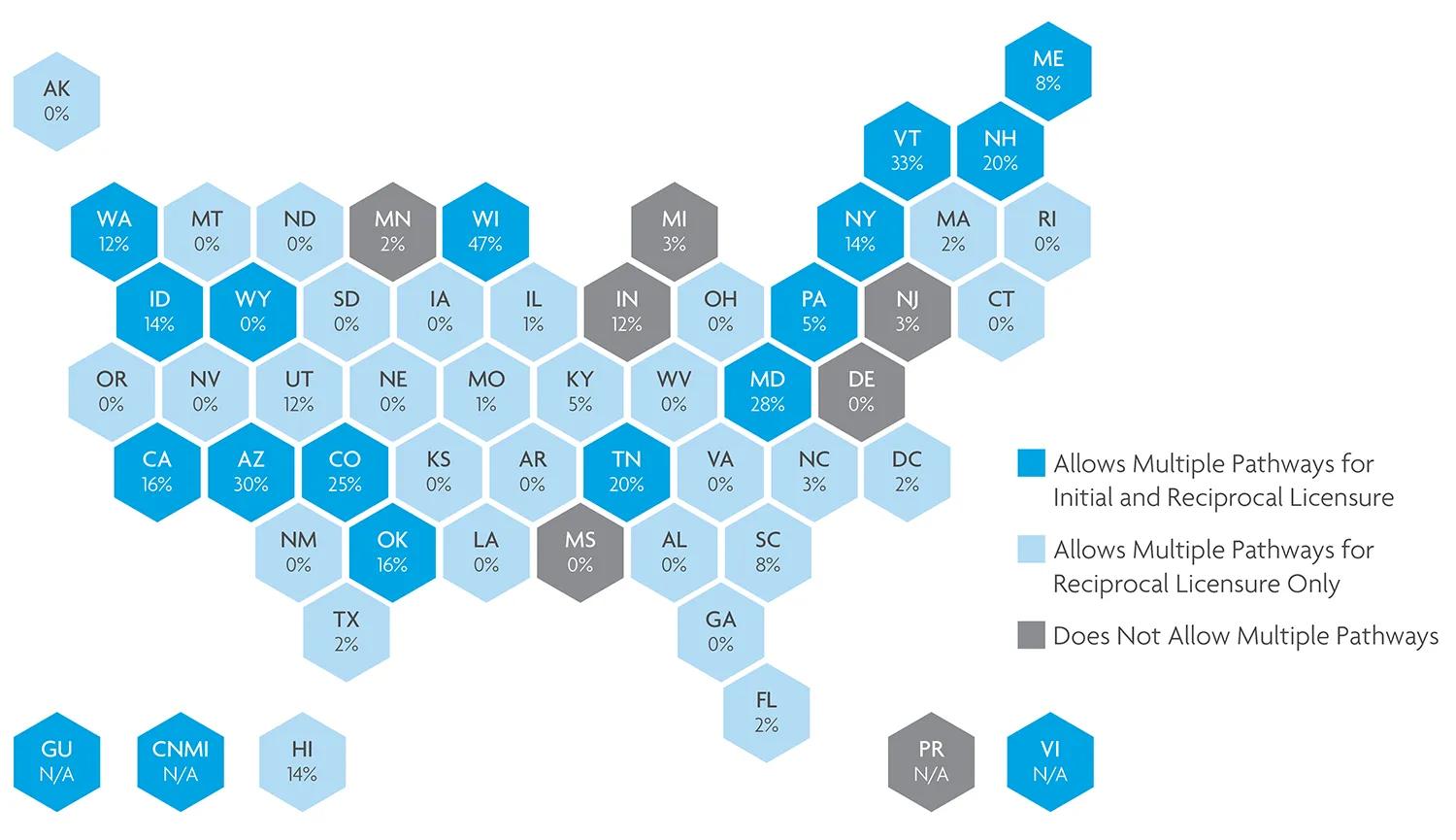
In 2025, only 19 jurisdictions offered pathways to initial licensure without a degree from a NAAB-accredited program. However, 49 jurisdictions allowed pathways to reciprocal licensure without a degree from a NAAB-accredited program. NCARB is working to encourage more choice through our Pathways to Practice effort—and in early 2026, we saw two additional jurisdictions (Massachusetts and North Dakota) align with offering multiple pathways.
New architects without a degree from a NAAB-accredited program make up 13% of the total new architect population nationwide. But in jurisdictions that allow paths to licensure without a degree from a NAAB-accredited program, these individuals typically make up an even larger portion of the new architect population. On average, 21% of new architects don’t hold a degree from a NAAB-accredited program in jurisdictions that offer additional licensure pathways.
Note: Some states that require a degree from a NAAB-accredited program still offer limited access to additional pathways, which is why states like New Jersey still show as many as 3% of new architects without a degree from an accredited program.
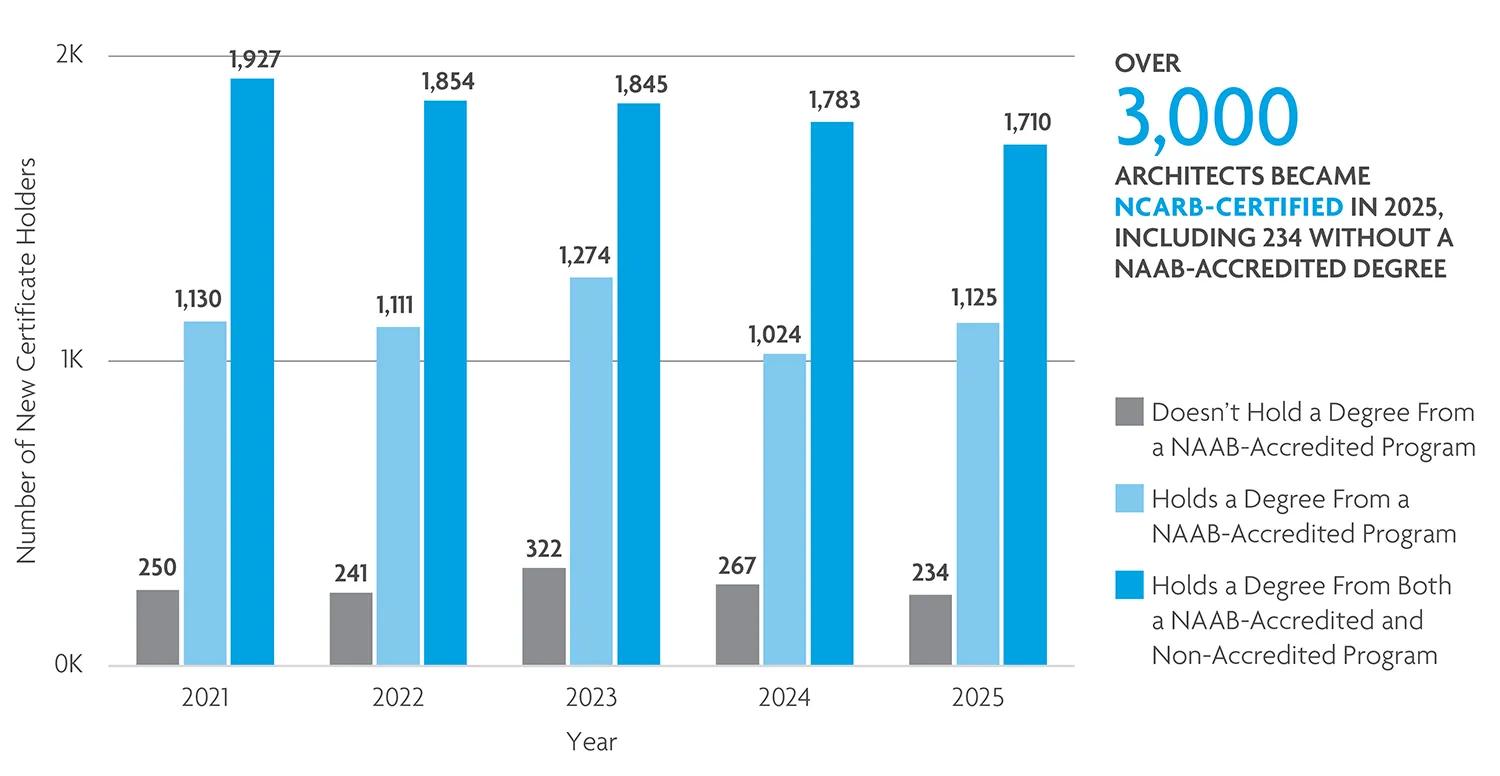
In 2025, 8% of new NCARB Certificate holders didn’t have a degree from a NAAB-accredited program.
The NCARB Certificate is a valuable credential that demonstrates architects have met national standards for licensure. Through the Certificate, architects gain access to streamlined mobility, both in the United States and in several international locations.
Over 3,000 architects earned an NCARB Certificate in 2025. Of new Certificate holders, 234 individuals (8% of all new Certificate holders) did not have a degree from a NAAB-accredited program.
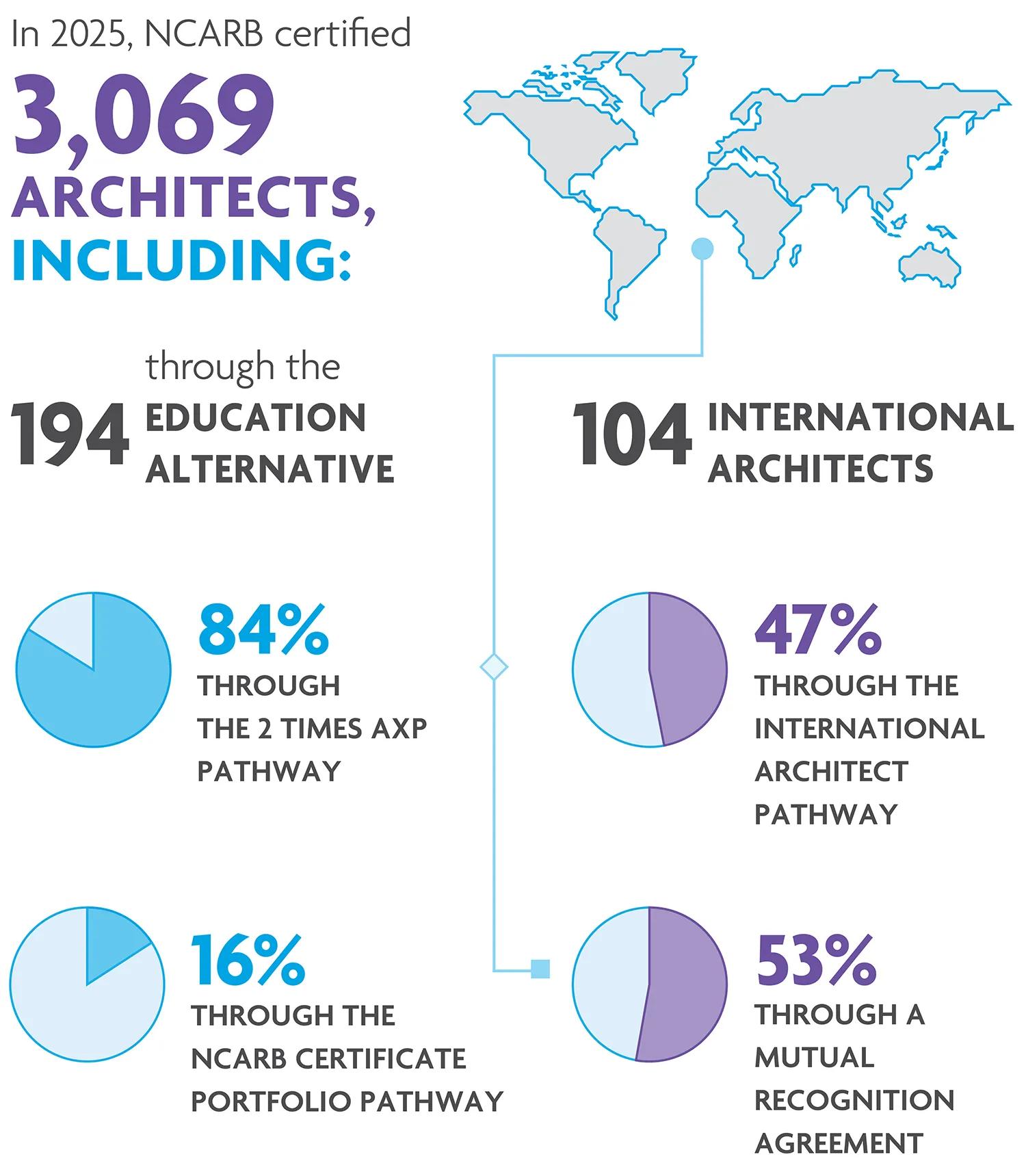
While NCARB provides pathways to certification for architects of all backgrounds, the Education Alternative pathway for architects without a degree from a NAAB-accredited program has historically included a delay between receiving initial licensure and applying for an NCARB Certificate. This waiting period was retired in January 2026. Since its removal, NCARB has seen significantly higher numbers of architects without a degree from a NAAB-accredited program pursuing NCARB certification—data that will be reflected in next year’s edition of NCARB by the Numbers.
Architects with a degree from a NAAB-accredited program submitted most reciprocal licensure applications.
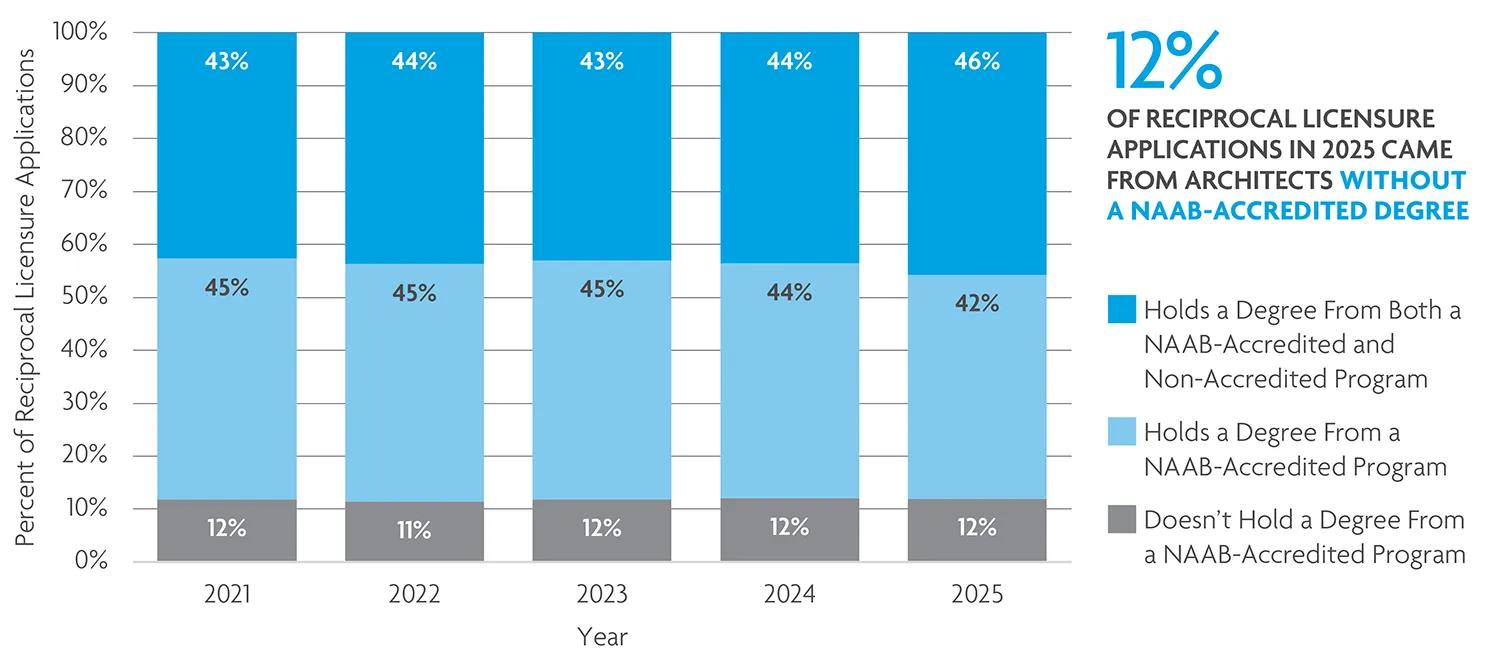
In 2025, NCARB processed over 13,000 requests to transmit an architect’s Record in support of a reciprocal licensure application. Of those transmittal requests, 88% were from individuals who hold a degree from a NAAB-accredited program, and the remaining 12% were from individuals without a degree from a NAAB-accredited program. In 2025, individuals without a NAAB-accredited degree made up 13% of the new architect population, and an estimated 15% of the total architect population.
Earning licenses in additional jurisdictions is essential for architects to expand their professional reach, allowing them to continue work for existing clients across jurisdictional lines or pursue new clients. By expanding Pathways to Practice, NCARB can ensure that architects of all backgrounds have access to important professional opportunities.
WHAT’S A TRANSMITTAL? To process a licensure application, most jurisdictions require the applicant to have NCARB “transmit” a copy of their NCARB Record to the licensing board, allowing the board to review their education, experience, examination, and licensure history.
Individuals without a degree from a NAAB-accredited program take nearly 20 years to become licensed.
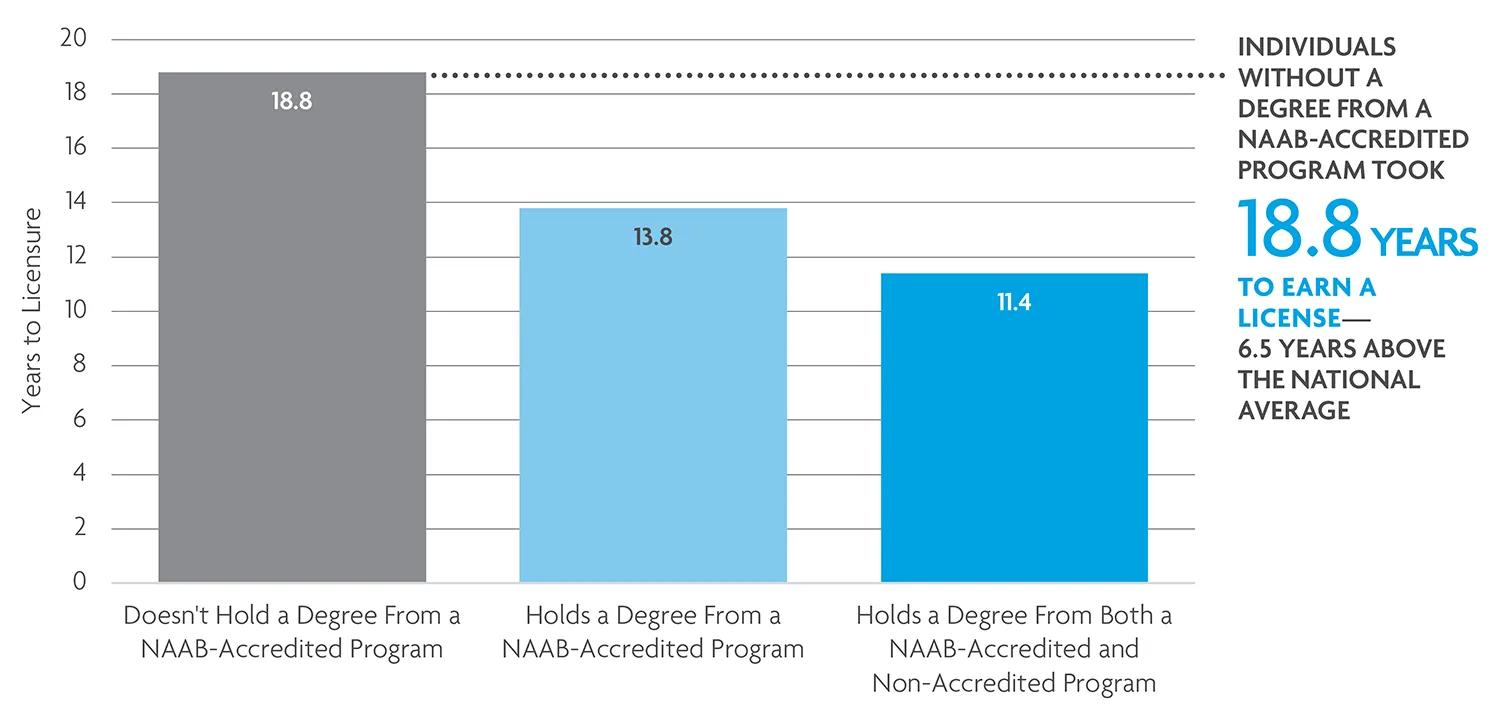
Typically, individuals without a degree from a NAAB-accredited program must demonstrate additional years of experience to qualify for initial licensure. The number of years of experience varies depending on the jurisdiction and the individual’s educational background, but can range anywhere from 1 – 8 years of additional experience.
As a result, individuals without a degree from a NAAB-accredited program typically take significantly longer to earn a license than their peers. In 2025, new architects without a degree from a NAAB-accredited program took 18.8 years, on average, to earn a license—6 and a half years above the national average.
While NCARB maintains that ensuring individuals of all backgrounds have a path to licensure that suits their personal and professional needs is more essential than ensuring candidates complete the path to licensure quickly, we also believe that reducing the disparity in time to licensure between NAAB- and non-NAAB degree holders is critical to expanding access and improving equity.
Many candidates wouldn’t choose to pursue a master’s degree if they didn’t need it for licensure.
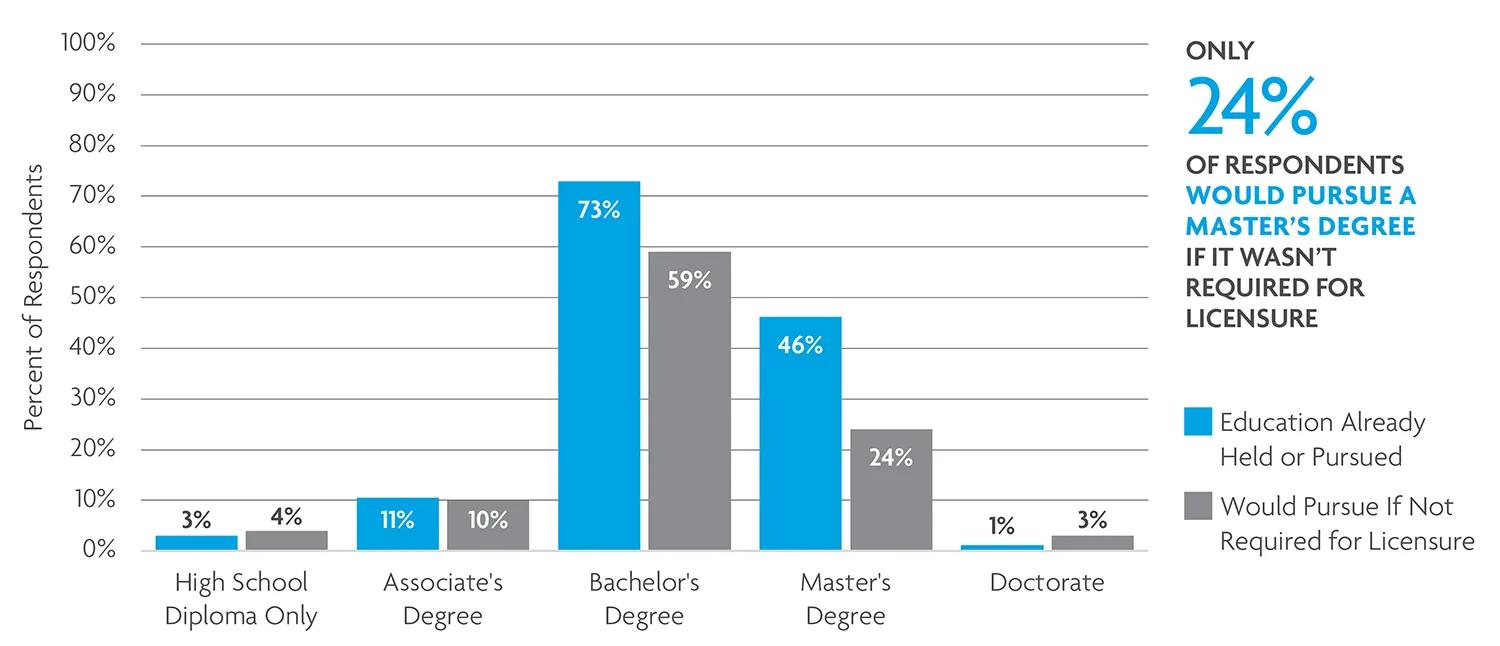
To better understand how Pathways to Practice might impact current and future licensure candidates, NCARB launched a Future of Architectural Licensure study in February 2026. As part of the study, candidates reported what level of education they already held or were in the process of pursuing. Nearly half (46%) of respondents held or were pursuing a master’s degree.
Then, NCARB asked candidates to indicate the highest level of education they would be interested in pursuing if it was not required for licensure. Only 24% of respondents indicated they would pursue a master’s degree if it wasn’t required for licensure, including just 41% of respondents who indicated they already held a master’s degree.
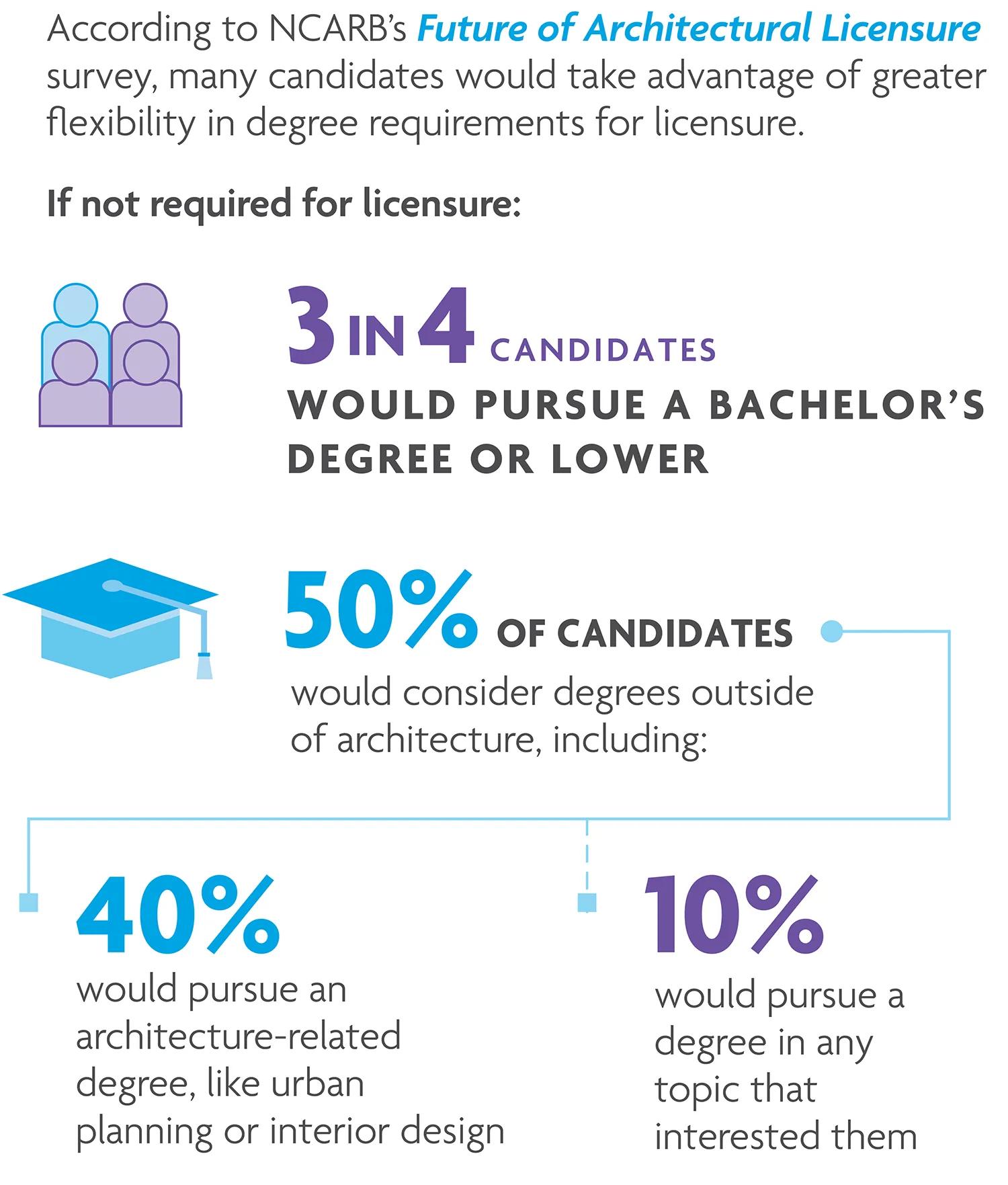
Together, these data points highlight that most licensure candidates who hold a master’s degree do so out of necessity, not interest—likely because they graduated from a non-accredited 4-year degree in architecture and then returned to complete a NAAB-accredited master’s program.
Note: This data is taken from NCARB’s 2026 Future of Architectural Licensure study. For more information about the study, please see the About section of this report.
M.Arch. graduates typically accrue higher levels of debt than B.Arch. and 4-year program graduates.
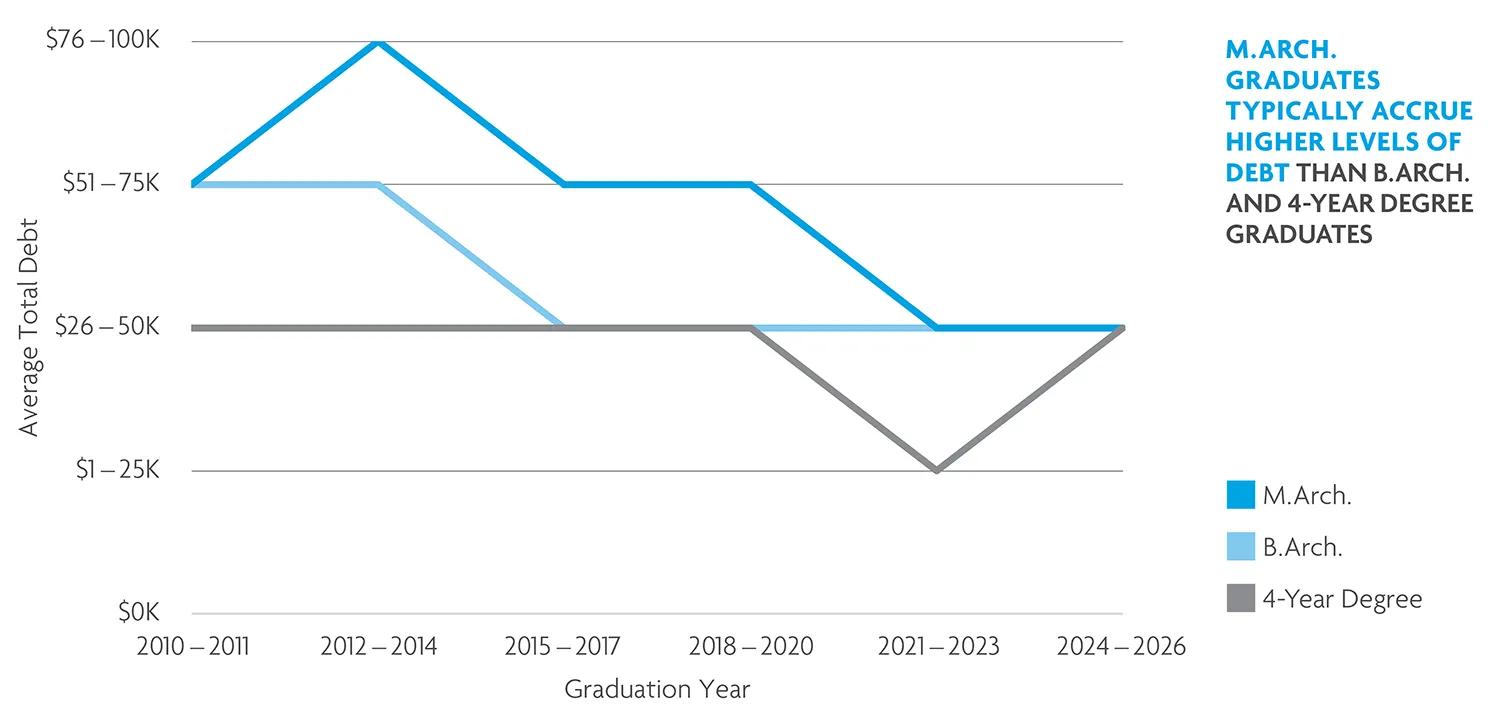
To better understand the impact of potential federal lending caps on future architects, NCARB also conducted a survey on student debt in early 2026. Through that study, NCARB saw that graduates with a Master of Architecture (M.Arch.) degree typically accrued a higher level of debt in pursuit of their M.Arch. degree than B.Arch. or 4-year degree students.
Broken down by graduation year, the average level of reported total debt for M.Arch. and B.Arch. graduates has been trending downward over the past several years. The median debt for M.Arch. and B.Arch. graduates in 2010 – 2011 was $51,000 – $75,000, compared to $26,000 – $50,000 for 2024 – 2026 graduates. Meanwhile, the median total debt for four-year architecture-related degree graduates has largely held steady at $26,000 – $50,000 since 2010.
These debt levels are reported per individual degree (i.e., debt accrued specifically pursuing an M.Arch. degree, not total debt across all degrees earned by an individual).
Note: This data is taken from NCARB’s 2026 student debt survey. For more information about the study, please see the About section of this report.
18% of 2024 – 2026 M.Arch. graduates accrued over $100K in debt.
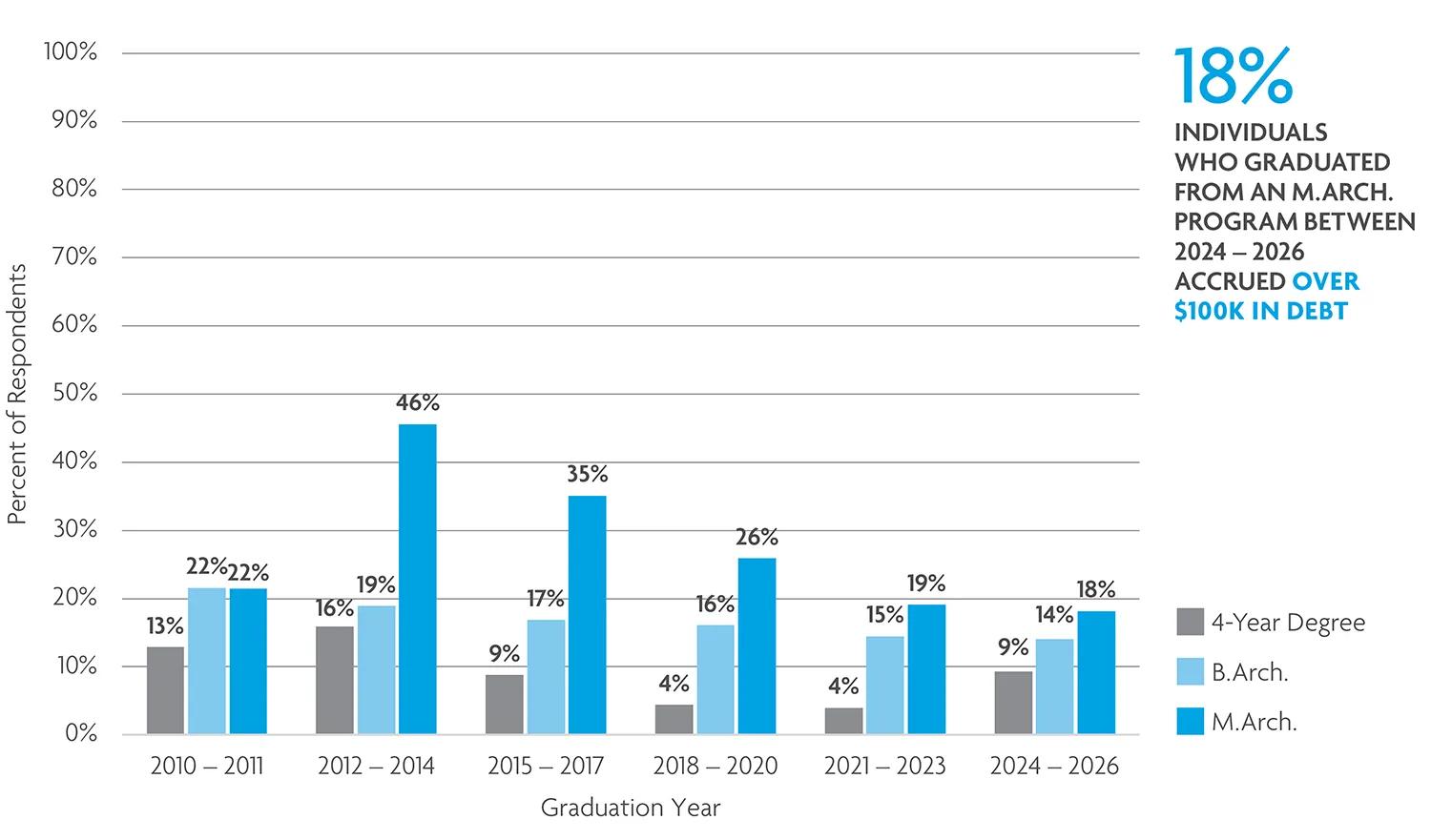
Of individuals who graduated from an M.Arch. program in 2024 – 2026, 18% accrued over $100,000 in debt to pay for their master’s degree—compared to 9% of 4-year degree holders. While the reported levels of debt for M.Arch. graduates showed a steady decline following a spike in 2012 – 2014, this data shows that master’s degrees continue to place a challenging debt burden on many students.
As with the median debt levels shown on the previous page, these debt levels are reported per individual degree (i.e., debt accrued specifically pursuing an M.Arch. degree, not total debt across all degrees earned by an individual).
Note: This data is taken from NCARB’s 2026 student debt survey. For more information about the study, please see the About section of this report.
Most candidates who stopped pursuing licensure during the AXP were over halfway done reporting hours.
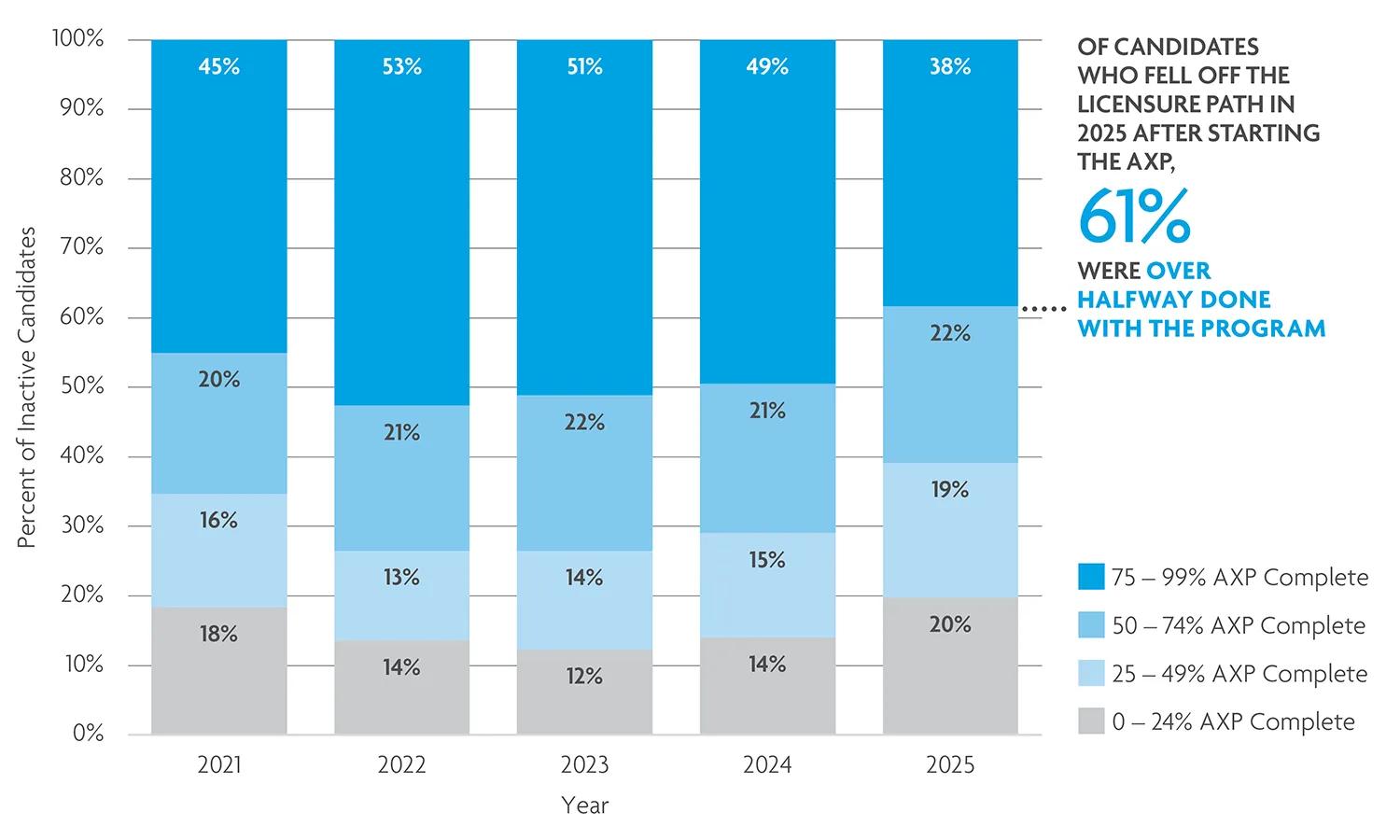
NCARB’s data shows that candidates who fall off the path to licensure tend to do so either prior to starting the AXP and ARE, or while reporting experience hours. In 2025, 61% of candidates who became inactive while navigating the AXP were over halfway done with the program at the point they fell off the path.
The average candidate who fell off the path to licensure during the AXP was 58% complete—this is equivalent to reporting over 2,000 hours toward the program’s requirements. These individuals might still resume the program at some point in the future and may need access to additional experience opportunities within their firm to progress on the path to licensure.
Supervisors approved 99% of experience reports in 2025.
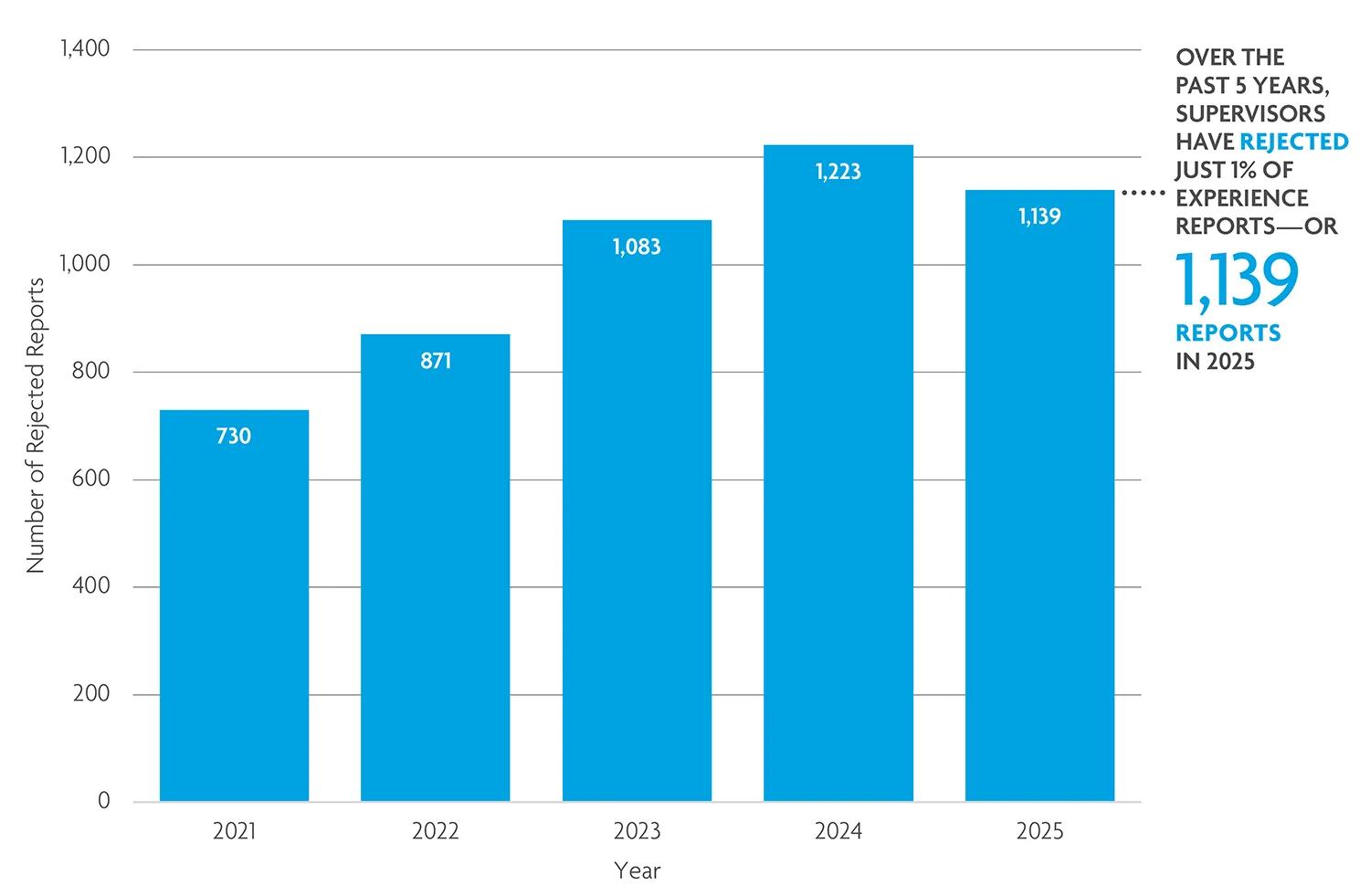
A candidate’s relationship with their AXP supervisor can have a significant impact on their ability to progress through the experience program. NCARB’s data shows that most supervisors support their candidates’ progress through the AXP: Supervisors ultimately approved 99% of AXP reports submitted in 2025, taking an average of 2 days to do so. Just over 1,100 experience reports were rejected in 2025, amounting to 1% of all reports submitted in the year.
For candidates who don’t have access to an AXP supervisor who is willing or able to review their reports in a timely manner or ensure they have access to work opportunities across all areas of the AXP, navigating the experience program can present a barrier on the path to licensure.
Most experience reports represented work performed in a traditional architecture setting.
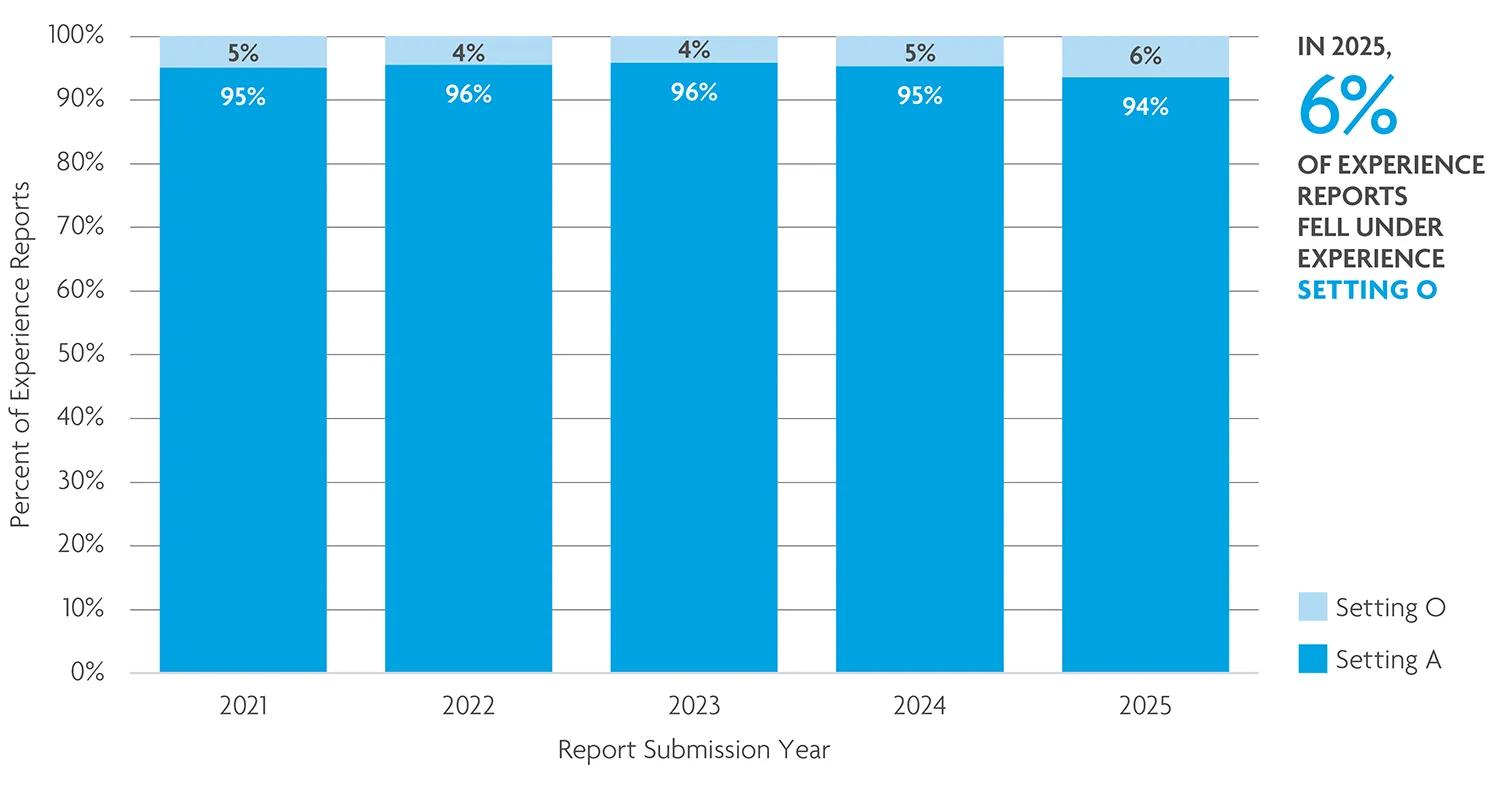
At least half of a candidate’s AXP experience must be completed while working under the supervision of a U.S. or Canadian architect, while employed by a firm that is a lawfully practicing architecture— this is experience setting A. Under experience setting O, candidates can earn up to 1,860 hours of experience through a variety of other opportunities, including volunteer work, work performed under other licensed professionals, and construction work. These opportunities are designed to recognize the variety of career paths licensure candidates can pursue, ensuring that relevant experience gained outside an architecture firm still counts toward licensure.
However, NCARB’s data shows that few licensure candidates take advantage of these opportunities: Of all experience reports submitted in 2025, 94% were under experience setting A and just 6% fell under experience setting O.
Some candidates may be unaware of setting O opportunities, or face difficulty engaging non-architect supervisors in the AXP process.
Most setting O reports fell under “Other Work Under Licensed Professionals.”
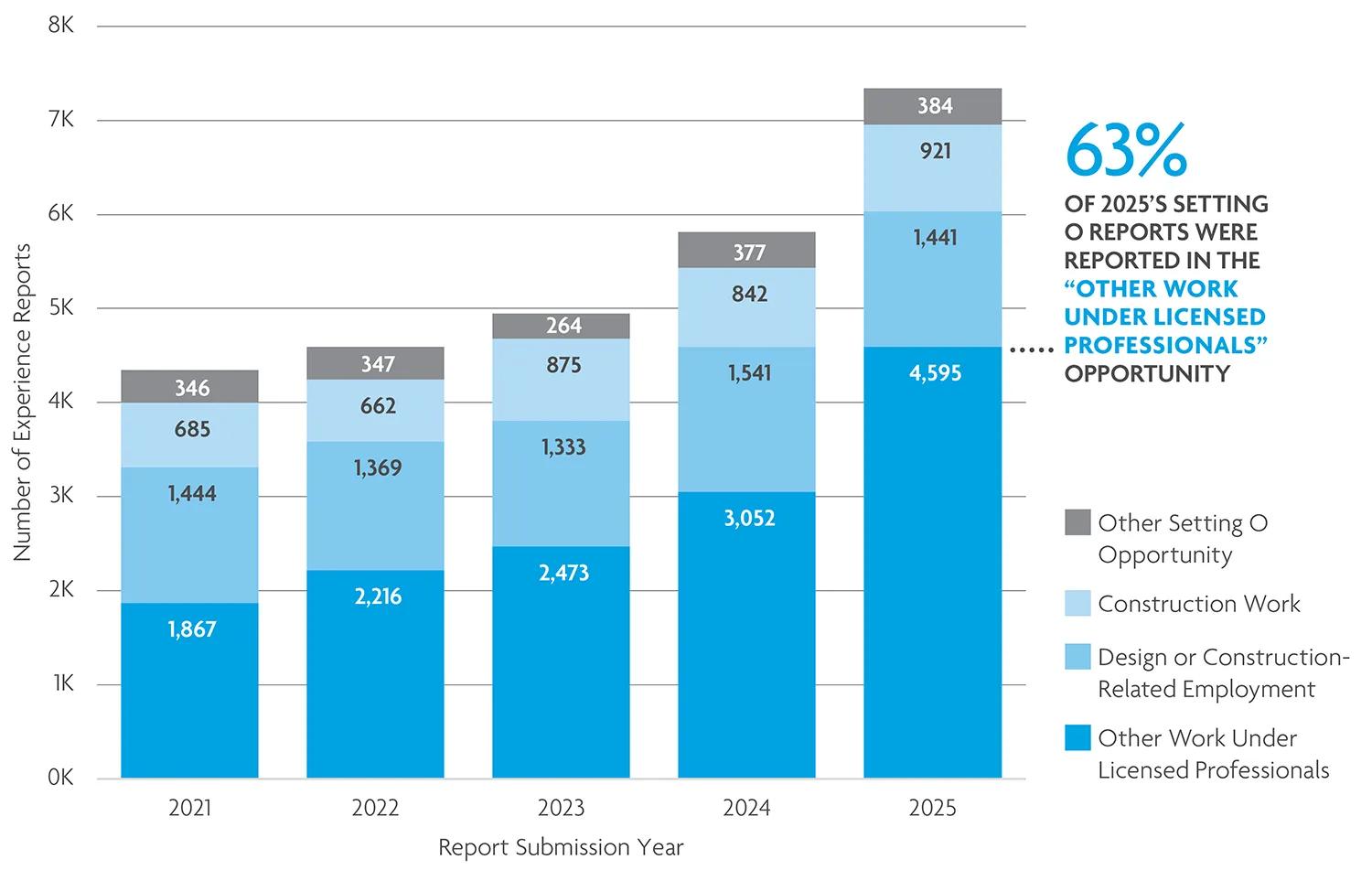
The most commonly used experience opportunity under AXP’s setting O was “Other Work Under Licensed Professionals,” an opportunity that includes both work performed for architects licensed internationally and work performed for other professionals such as engineers or landscape architects. Work under other licensed professionals represented 63% of setting O reports submitted in 2025.
Note: The uptick in experience report submissions seen in 2025 is likely a result of the update to the program’s experience reporting policy, which allows candidates to gain additional experience for work over 8 months old. Many candidates submitted experience reports for older work to take advantage of the policy’s implementation in November 2025.
Most candidates would prefer to demonstrate their competency through experience.
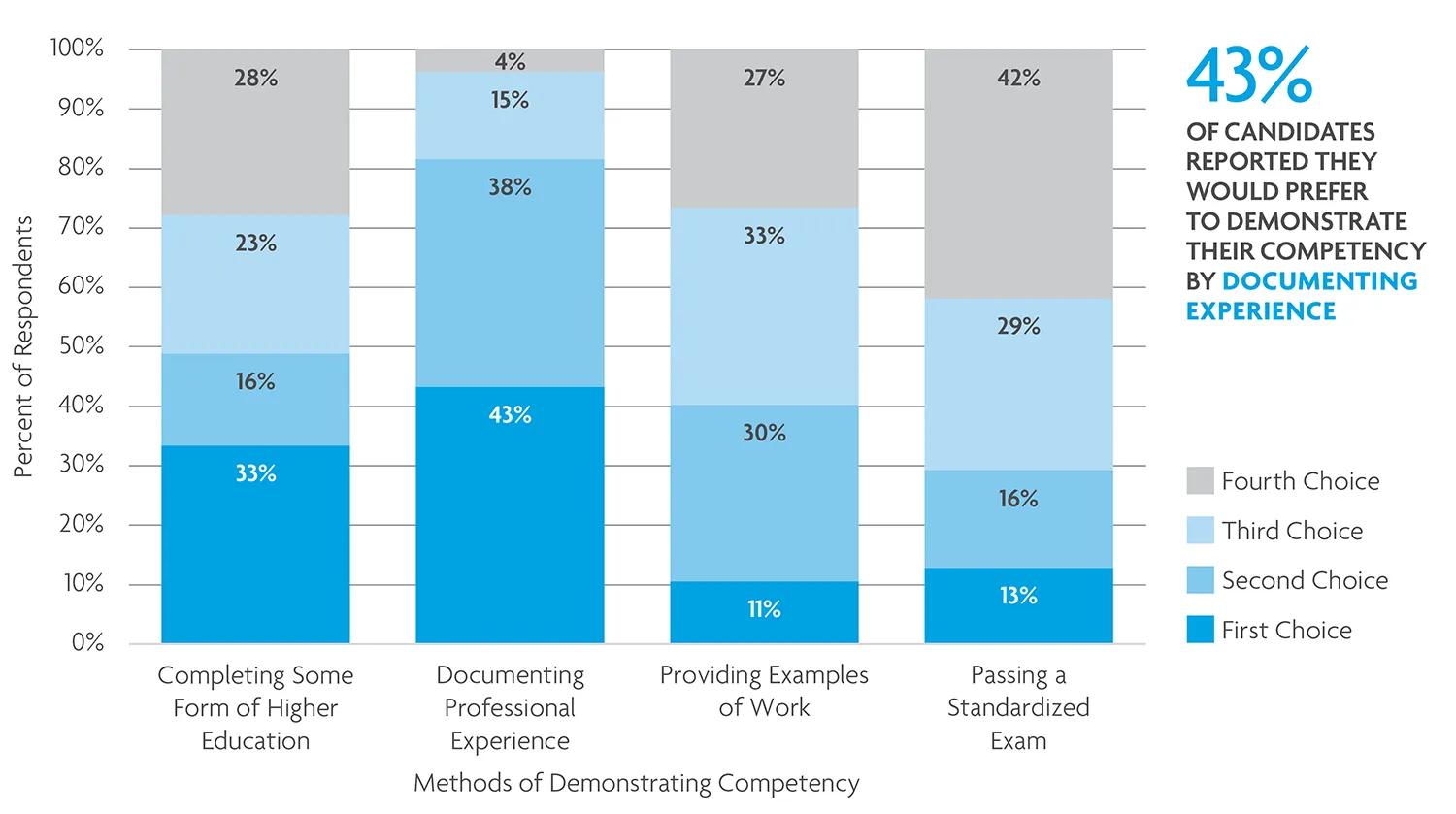
As part of NCARB’s Future of Architectural Licensure study, NCARB asked candidates to rank how they would prefer to demonstrate their competency for licensure. Over 40% of candidates ranked “documenting professional experience” as their top choice, and an additional 38% ranked it in second place—the strongest alignment across assessment methods.
While candidates were more split when ranking other methods of demonstrating competency—especially education, which saw 33% of respondents rank it in first place and but 28% rank it in last place—nearly two-thirds (63%) of candidates ranked “providing examples of work” in either second or third place.
A future licensure framework that allows candidates to choose which methods they use to demonstrate competency in a particular area could see candidates lean in to an experience- or work sample-based process.
Note: This data is taken from NCARB’s 2026 Future of Architectural Licensure study. For more information about the survey, please see the About section of this report.
Candidates were confident in the accuracy of a work sample-based experience assessment.
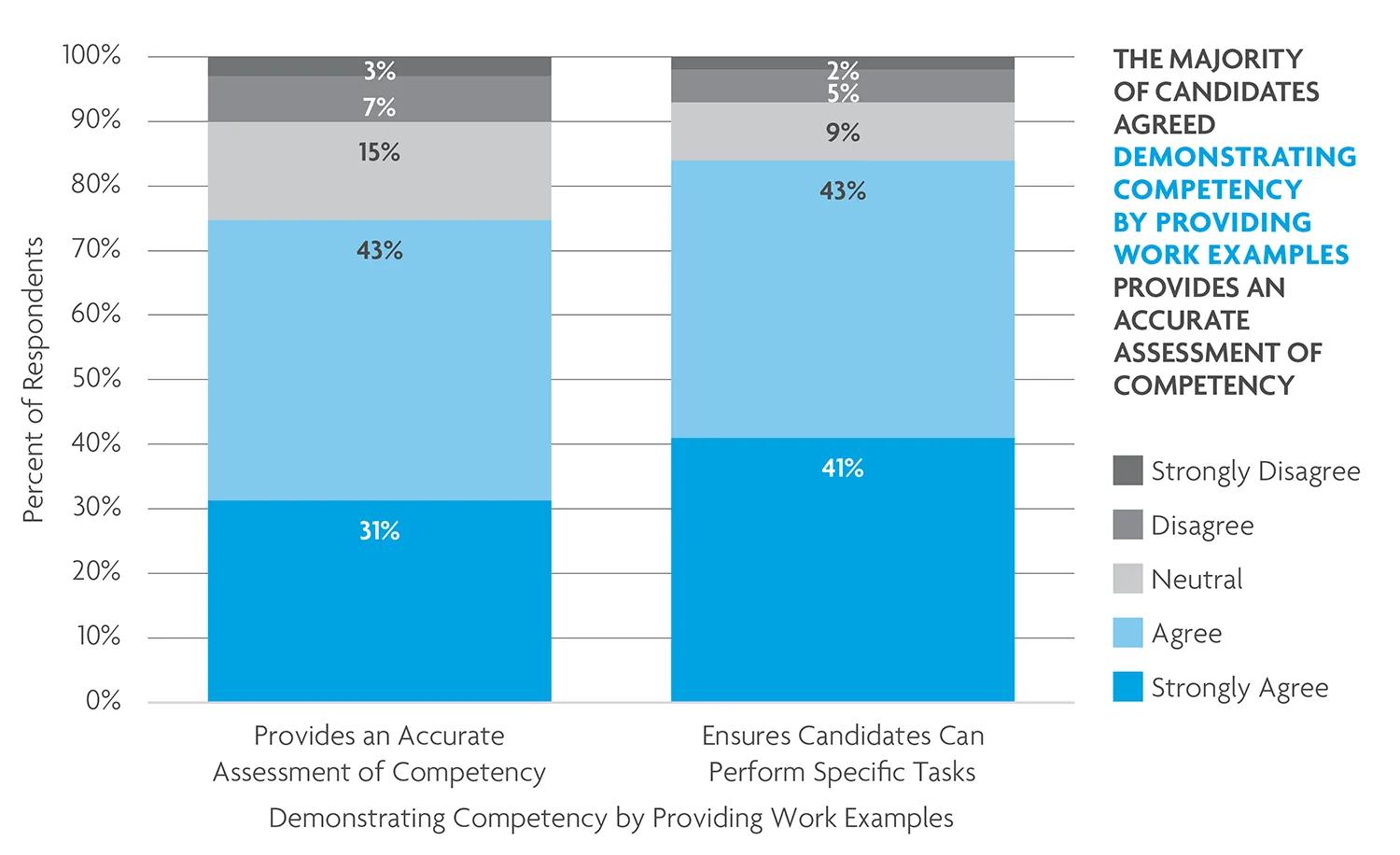
The Future of Architectural Licensure study also asked candidates to rate their agreement with several statements, including that “demonstrating competency by providing work examples would provide an accurate assessment” and that “demonstrating competency by providing work examples would ensure candidates can perform specific tasks.” Nearly three-quarters of respondents (74%) agreed or strongly agreed that demonstrating competency through work examples would provide an accurate assessment of their competency.
Candidates were even more enthusiastic in agreeing that a work example-based assessment would ensure that they could perform specific tasks, with 84% of respondents agreeing or strongly agreeing.
Together, these data points highlight that a work example-based assessment method could help ensure that candidates have fully developed their knowledge and skills in particular areas before becoming licensed.
Note: This data is taken from NCARB’s 2026 Future of Architectural Licensure study. For more information about the survey, please see the About section of this report.
On average, candidates who completed the ARE in 2025 failed between 3 – 4 ARE divisions.
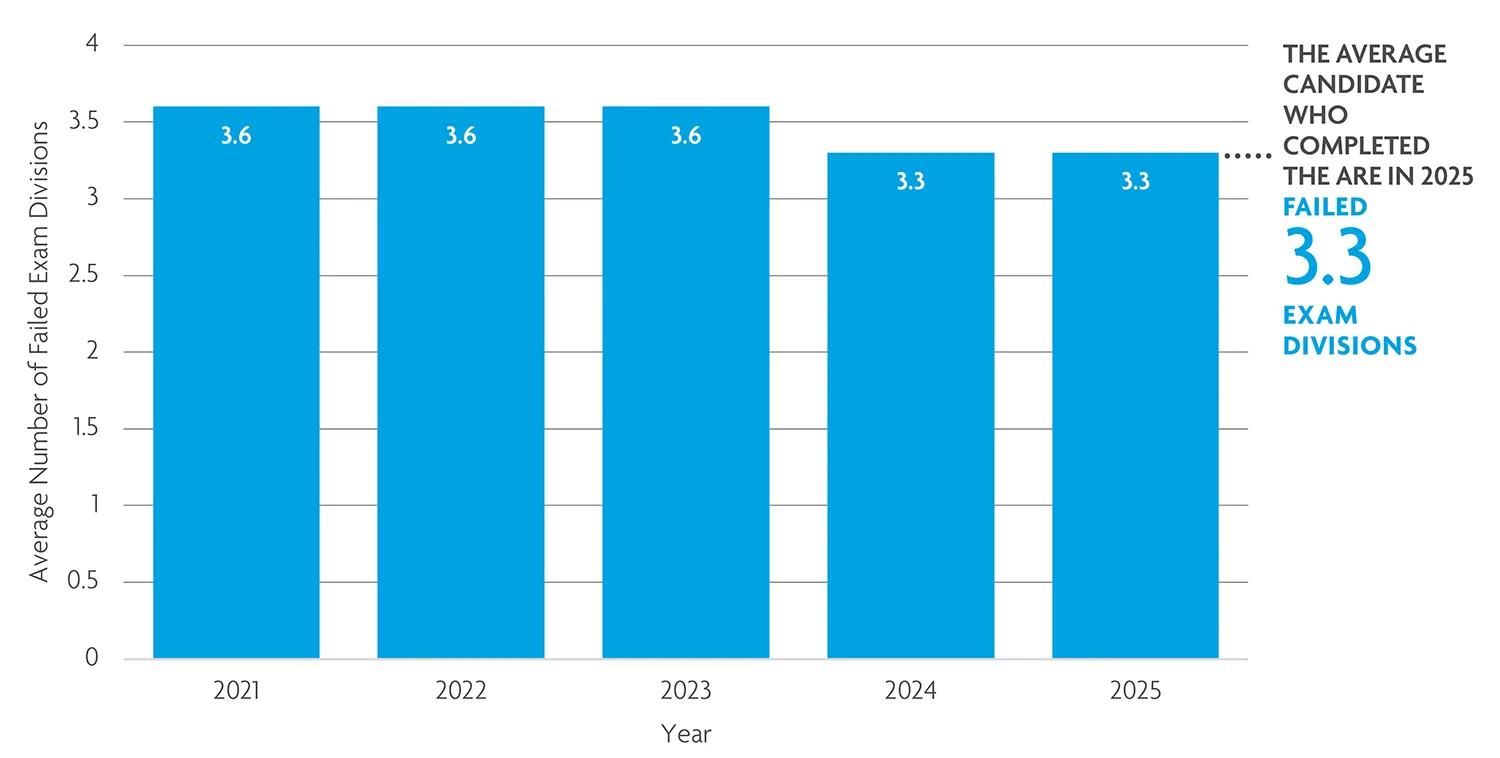
The average candidate who completed the ARE in 2025 did so in 9 total division attempts, including an average 3.3 failed division attempts. The average number of failed division attempts has held relatively steady between 3 – 4 attempts since 2021.
NCARB’s data shows that candidates don’t typically fall off the path to licensure during the exam—most candidates who have reached this point tend to complete the licensure path. However, high levels of failed division attempts can create additional financial and time constraints for licensure candidates.
DID YOU KNOW? Averages can be measured in several ways. NCARB often uses median to measure averages throughout NBTN, which allows us to avoid skewing the average with outlier data points. However, for this particular data point, a mean is more appropriate. When we refer to the average number of exam attempts, we’re referring to the arithmetic average, or mean.
Time to complete the ARE increased with additional exam division attempts.
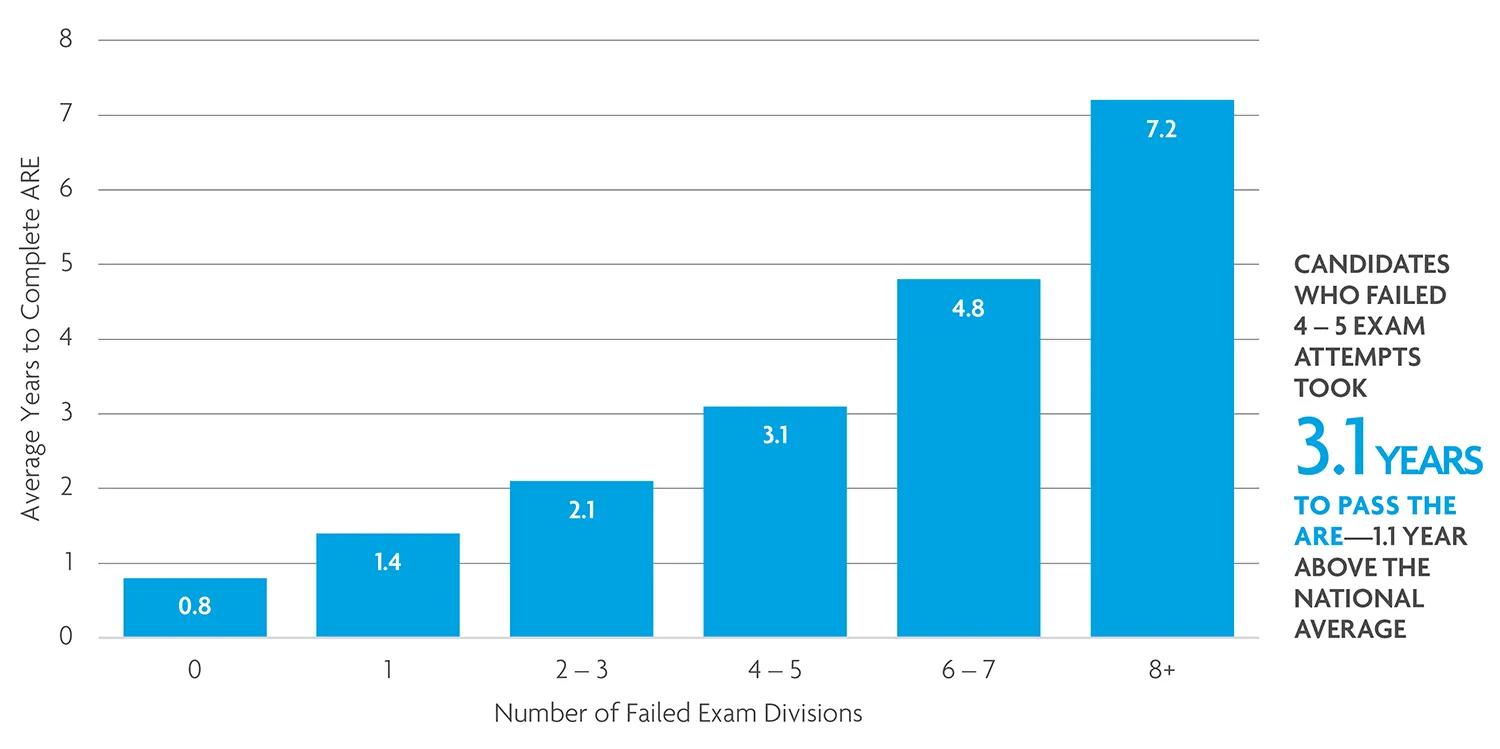
While 69% of candidates who finished the ARE in 2025 failed 3 or fewer divisional attempts before completing the ARE, those who saw above-average numbers of failed division attempts took significantly longer to complete the ARE. The average time to ARE completion in 2025 was 2 years, but candidates who failed divisions 4 – 5 times took an average of 3.1 years.
The average ARE completion time scaled upward with additional failed attempts, rising to 7.2 years for those who failed upwards of 8 division attempts. This added time is, in part, due to NCARB’s retake policy: Candidates must wait 60 days before retaking an exam division and can take a single exam division no more than 3 times in a rolling 12-month period. However, the retake policy is not the only factor driving increased exam completion times, as candidates also reassess and strengthen their exam preparation approach, rest between exams, and sometimes lose motivation.
Through Pathways to Practice, NCARB hopes to provide candidates with the opportunity to choose the competency assessment method that best suits their career path and preferences, allowing those who struggle with standardized assessments to pursue a different—but equally rigorous—assessment method.