
NCARB’s Architect Registration Examination® (ARE®) is a 6-part exam required to become an architect in the United States. For most candidates, taking the ARE is the final step on the path to licensure.
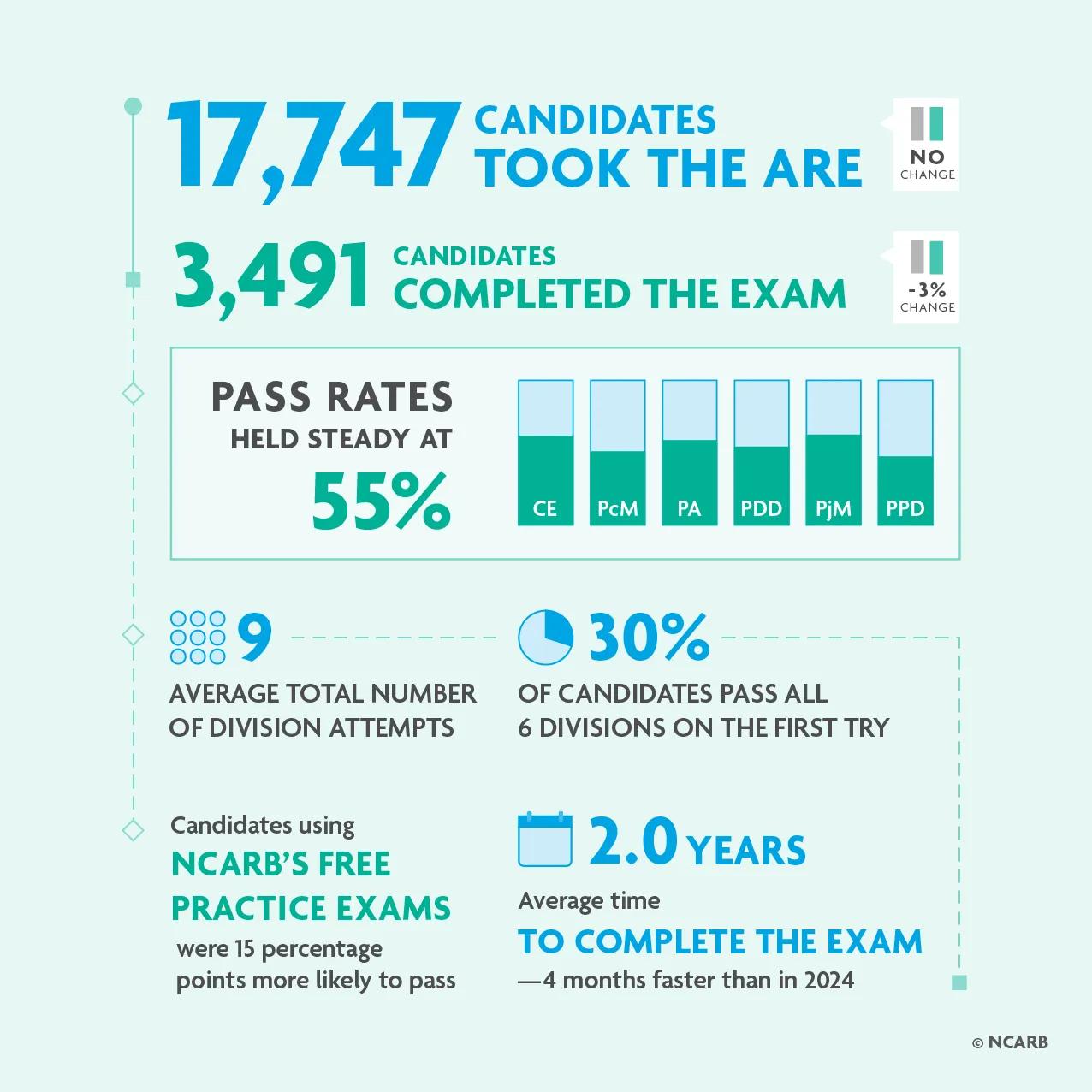
In 2025, NCARB saw the time to complete the exam fall to a record low. The average candidate who finished the ARE in 2025 took just 2 years—4 months faster than in 2024 and the lowest average completion time seen in the history of the computerized ARE. Plus, over 1,000 candidates who finished the exam in 2025 did so in 12 months or less.
Despite the decreased time to complete the ARE, NCARB saw no change in the number of candidates taking the exam and a slight drop in the number of candidates finishing the exam. Exam pass rates held steady at 55%, with the average 2025 candidate taking a total of 9 attempts across all 6 divisions to pass the ARE. However, nearly a third of candidates pass all 6 divisions on the first try. Candidates who take advantage of NCARB’s free practice exams consistently see higher pass rates: In 2025, candidates who used NCARB’s practice exams were 15 percentage points more likely to pass than those who didn’t.
Over the past several years, NCARB has been implementing changes to improve the equity and accessibility of the ARE. While NCARB continues to see a disparity in pass rates between white candidates and candidates of color, recent changes are helping to close the gap over time.
The number of candidates finishing the ARE fell by 3%.
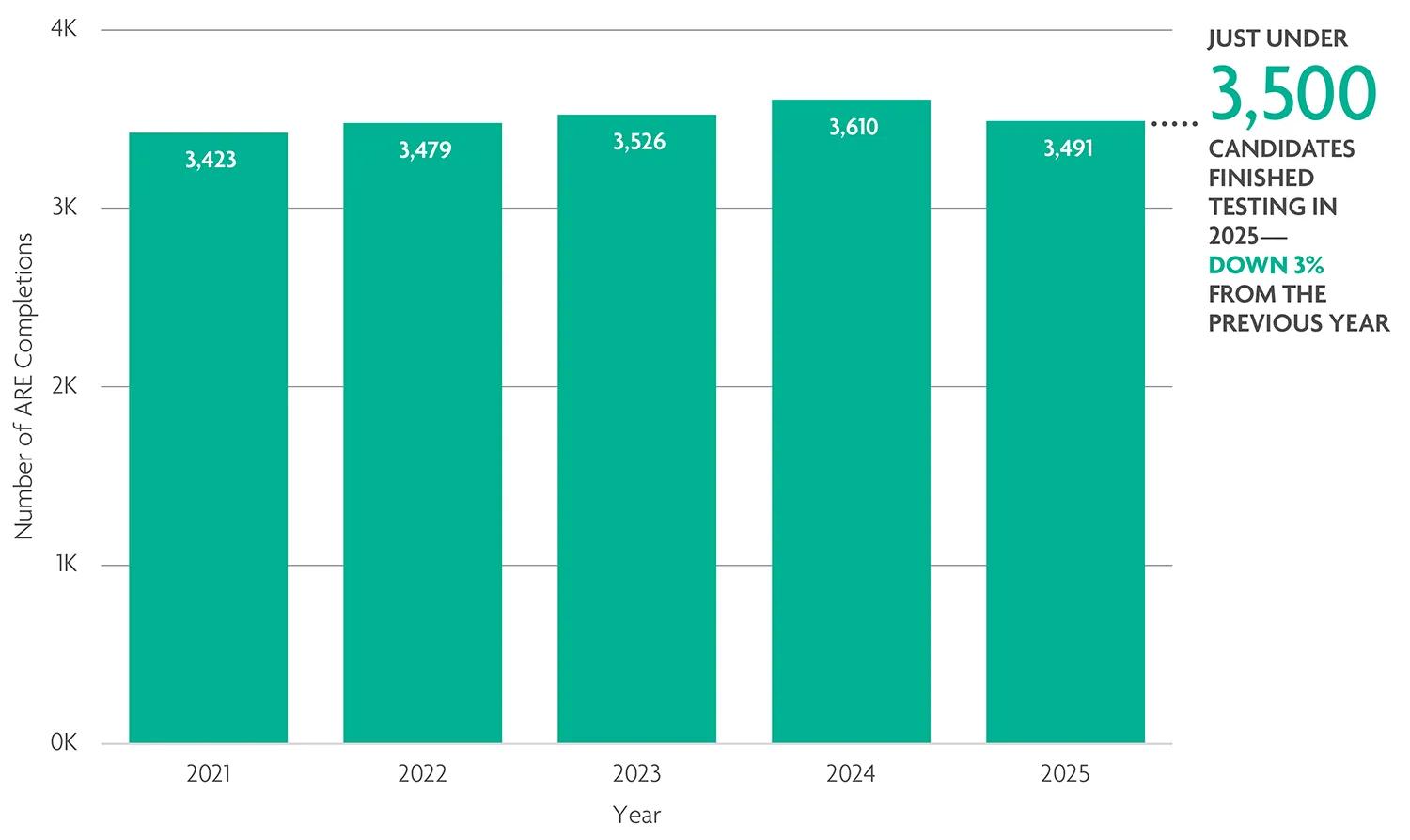
Just under 3,500 candidates finished their final exam division in 2025, a 3% decrease from 2024. However, 2025’s number of ARE completions is still on par with the 5-year average of 3,506.
Despite slight fluctuations from year to year, the number of candidates finishing the exam has held relatively steady since 2021, with the slight uptick in 2023 – 2024 likely a result of the retirement of the exam’s 5-year rolling clock policy.
As the licensure pipeline recovered from the COVID-19 pandemic in 2022 – 2023, NCARB saw aboveaverage levels of candidates starting the licensure process. We expect to see these candidates begin trickling into the exam pipeline over the next several years, potentially leading to higher levels of exam completions in the near future.
Time to complete the ARE fell to a record low in 2025.
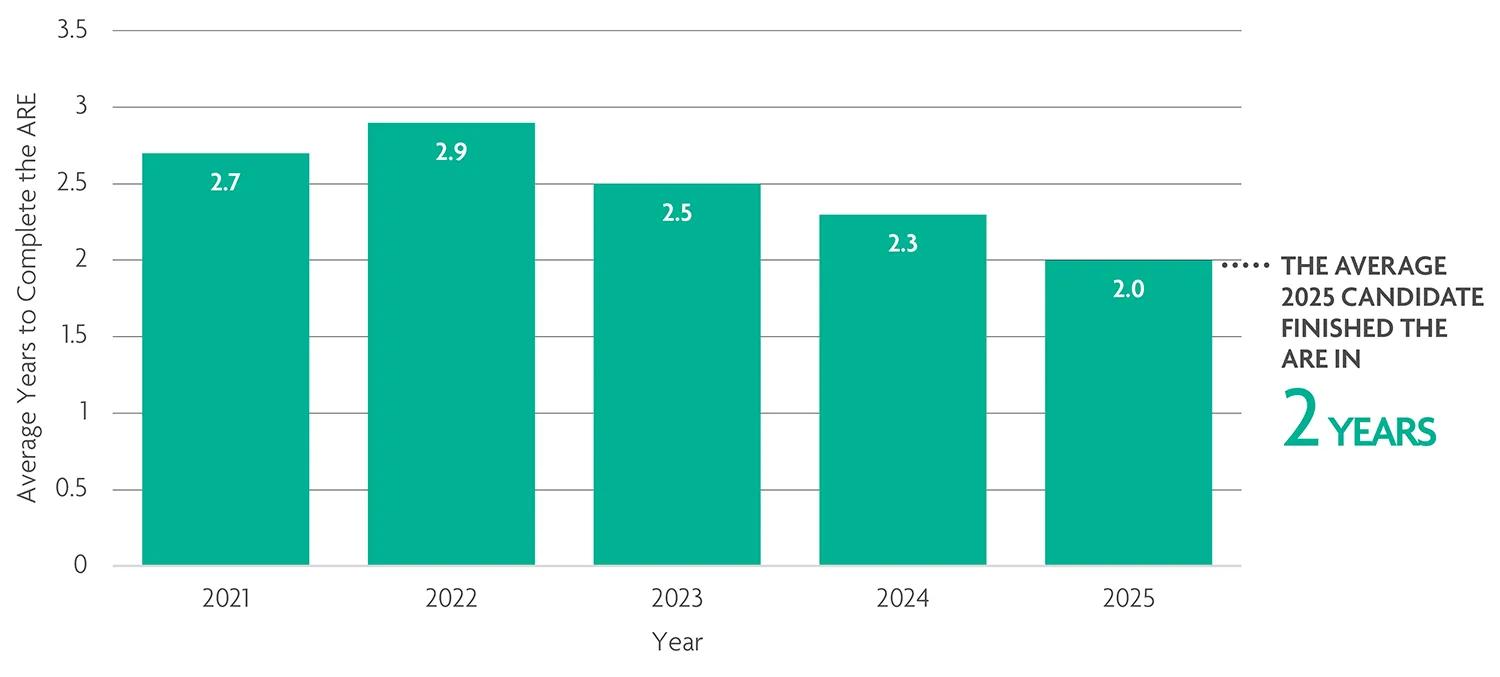
The average time to complete the ARE fell by 4 months in 2025. On average, candidates who completed the ARE in 2025 took just 2 years—a record low in the history of the computerized ARE. The steady decrease in time to complete the ARE over the past 3 years is likely due to a combination of the exam changes NCARB has implemented over the past several years, as well as the receding impact of the COVID-19 pandemic.
2025’s average time to complete the ARE is almost an entire year faster than the spike seen in 2022, which was a delayed result of the COVID-19 pandemic. Candidates who finished the exam in 2022 would have started testing in 2019 – 2020, during the height of pandemic-related test center closures. With 2 years between the first and last test, the typical candidate who finished the exam in 2025 would have started testing in 2023, after the majority of the pandemic’s impact on the exam had passed.
DID YOU KNOW? Averages can be measured in several ways. NCARB typically uses median to measure averages throughout NBTN, which allows us to avoid skewing the average with outlier data points.
More than 1,000 candidates completed the ARE in a year or less.
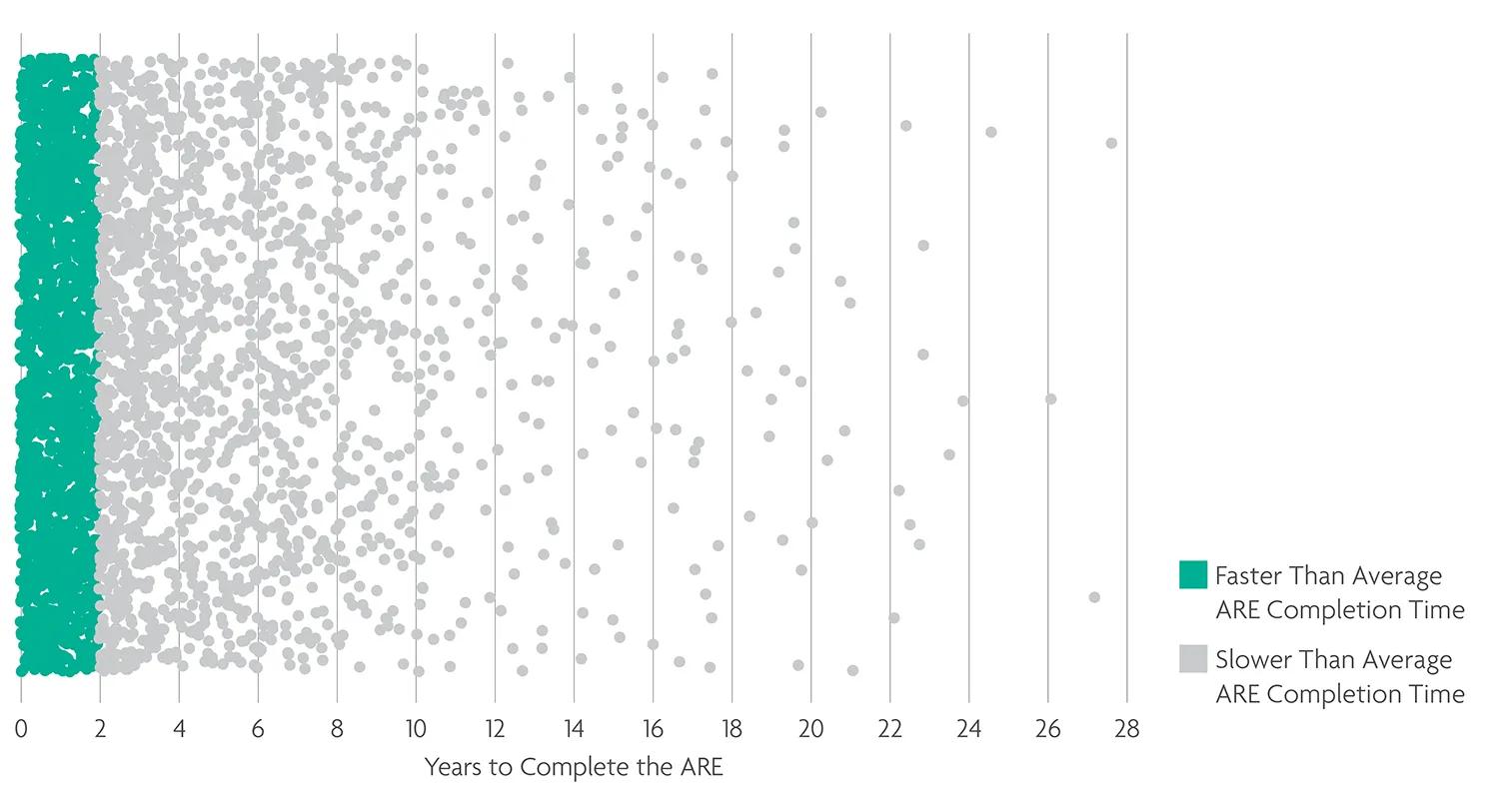
The median time to complete the ARE in 2025 was 2 years—meaning that half of all candidates completing the program finished in less time, and half finished in more time.
As with the Architectural Experience Program® (AXP®), candidates who take longer to complete the exam are more widely distributed than those who complete the exam faster than average. Over 1,000 candidates completed the ARE in less than 1 year in 2025; 20 candidates took 20 years or more.
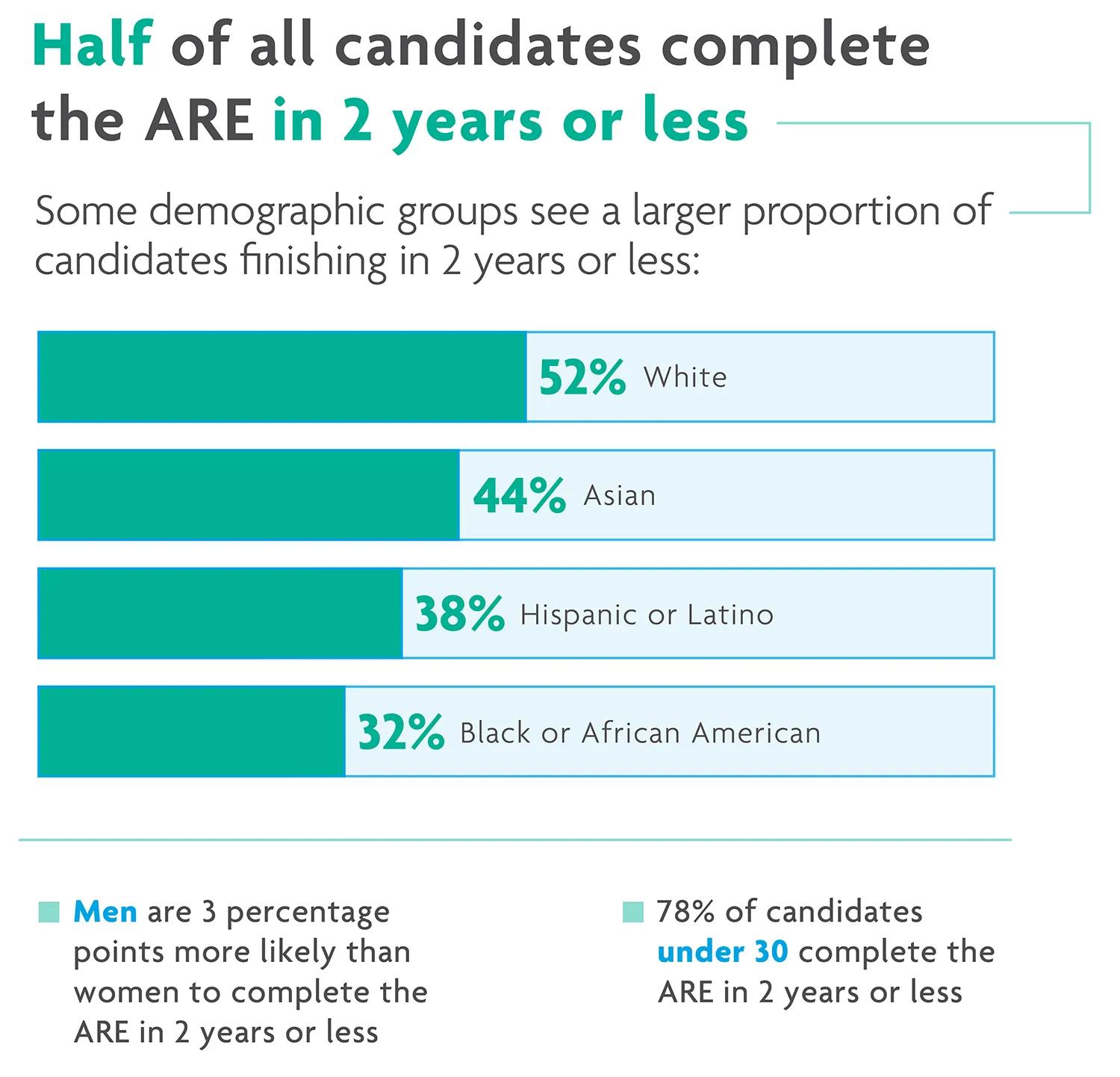
Typically, men and white candidates are more likely to complete the ARE in a shorter time frame compared to their peers.
HOW TO READ THIS CHART: Each dot on this chart represents a candidate who completed the ARE in 2025. Because NCARB uses median— the mid-point—to measure average time to completion, half of the dots are below the 2-year mark and half are above.
Candidates’ exam activity held steady in 2025.
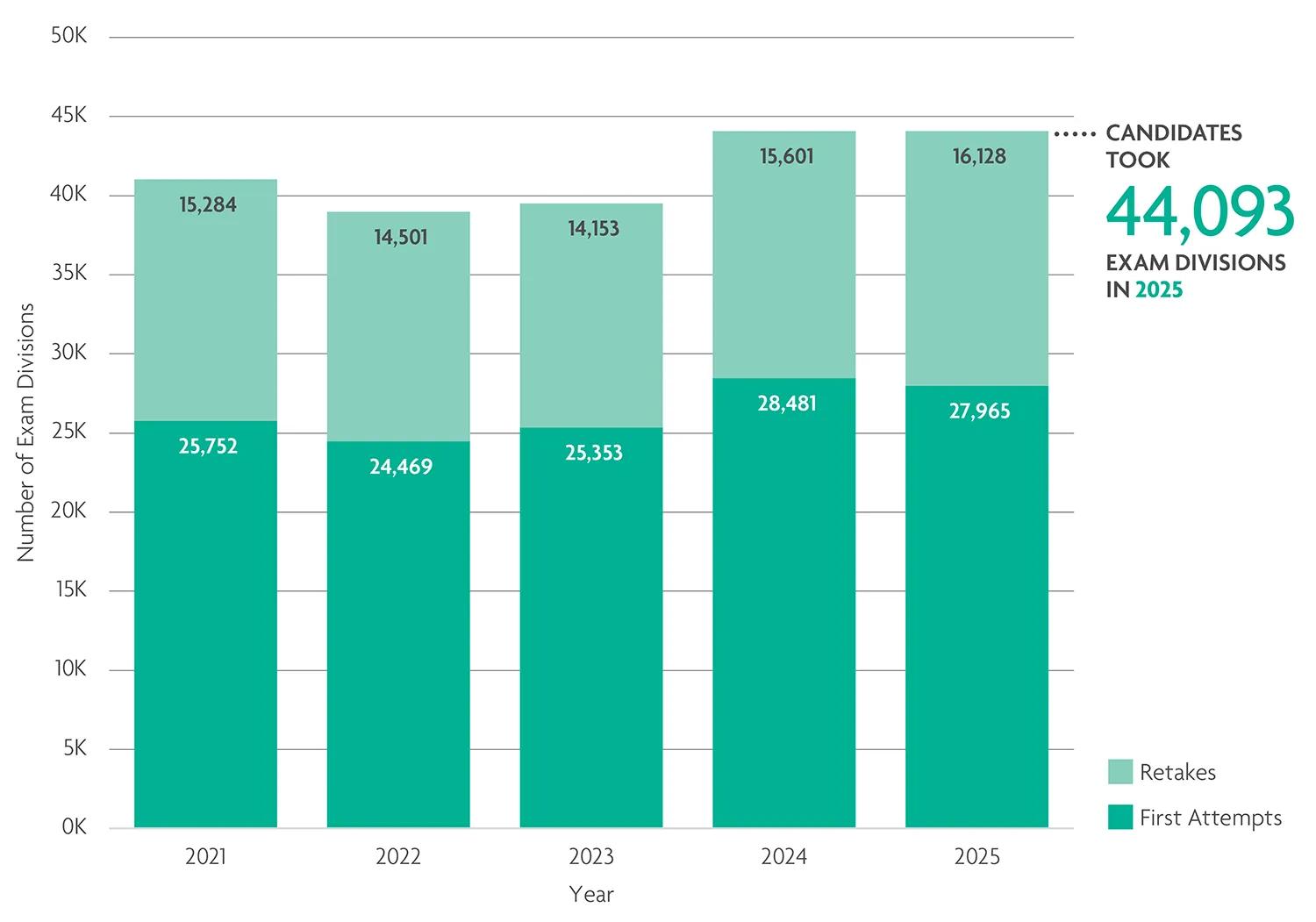
The number of exam divisions taken in 2025 held at approximately the same number seen in 2024: Candidates took 44,093 divisions of the ARE, about 10 more total attempts than in 2024. This is the highest number of total division attempts seen since the COVID-19 pandemic, but still below the record high of over 56,000 divisions taken in 2017 as candidates rushed to complete the exam before the retirement of ARE 4.0.
Approximately 63% of all exams administered in 2025 were first attempts, while the remaining 37% were retakes of previously failed divisions. Over the past 5 years, first attempts have consistently made up 63% – 65% of all exam attempts.
More than 20% of all exam attempts were for the Practice Management division.
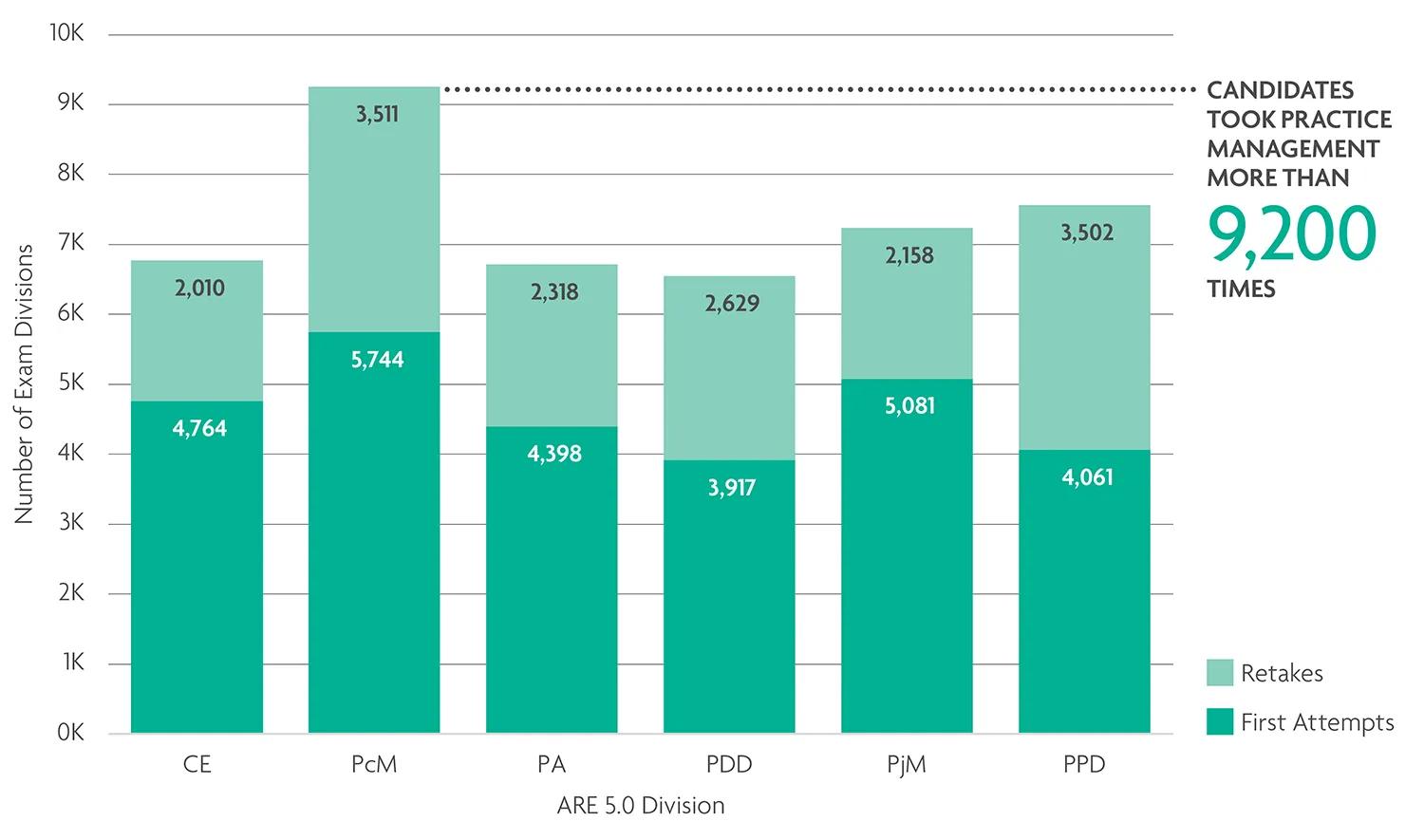
Of the 44,093 ARE divisions taken in 2025, more than 9,200 were in the Practice Management division—21% of all exam attempts.
Though candidates can take the divisions in any order, many candidates start their exam journey with Practice Management, which is typically listed first in NCARB’s materials. The next most-taken division was Project Planning & Design, which also has one of the highest number of retakes out of the 6 divisions (alongside Practice Management).
Overall exam pass rates held steady at 55%.
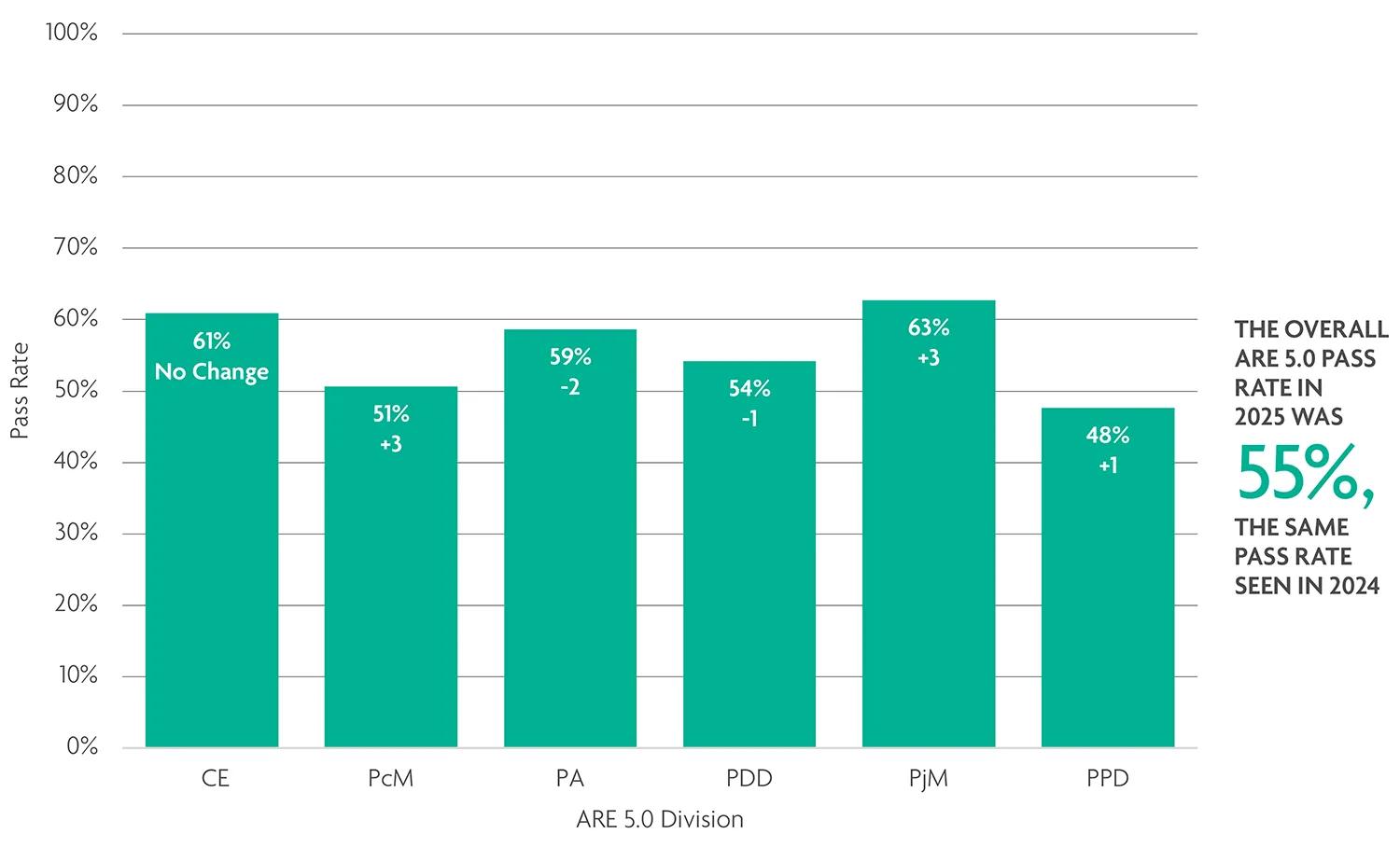
The overall ARE 5.0 pass rate held steady at 55% in 2025, the same pass rate seen in 2024. Three of the 6 ARE 5.0 divisions saw higher pass rates than in 2024: Practice Management, Project Management, and Project Planning & Design.
Pass rates for the Programming & Analysis division decreased by 2 percentage points, and pass rates for Project Development & Documentation fell by 1 percentage point. Meanwhile, pass rates for Construction & Evaluation held steady at 61%.
Over the past several years, NCARB has made several updates to the exam to align with current testing best practices and ensure greater accessibility, including expanding accommodations, launching free practice exams, retiring the 5-year rolling clock policy, and removing certain item types. Going forward, NCARB will continue to monitor the impact of these changes and explore opportunities for additional exam improvements.
White men had the highest ARE pass rates.
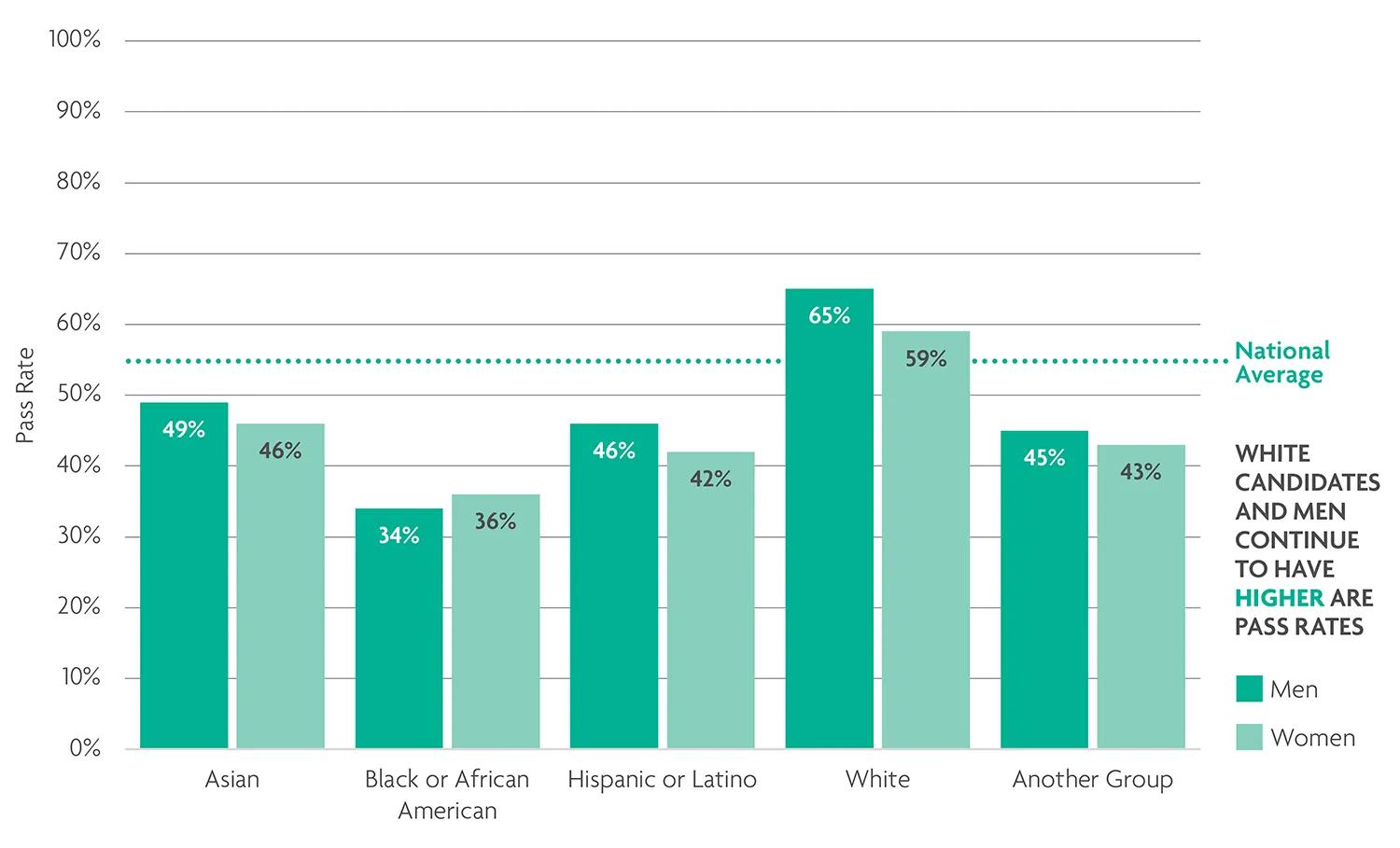
While NCARB has implemented updates to make the exam more accessible for candidates of all backgrounds, pass rates remained higher for white candidates than for candidates of color. White men continued to have the highest pass rate at 65% in 2025, 10 percentage points above the national average.
Additionally, women tended to receive lower pass rates than men of the same racial or ethnic group, with the exception of Black or African American men, who generally had the lowest overall pass rate.
On average, candidates took each division 1 – 2 times.
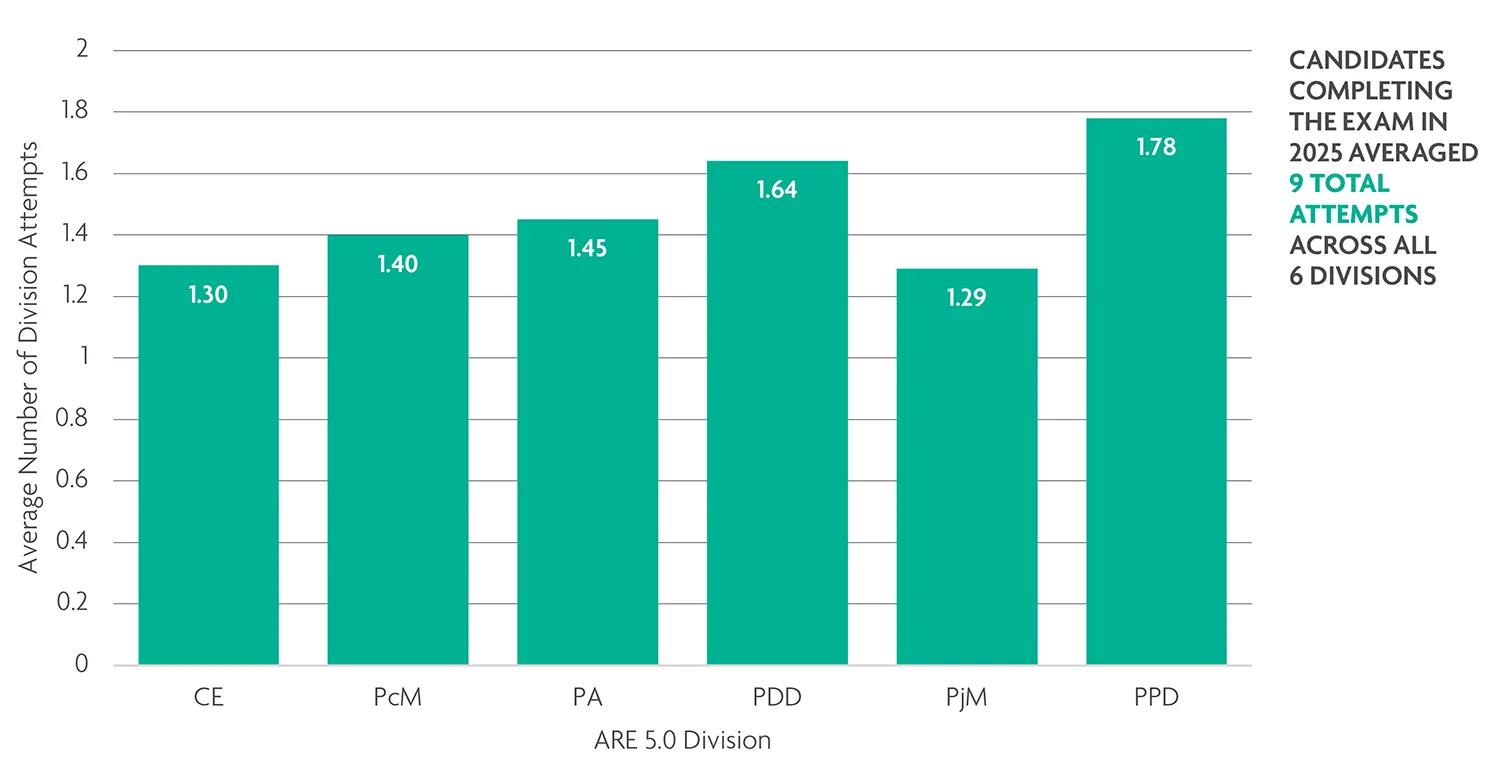
The typical candidate who completed the ARE in 2025 took each division 1 – 2 times. On average, candidates who passed their final ARE division in 2025 took a total of 9 attempts across all 6 divisions—indicating that the average candidate fails approximately 3 divisions before completing the exam.
By division, Project Planning & Design—the ARE 5.0 division with the lowest pass rate—has the highest average number of attempts at 1.78. Project Management—the division with the highest pass rate—has the lowest average number of attempts at 1.29.
DID YOU KNOW? Averages can be measured in several ways. NCARB often uses median to measure averages throughout NBTN, which allows us to avoid skewing the average with outlier data points. However, for this particular data point, a mean is more appropriate. When we refer to the average number of exam attempts, we’re referring to the arithmetic average, or mean.
Pass rates were significantly higher for first attempts.
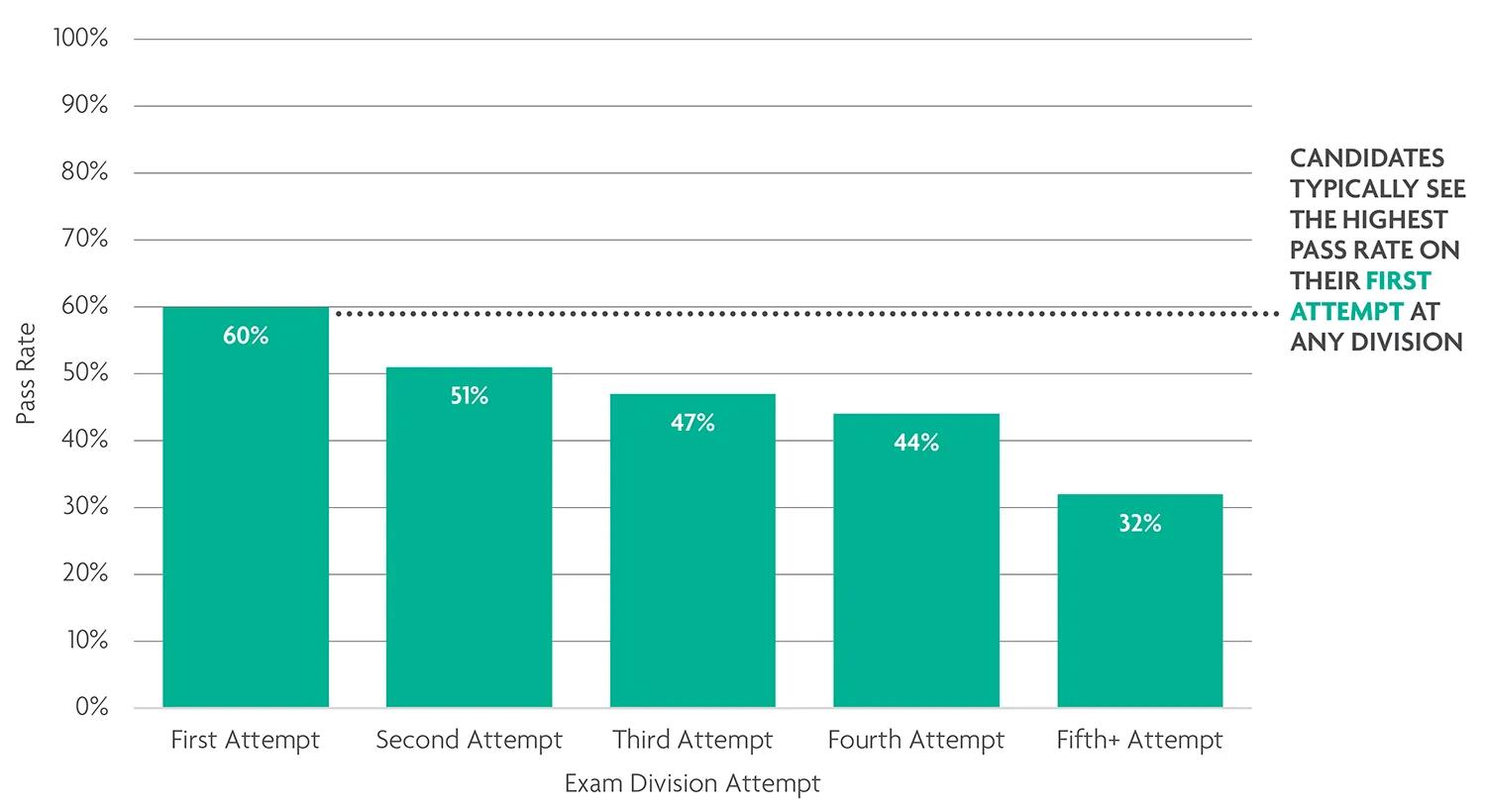
Across all exam divisions, pass rates were higher for candidates attempting any division for the first time compared to those retaking after failing that division at least once. Averaged across the exam’s divisions, candidates saw a 60% pass rate on their first attempt at any division in 2025—5 percentage points higher than the overall average pass rate.
Pass rates fell with each subsequent attempt at the division, with a 51% pass rate for second attempts. While the majority of candidates passed on either their first or second attempt at any division, those who took a division more than 2 times faced significantly lower pass rates, falling to 32% for those attempting 5 or more times.
Through Pathways to Practice, NCARB hopes to develop a licensure model that offers multiple methods of demonstrating competency across each essential area of architectural practice, providing candidates facing challenges navigating the current licensure process additional options to demonstrate their competency.
Nearly a third of candidates passed all 6 divisions on their first try.
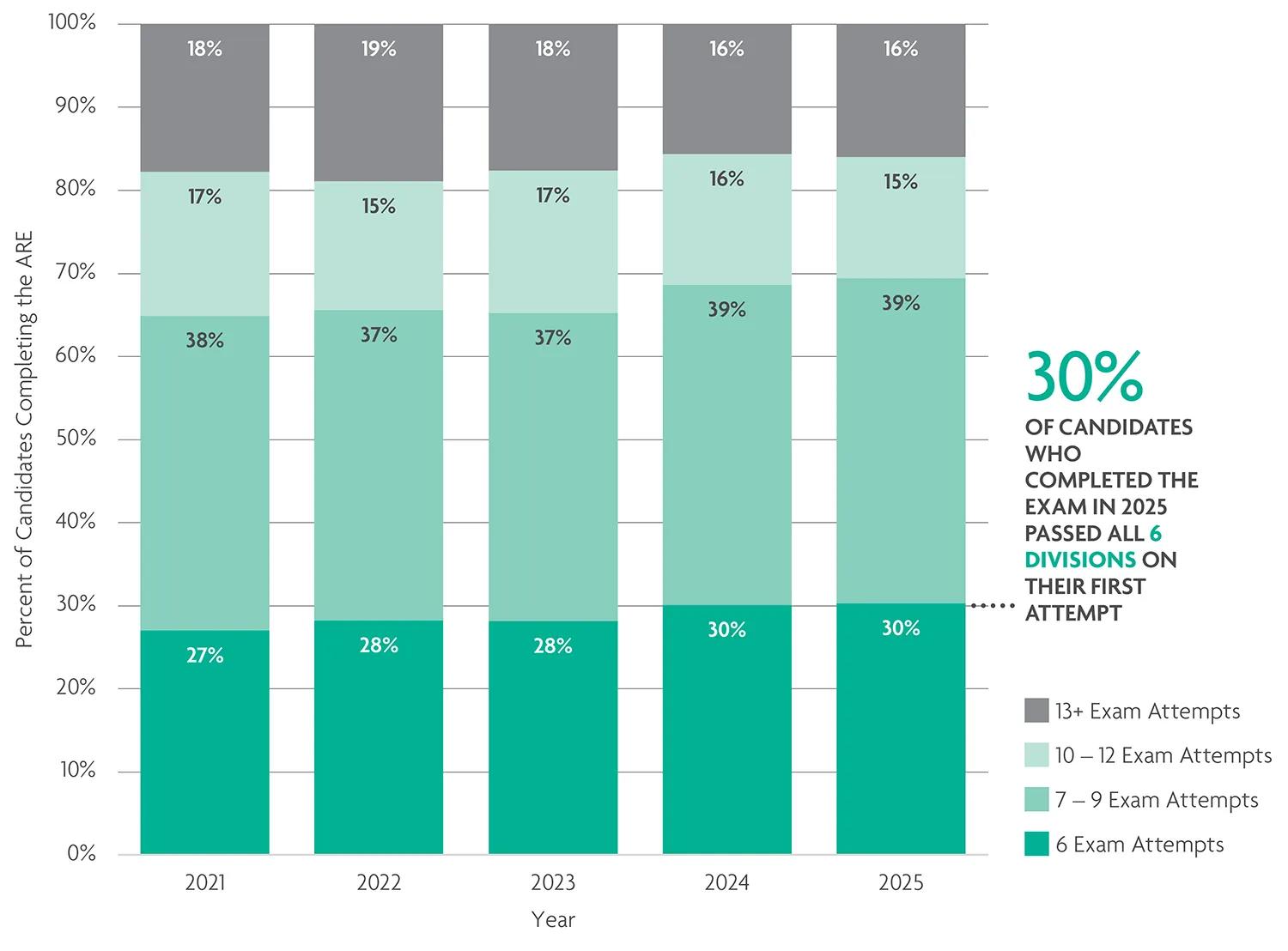
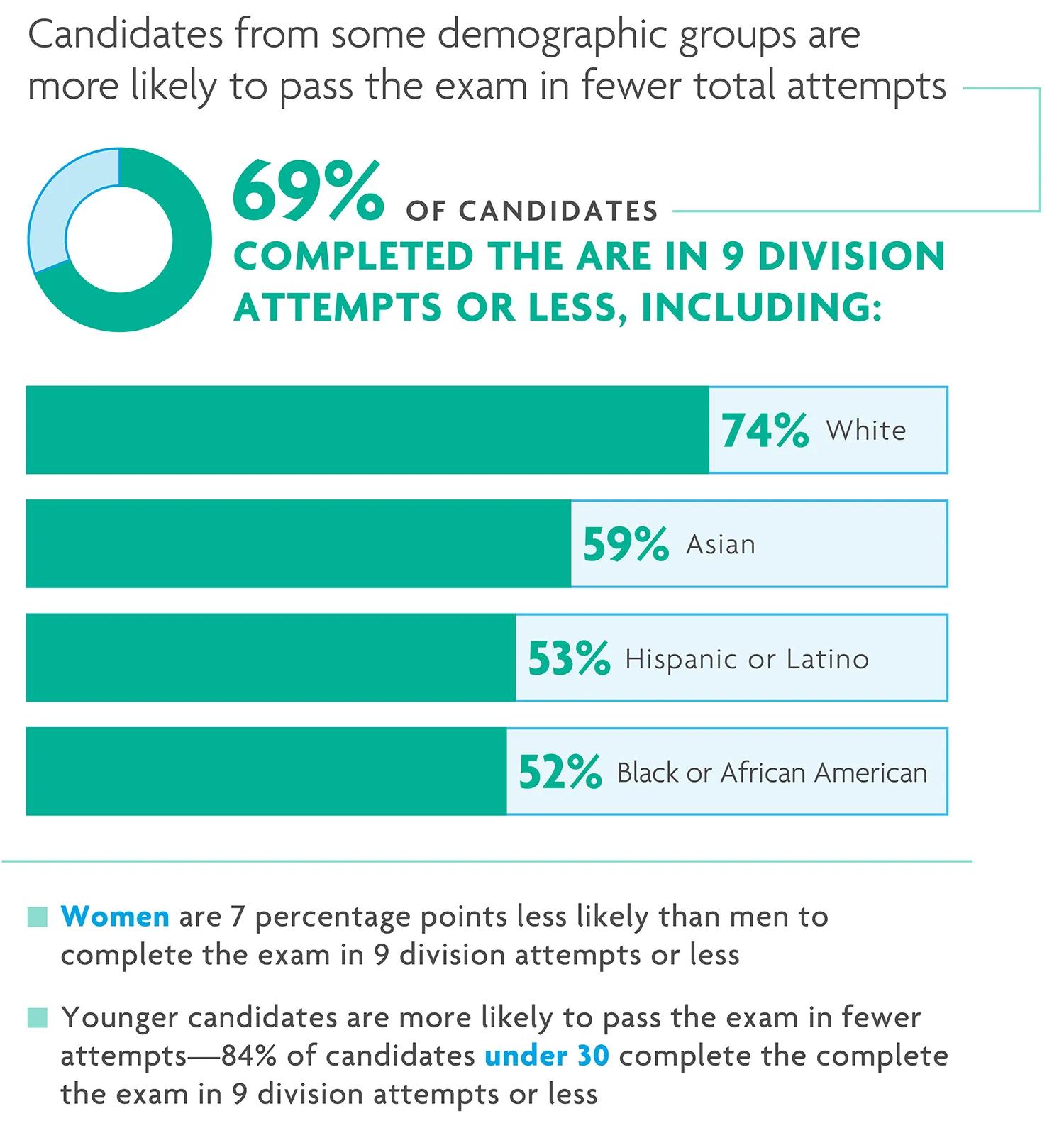
While the average number of exam attempts for candidates finishing the ARE was 9, 69% of candidates who finished the exam in 2025 hit at or below this average. Of candidates who completed the ARE in 2025, nearly a third took just 6 total division attempts to do so—in other words, 30% of ARE complete candidates passed all 6 divisions on their first try. Another 39% of candidates completing the exam in 2025 attempted 7 – 9 total divisions, failing between 1 and 3 divisions.
Candidates who used NCARB’s practice exams performed 15 percentage points better.
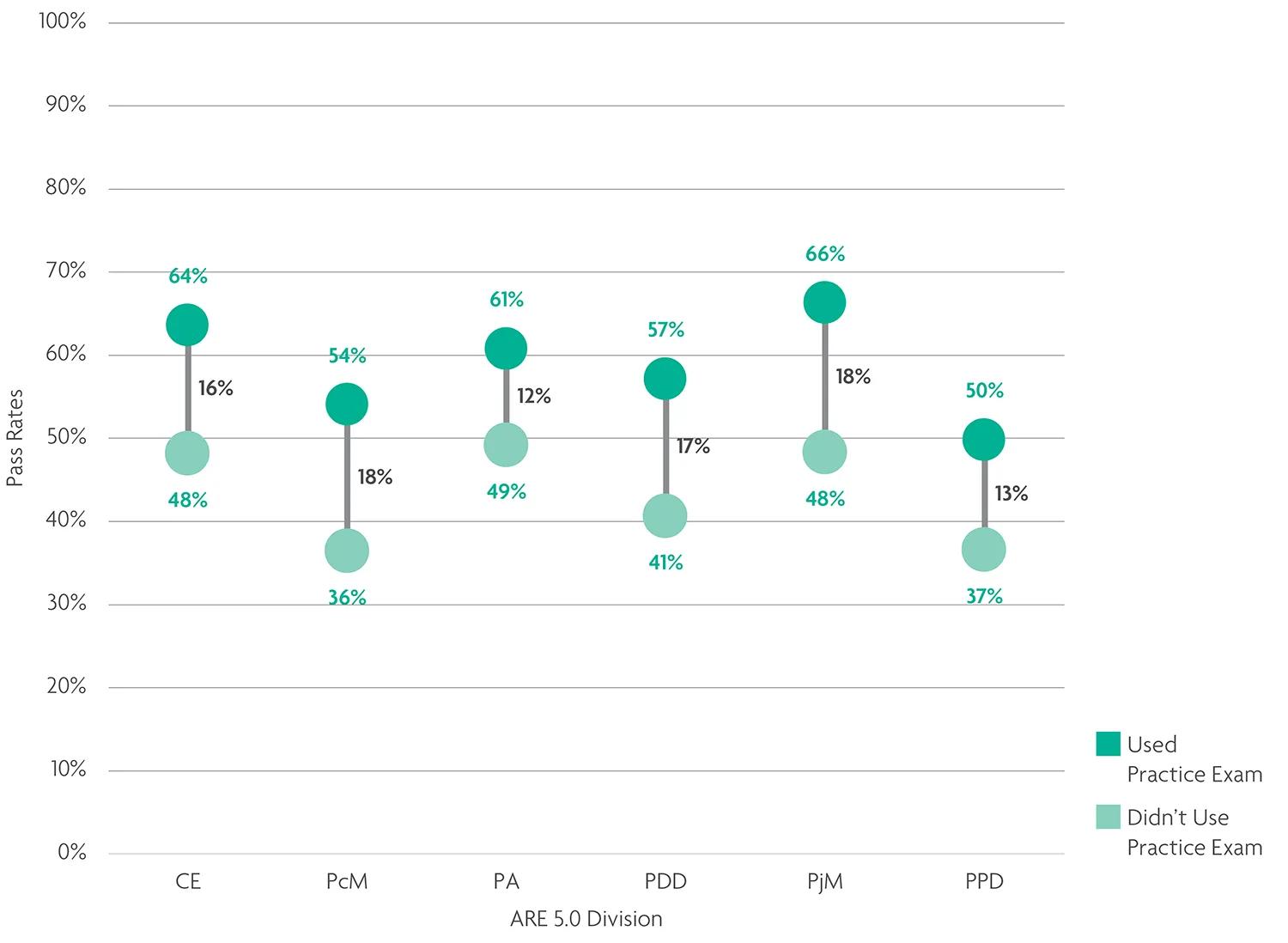
Overall, candidates who took a free NCARB practice exam before attempting the related division were 15 percentage points more likely to succeed. Higher pass rates ranged anywhere from 12 – 18 percentage points, depending on the division. Performance improved most (18 percentage points) for candidates taking Practice Management and Project Management, and least (12 percentage points) for candidates taking the Programming & Analysis division.
People of color see larger positive impact from using NCARB's practice exams.

The average white candidate using NCARB's practice exams were 14 percentage pints more likely to pass than white candidates who didn't use NCARB's free practice exams. For candidates of color, this pass rate improvement increases to 18 percentage points. Similarly, women saw a larger positive impact on exam pass rates when using NCARB's free practice exams compared to men.
Nearly 60% of candidates overlapped the AXP and ARE.
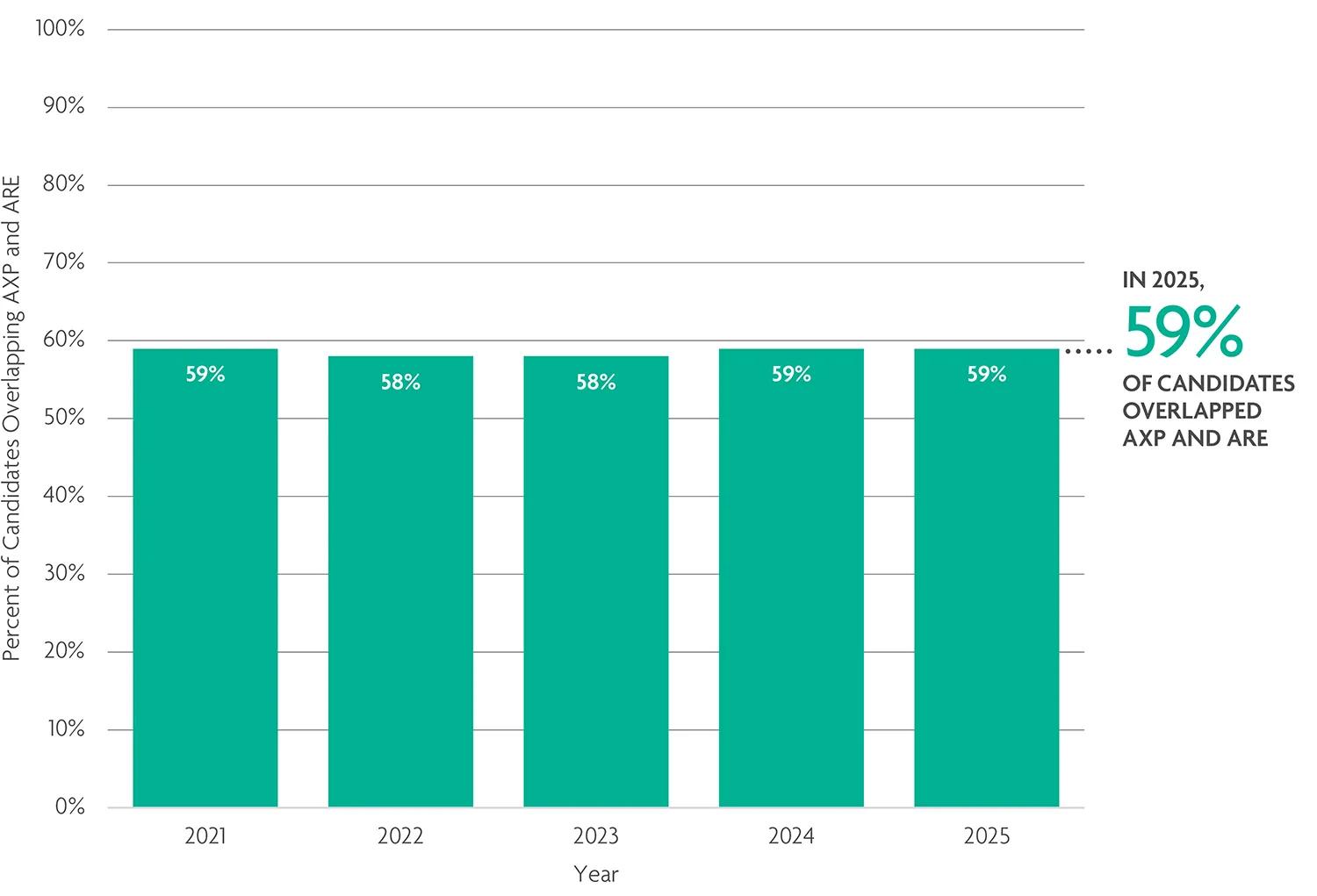
Although AXP experience areas and ARE 5.0 divisions were intentionally designed to align with each other, NCARB’s data shows that just under 60% of candidates typically take the exam while working to complete the experience program.
In 2025, 59% of candidates took at least 1 ARE division while they were still working toward completing the AXP—the same proportion seen in 2024. This proportion has held steady for the past 5 years.
Note: Because candidates can backdate experience, AXP data can shift over time.
The best time to take an exam division was within 3 months of completing the related experience area.
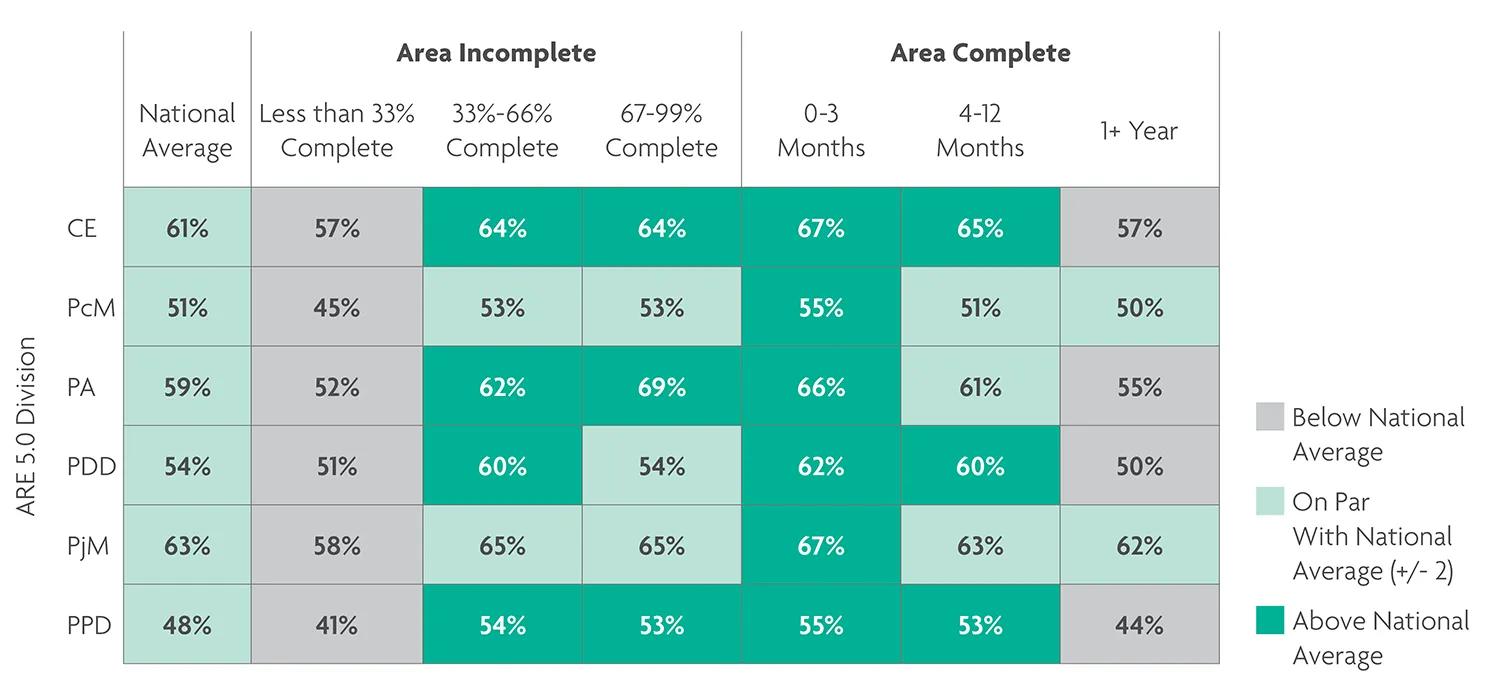
NCARB recommends that candidates take the ARE at the time that best meets their needs—whether that’s based on finances, bandwidth, preparation, or other factors. But NCARB’s data indicates that candidates should also consider their AXP progress when establishing a testing timeline. On average, candidates perform better on the exam when they take an ARE division immediately after finishing the related AXP experience area.
Currently, most candidates wait a year or more after finishing an AXP area before taking its related ARE division. However, pass rates at that point are anywhere from 5 – 12 percentage points lower on average compared to divisions taken within 0 – 3 months of completing the related experience area.
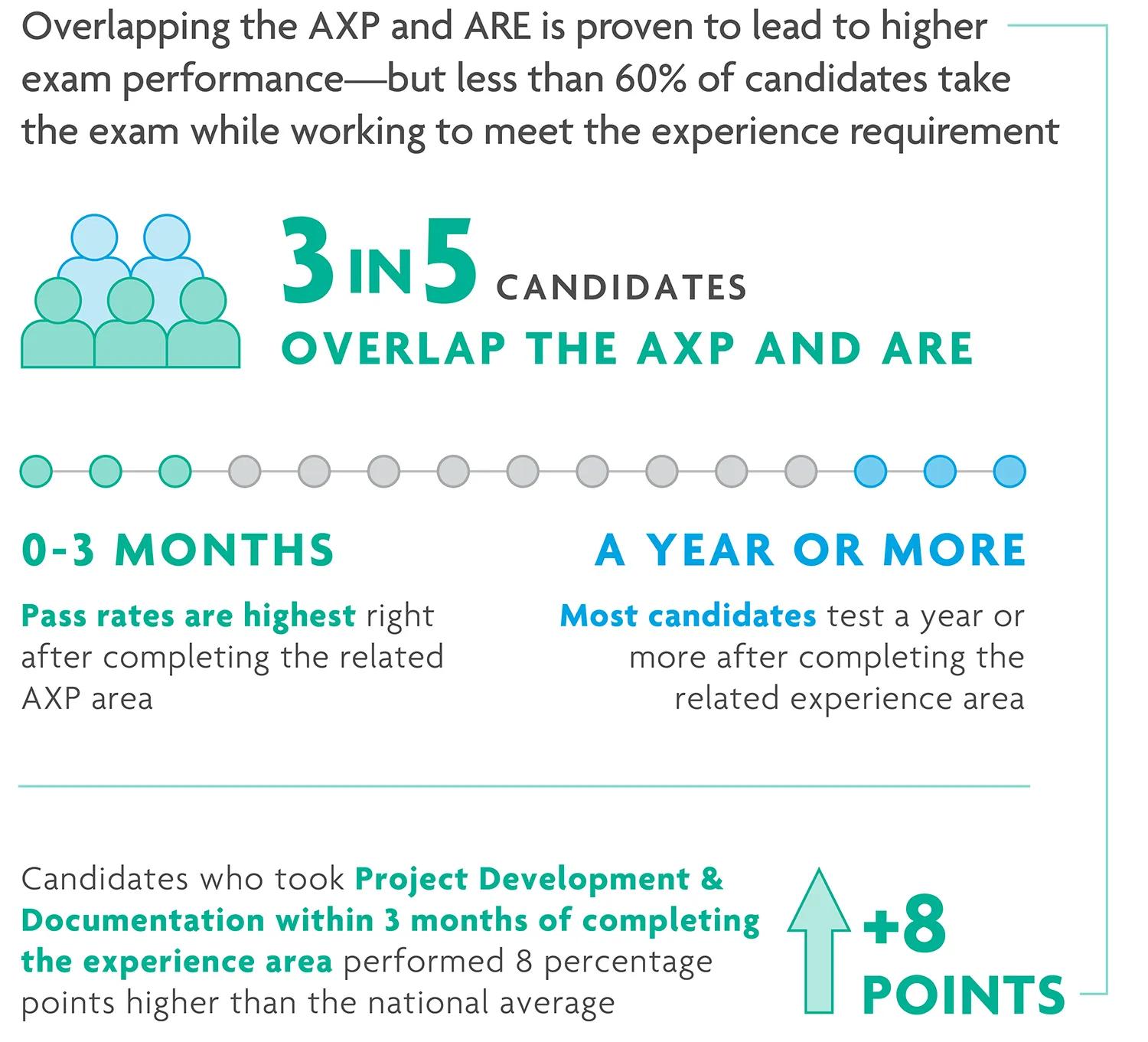
The ARE is designed to reflect day-to-day practice, so testing while related experience is fresh might help candidates connect the exam to the real world.