The licensure process is designed to help candidates build up their ability to competently practice architecture—specifically in areas of practice that are tied to the public’s health, safety, and welfare.
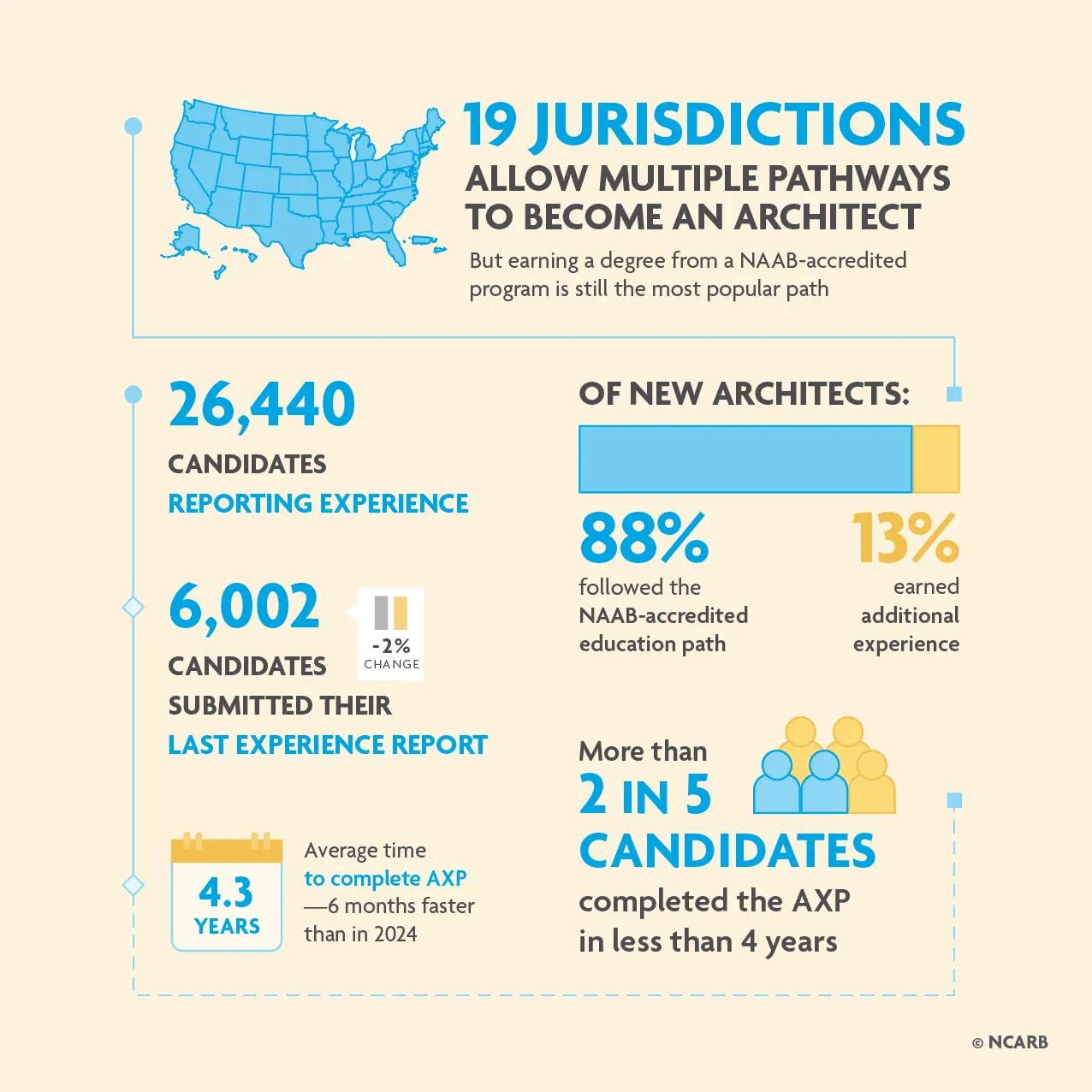
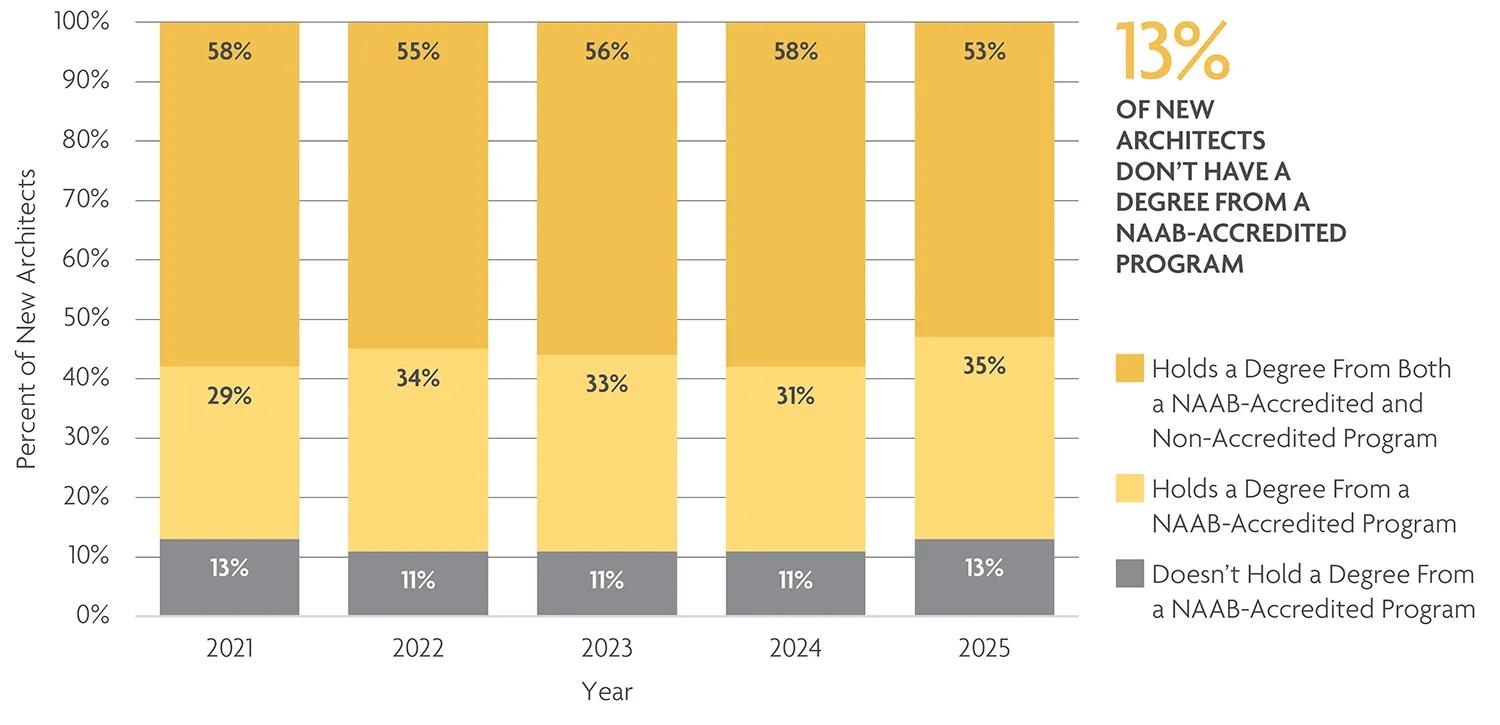
Typically, candidates develop these competencies through a combination of education and experience. Most candidates satisfy education and experience requirements by earning a degree from a program accredited by the National Architectural Accrediting Board (NAAB) and completing the Architectural Experience Program® (AXP®). However, the proportion of candidates pursuing licensure through alternative Pathways to Practice—and acceptance of those alternative paths at the jurisdictional level—is growing. In 2025, 13% of new architects chose to earn additional experience in lieu of earning a degree from a NAAB-accredited program, up 2 percentage points from 2024.
Through our Pathways to Practice initiative, NCARB is working to expand access to licensure for those with non-traditional education or career paths— including those without a degree from a NAAB-accredited program.
NCARB also launched several updates to the AXP in 2025, aligning the program with the NCARB Competency Standard for Architects and refreshing the program’s reporting policy. As a result, NCARB saw above-average numbers of candidates complete the AXP in 2024 – 2025, as well as a drop in the average time to complete the program.
NAAB enrollment grew by 9% in 2025.
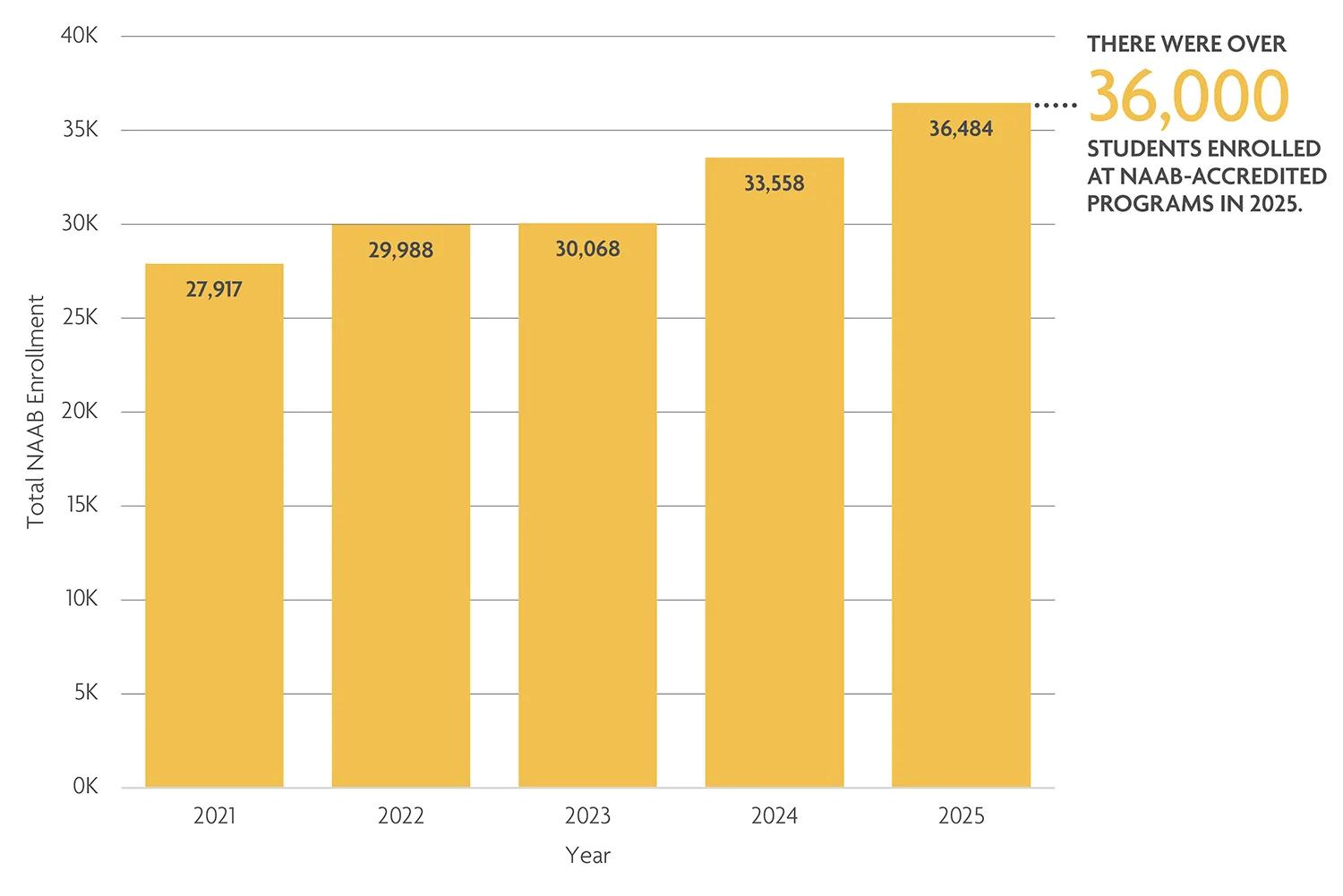
More than 36,000 students were enrolled in a NAAB-accredited program in the 2024 – 2025 school year, a 9% increase compared to the previous school year. The total number of students enrolled in a NAAB-accredited program has been steadily growing over the past several years. Of the more than 36,000 total enrollees, over 11,000 graduated in the 2024 – 2025 school year.
Of students enrolled in NAAB-accredited programs, 69% are enrolled in Bachelor of Architecture programs, and 31% are enrolled in Master of Architecture or Doctor of Architecture programs.
Note: This data is provided to the NAAB by accredited programs and will be published in the 2025 NAAB Report on Accreditation in Architecture, available at www.naab.org. Students enrolled in nonaccredited architecture programs are not represented.
Most new architects have a degree from a NAAB-accredited program.
Most of the 55 U.S. jurisdictions require licensure candidates to have a degree from a NAAB-accredited program for initial licensure. In 2025, only 19 jurisdictions offered multiple pathways to initial licensure. However, 49 jurisdictions allowed multiple pathways to reciprocal licensure, an option NCARB is working to expand through our Pathways to Practice effort.
Because most jurisdictions require a degree from a NAAB-accredited program, this is the most common path to earning a license in the United States. However, several additional jurisdictions have recently adopted multiple pathways for initial licensure. The proportion of new architects without a degree from a NAAB-accredited program rose to 13% in 2025, up 2 percentage points from 2024.
Earning a degree from an accredited program typically takes 5 – 7 years. Often, candidates graduate from a non-accredited, 4-year program and then return to school for a Master of Architecture degree, an investment of time and resources that can create a significant burden on early career professionals. To address this impediment, NCARB is working to create multiple pathways to licensure that include a variety of education, experience, and examination opportunities.
New Black architects are most likely to have a degree from a NAAB-accredited program.
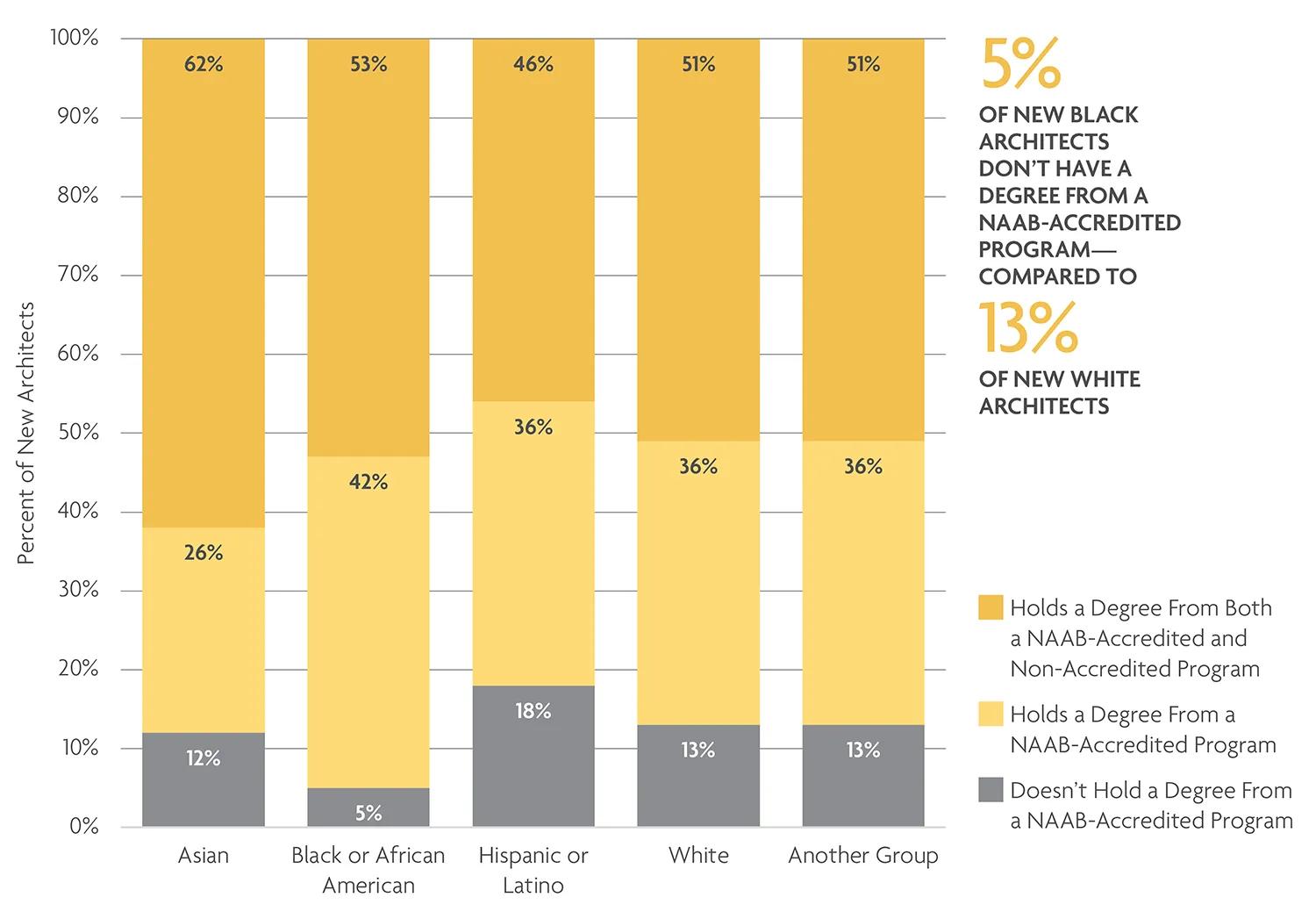
Newly licensed architects who identify as Black or African American are typically the most likely to hold a degree from a NAAB-accredited program. In 2025, just 5% of new Black architects did not have an accredited degree—8 percentage points fewer than the proportion of new white architects without an accredited degree.
Newly licensed architects who identified as Hispanic or Latino were the most likely not to hold a degree from a NAAB-accredited program at 18%.
70% of new architects graduated from public universities.
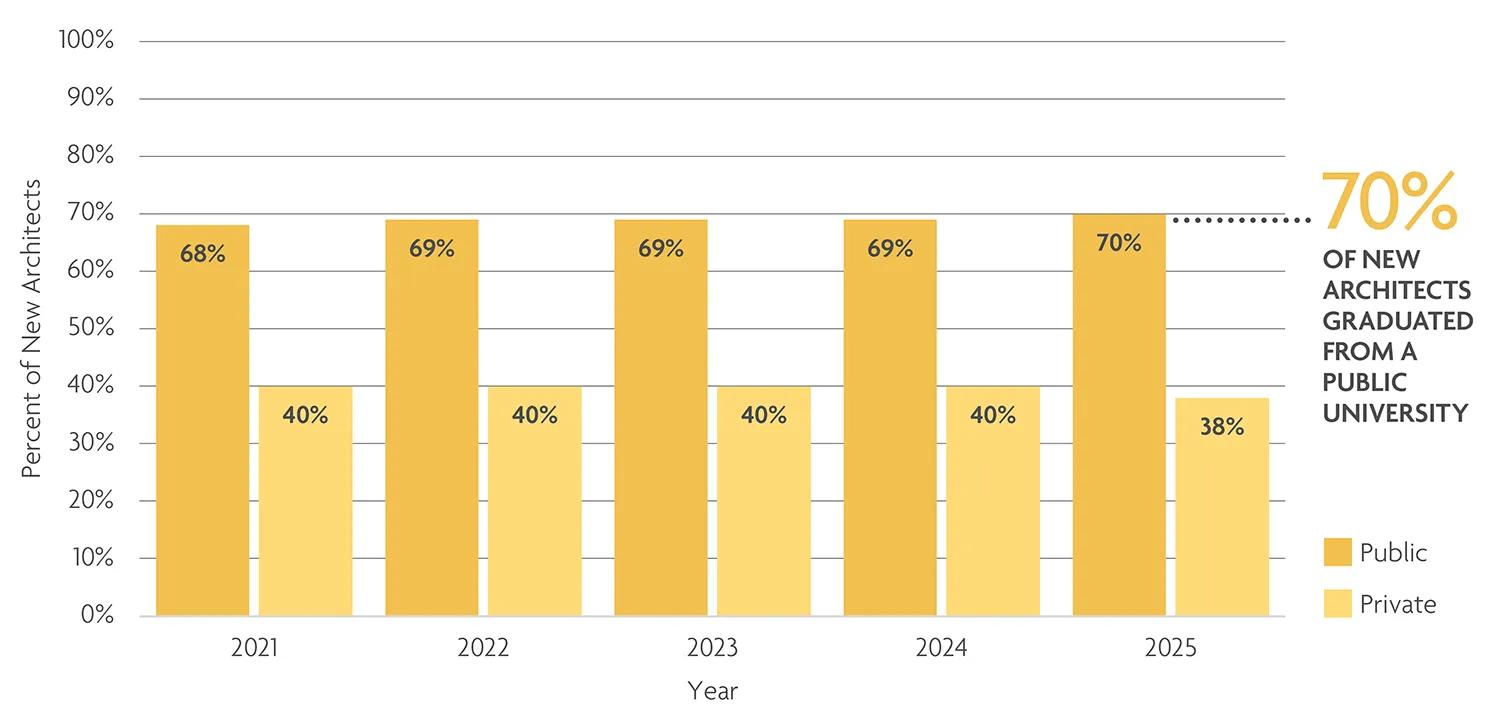
Most new architects attend public, rather than private, universities. The ratio of public to private has stayed relatively stable over the past 5 years, with 68 – 70% of new architects each year attending a public institution. According to the NAAB’s latest report, 60% of schools that offer NAAB-accredited programs are public institutions, and the remaining 40% are private. 4 of the 5 of the schools whose graduates make up the largest proportion of new architects are public universities. Of architects licensed in 2025:
- 2.4% attended Virginia Tech
- 2.3% attended Cal Poly
- 2.2% attended the University of Oregon
- 2.0% attended the University of Michigan
- 1.9% attended Harvard University
WHY DOES THIS CHART ADD TO MORE THAN 100%? Because many architects have more than one degree, individuals can be represented in more than one column on this chart. Some new architects hold degrees from both public and private institutions.
Over half of new architects have more than 1 degree.
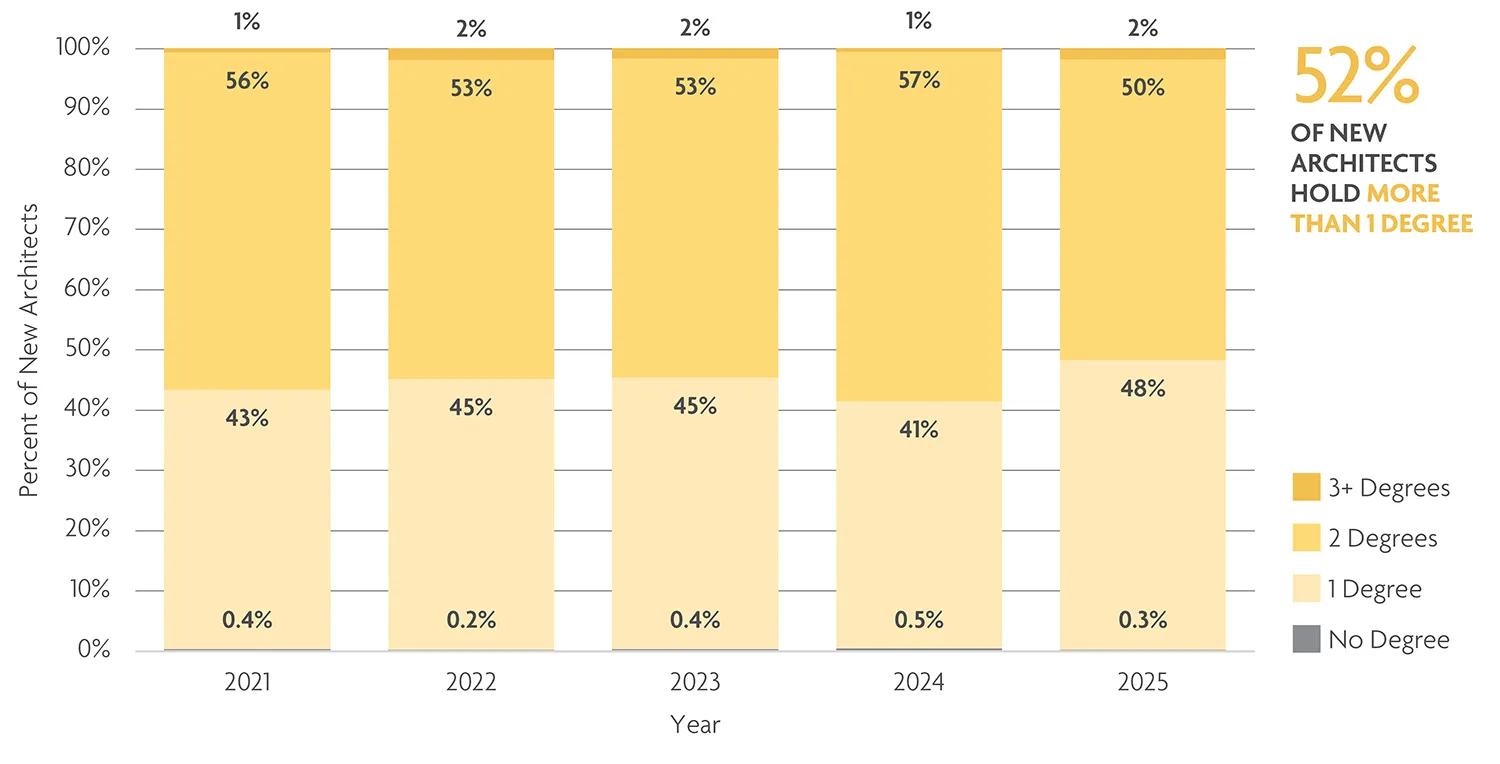
NCARB saw a 7-percentage point increase in the number of new architects with only 1 degree between 2024 and 2025, from 41% to 48%. However, most new architects still hold more than one post-secondary degree. Half (50%) of the nearly 3,500 architects licensed in 2025 held 2 degrees, and an additional 2% held 3 or more degrees.
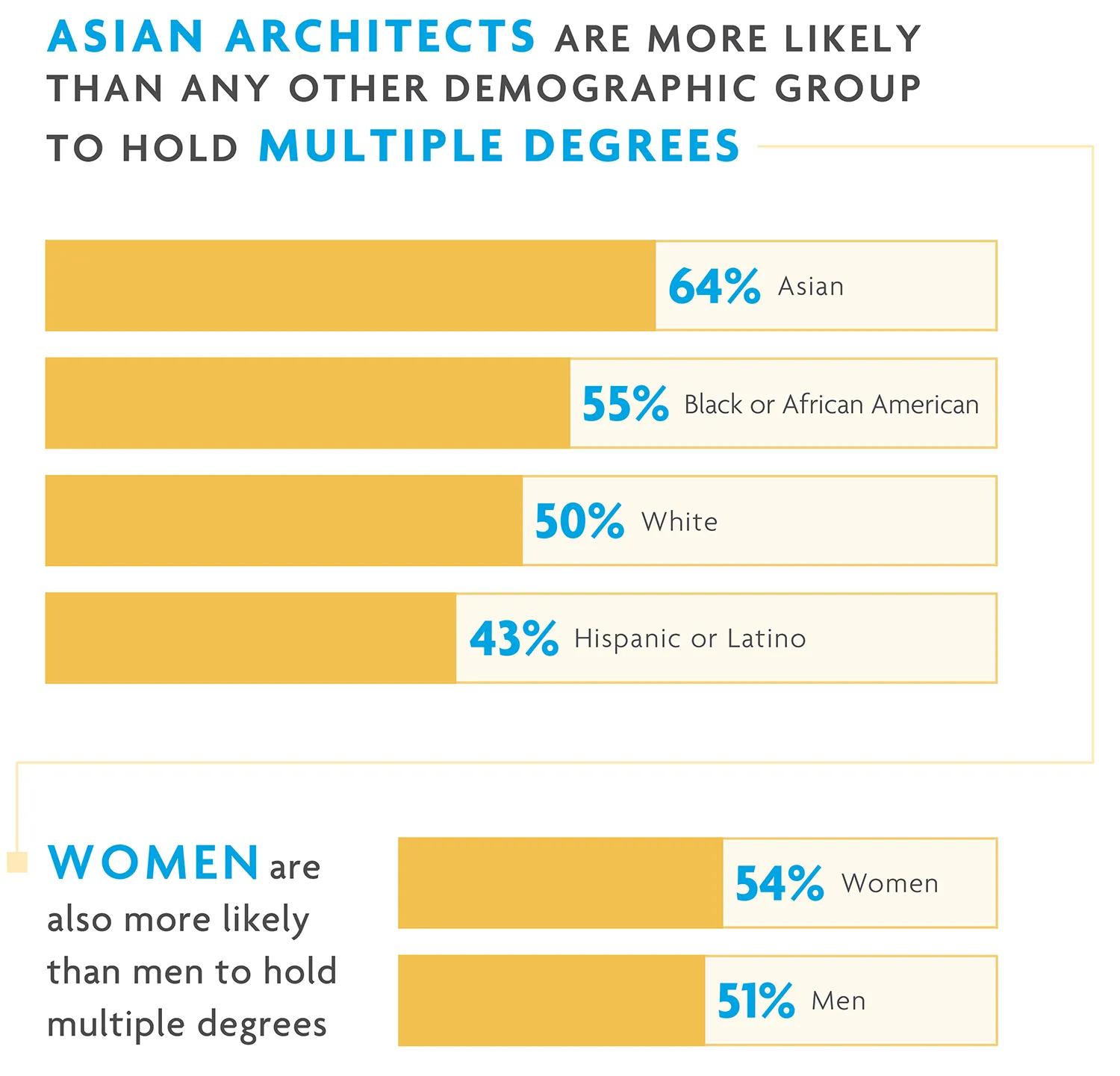
This data aligns with NCARB’s data regarding the types of degrees held by new architects. Approximately 53% of new architects in 2025 hold both a degree from a NAAB-accredited program and a degree from a program not accredited by the NAAB. For some, this approach is planned: Many candidates intentionally attend a non-accredited bachelor’s program first and then complete their education at a NAAB-accredited Master of Architecture program. But for others, holding multiple degrees may be the result of low awareness of the education requirements for licensure. Because many candidates don’t know they’ll need a degree from a NAAB-accredited program, they must eventually return to school for an additional degree before earning a license in their chosen jurisdiction.
Candidates with multiple degrees consistently perform better on the exam.
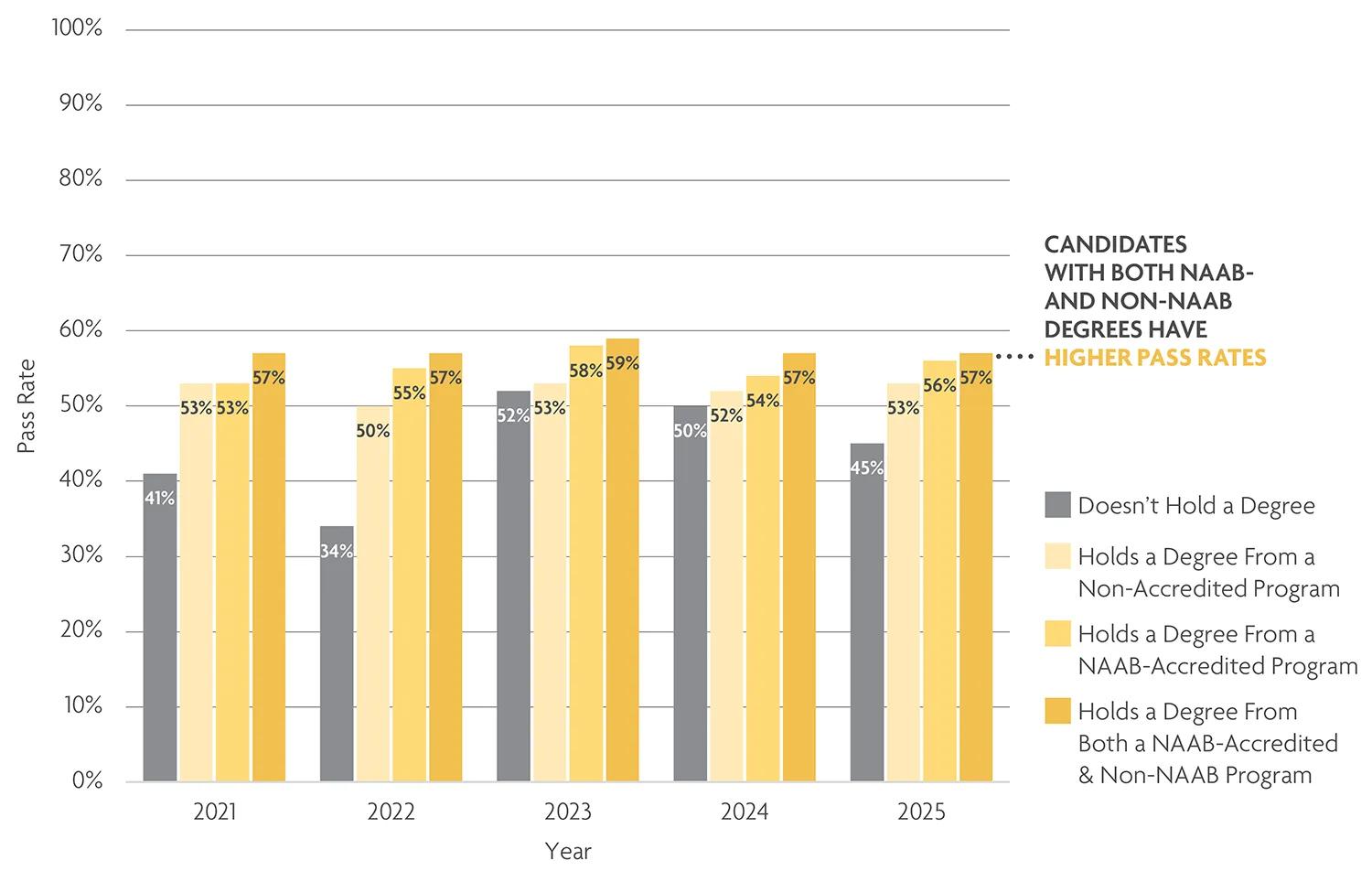
Historically, candidates who hold a degree from a NAAB-accredited program have been more likely to pass the ARE than their peers who don’t hold a degree from an accredited program. Licensure candidates who hold both a degree from a program accredited by the NAAB and from a non-accredited program are even more likely to pass the exam than those who only hold an accredited degree—performing 2 percentage points above the national average overall.
Similar to previous years, candidates with multiple degrees had slightly higher pass rates (1 or 2 percentage points above the national average) across most divisions, rather than significantly higher pass rates on a single division.
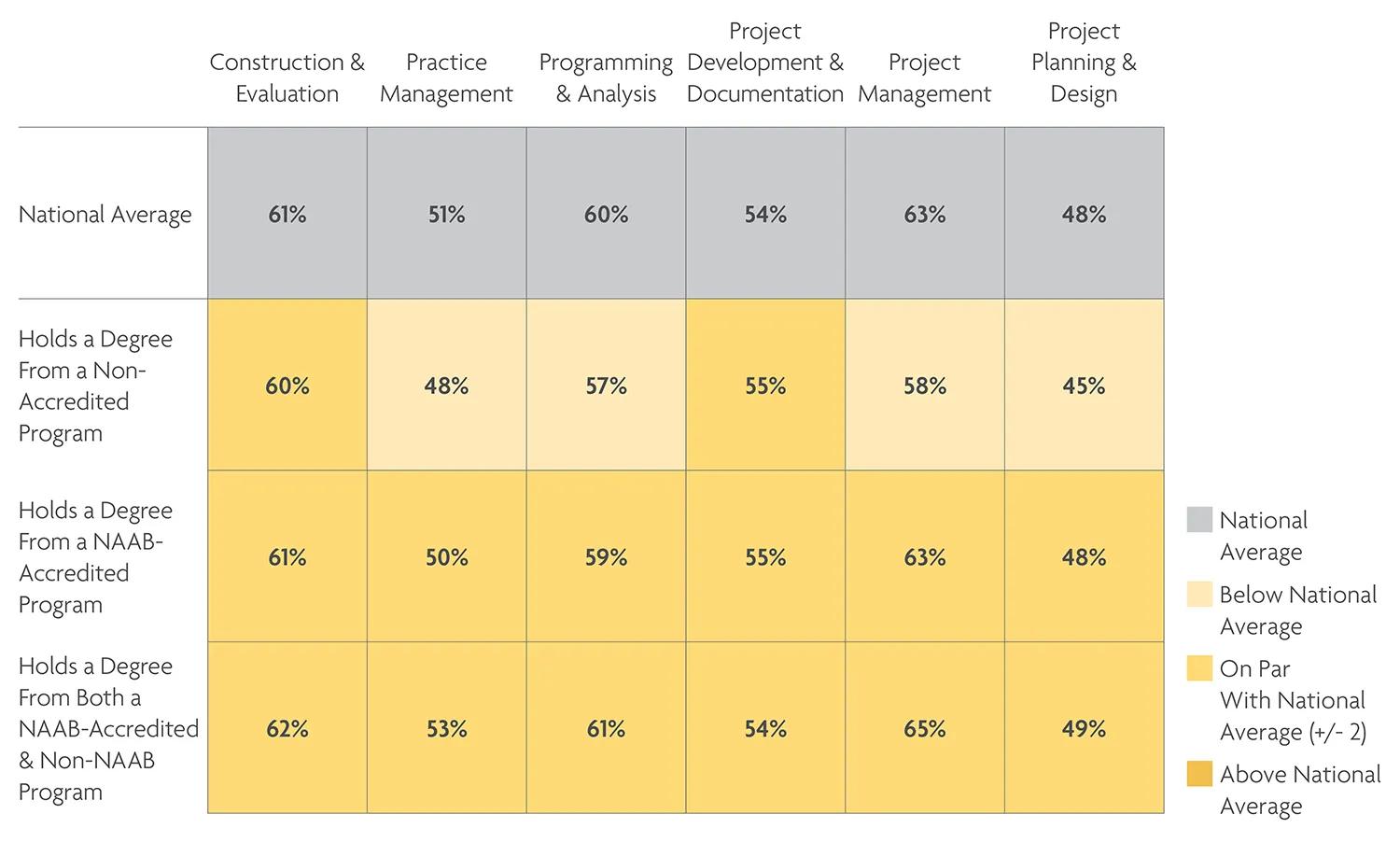
Comparatively, candidates who only hold a degree from a non-accredited program perform at or slightly below the national average across most divisions, with the exception of the Project Development & Documentation division in 2025, where they saw pass rates 1 percentage point above the national average.
Candidates who don’t hold any degrees consistently hold the lowest overall ARE pass rates; however, there are not enough candidates in this cohort to explore pass rates by division.
NCARB updated the Integrated Path to Architectural Licensure (IPAL).
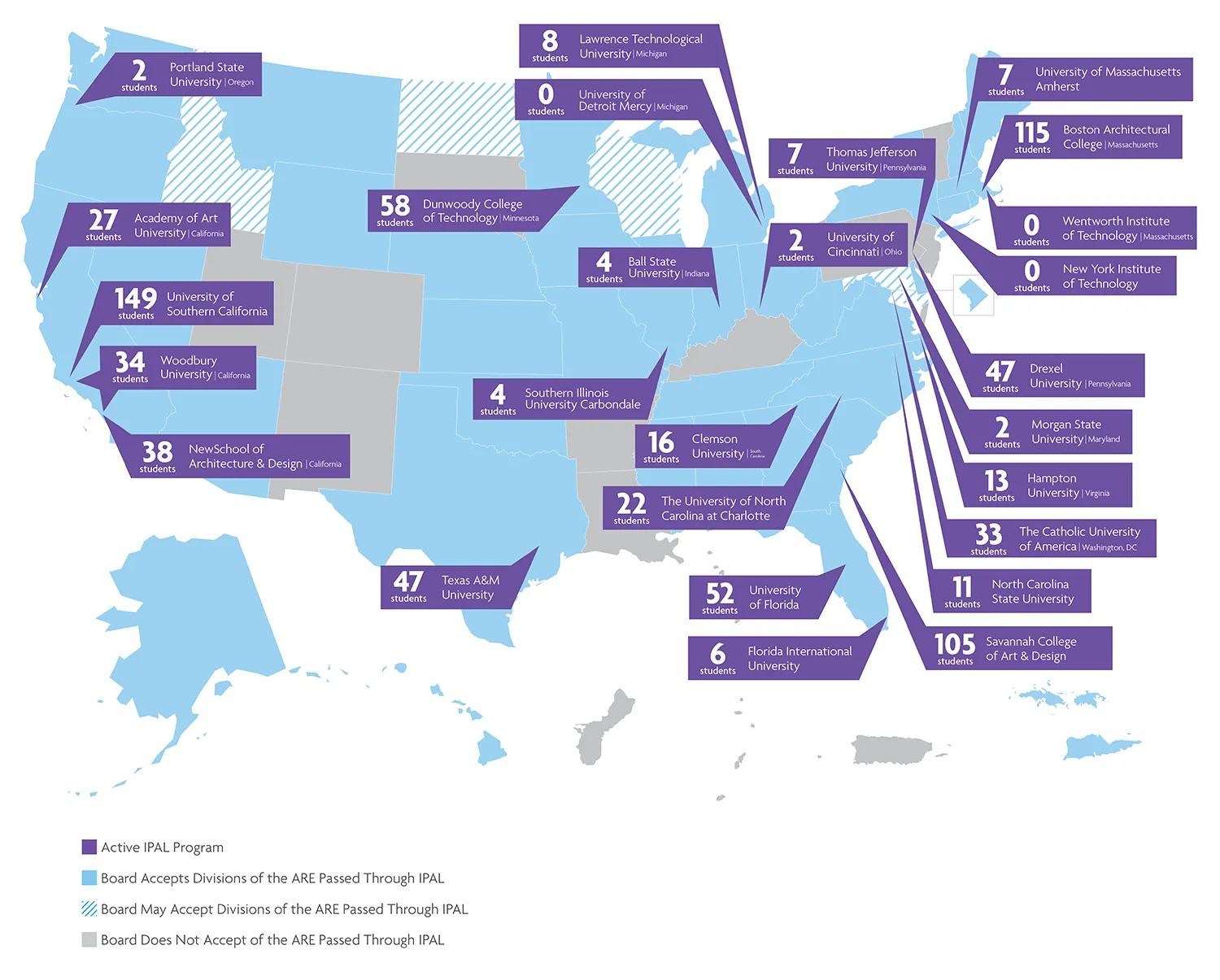
There are currently 32 programs at 27 colleges participating in NCARB’s Integrated Path to Architectural Licensure (IPAL) initiative. The IPAL option—offered as an additional path within an existing NAAB-accredited program—seeks to shorten the time it takes to become an architect for students who are focused on earning a license. In 2025, NCARB implemented several updates to IPAL’s requirements to expand access to a wider range of students. As a result, NCARB hopes to see participation in IPAL increase in the years ahead. There were over 800 students enrolled in IPAL options across the United States during the 2024 – 2025 school year.
DID YOU KNOW? Over 800 students are enrolled in IPAL options across the U.S.
The number of candidates reporting experience fell by 1% in 2025.
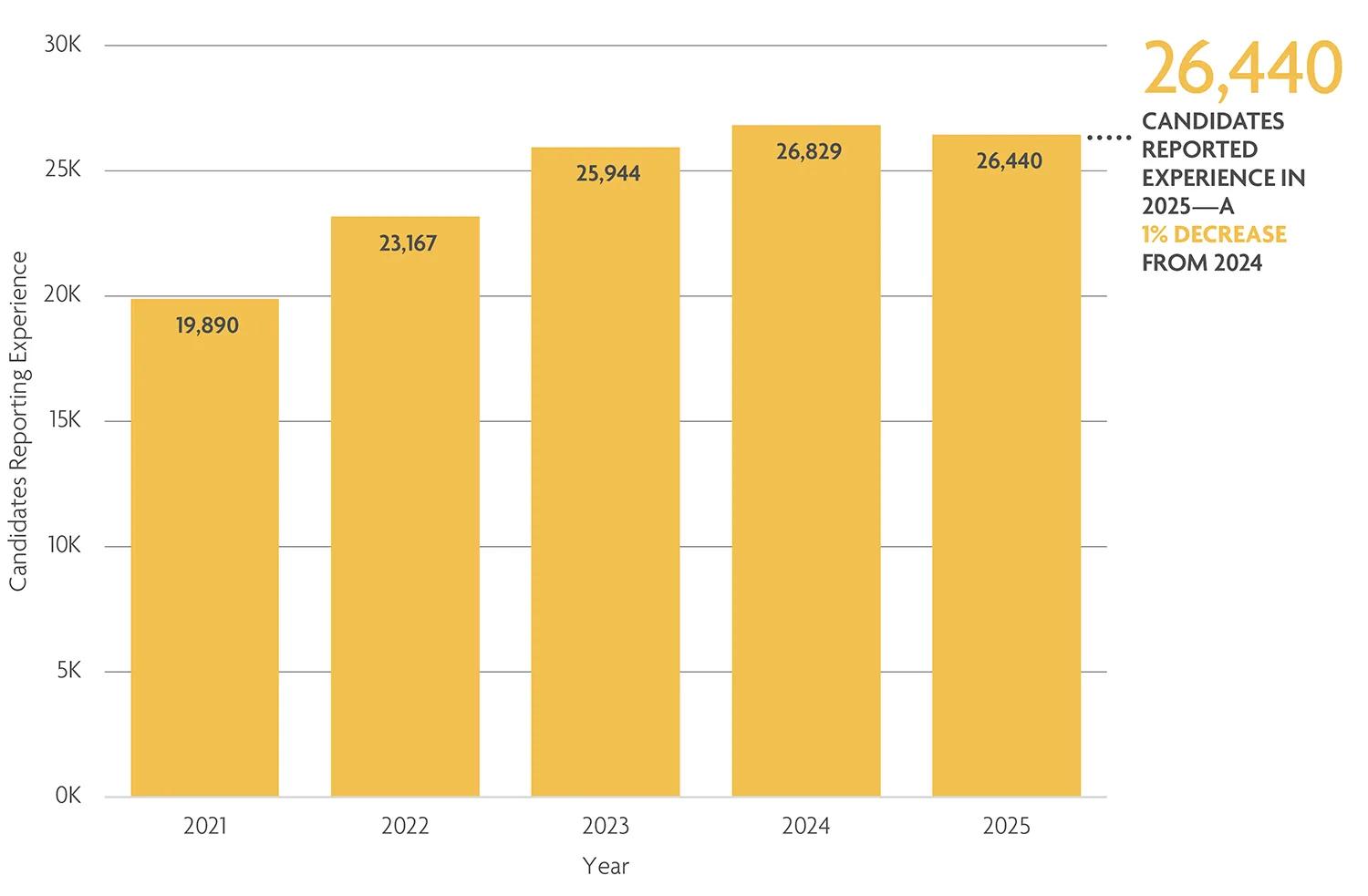
Just over 26,400 candidates reported AXP experience in 2025, approximately 400 fewer than in 2024. The number of candidates reporting experience has remained close to 26,000 for the past three years, suggesting a new “normal” level of participation following a decline due to the COVID-19 pandemic.
In November 2025, NCARB launched several updates to the AXP, including a change to the program’s reporting policy that allows candidates to report experience earned at any point in the past for 75% credit. Because NCARB tracks AXP participation by the date the experience was earned—not the date it was submitted to NCARB—NCARB expects the number of candidates reporting experience in 2025 to shift upward over time.
Over 6,000 candidates completed the AXP in 2025.
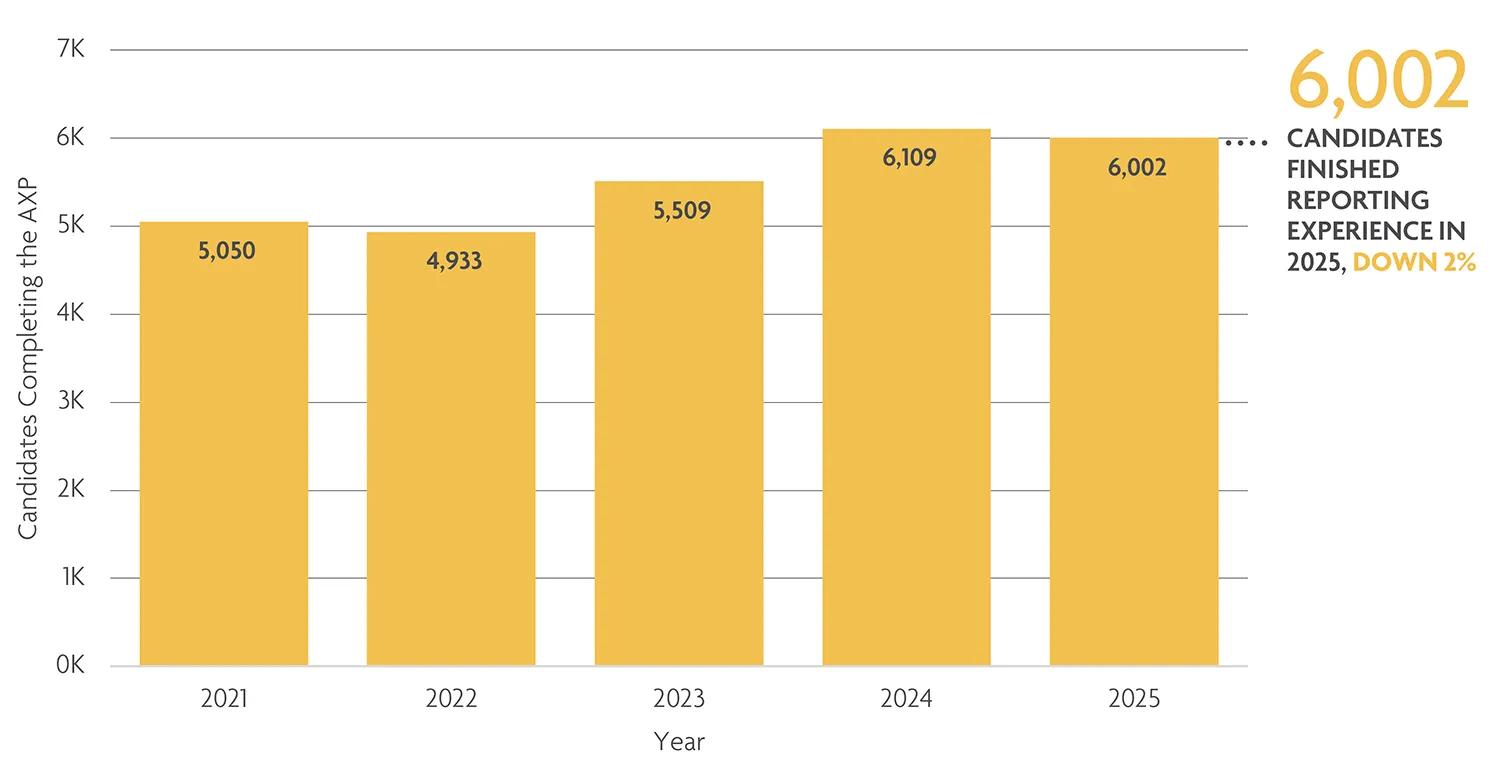
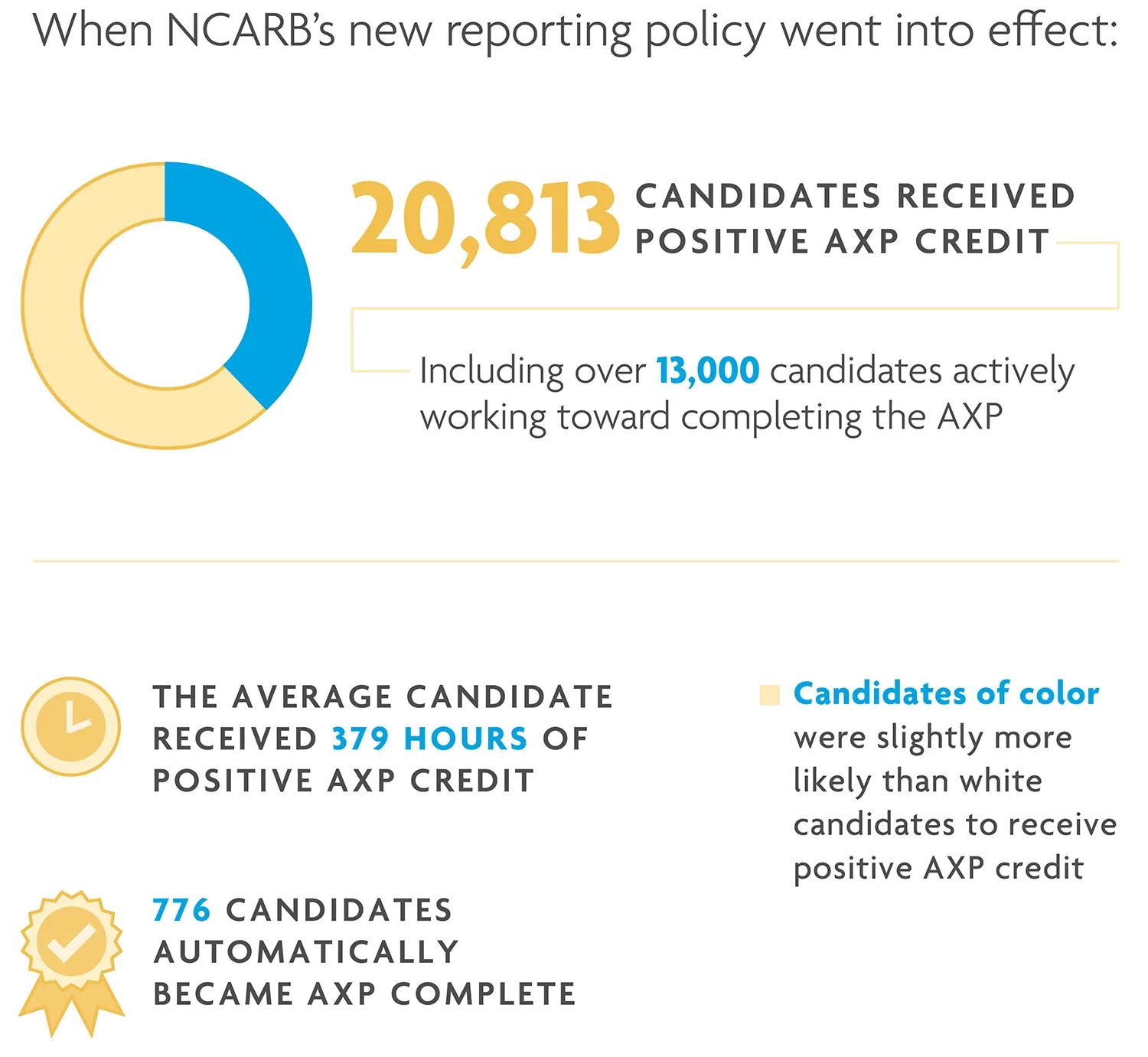
When NCARB implemented the new experience reporting policy in November 2025, thousands of candidates received retroactive AXP credit—including over 700 candidates who automatically became AXP complete.
Because candidates can submit experience reports for work completed in the past—and past work is now worth 75% credit indefinitely, rather than 50% credit for up to 5 years—NCARB has seen a significant increase in AXP completions for both 2024 and 2025. In 2025, over 6,000 candidates completed the AXP—2% less than in 2024, but well above the numbers seen in 2021 –2023. The number of AXP completions in 2025 is likely to shift upward over time as candidates report backdated experience in the future.
DID YOU KNOW? NCARB measures experience start and end dates based on when the work was performed. For example, if a candidate submitted their final experience report in 2025 for work performed in 2022, their AXP complete date would be counted as 2022.
Time to complete the AXP fell by 6 months in 2025.
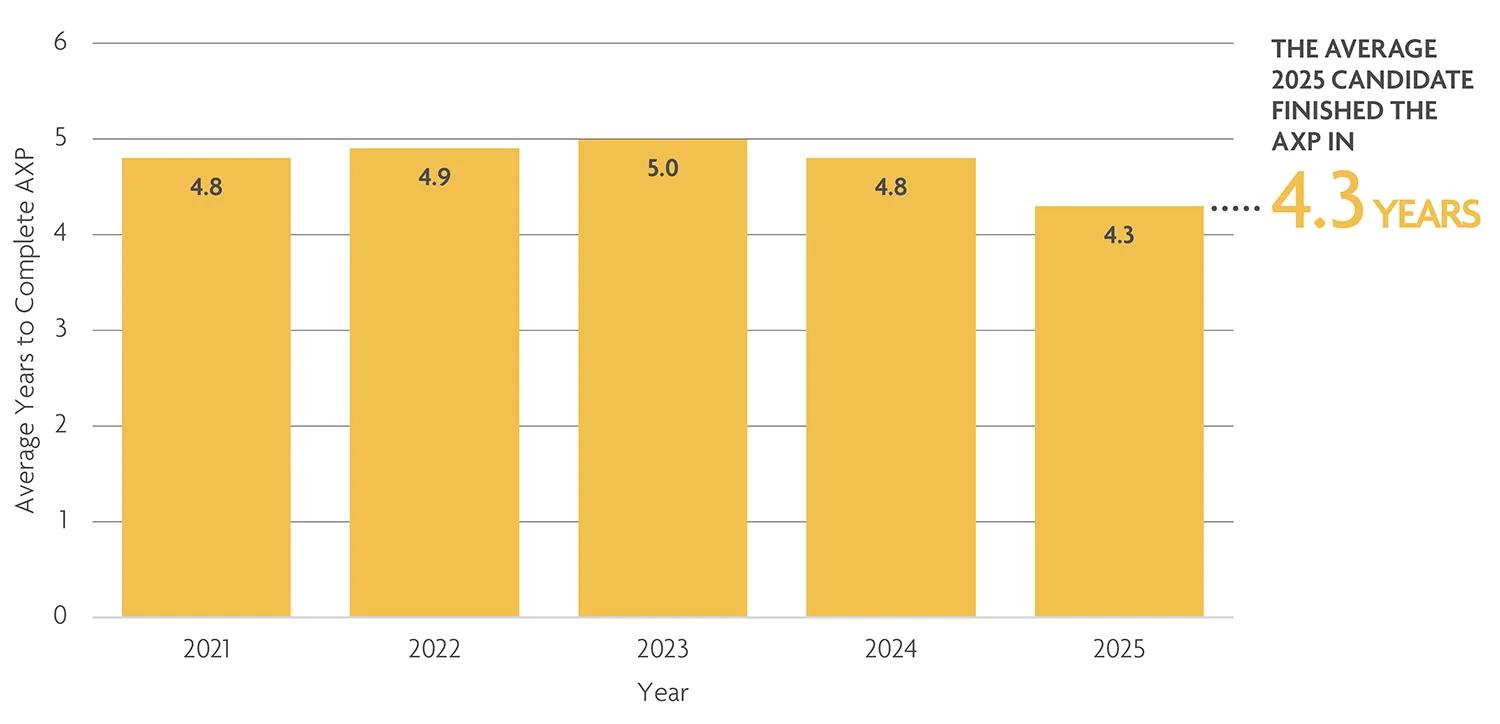
In 2025, the average time to complete the experience program fell significantly as a result of changes to the program’s reporting policy. Candidates who completed the AXP in 2025 took an average of 4.3 years to complete the program, 6 months faster than those who completed it in 2024. Because the new reporting policy provides more flexibility when reporting past experience, NCARB expects fewer candidates to lose significant credit when reporting experience that is several years old.
In addition, NCARB is beginning the see the impacts of the COVID-19 pandemic fade from current AXP candidates. Many candidates who completed the program in 2025 would have started earning and reporting professional experience in 2021 and may have experienced fewer immediate impacts than those who began the experience program in 2019 – 2020.
DID YOU KNOW? Averages can be measured in several ways. NCARB uses median to measure averages throughout NCARB by the Numbers, which allows us to avoid skewing the average with outlier data points.
Candidates with a degree from a non-accredited program complete the AXP faster than their peers.
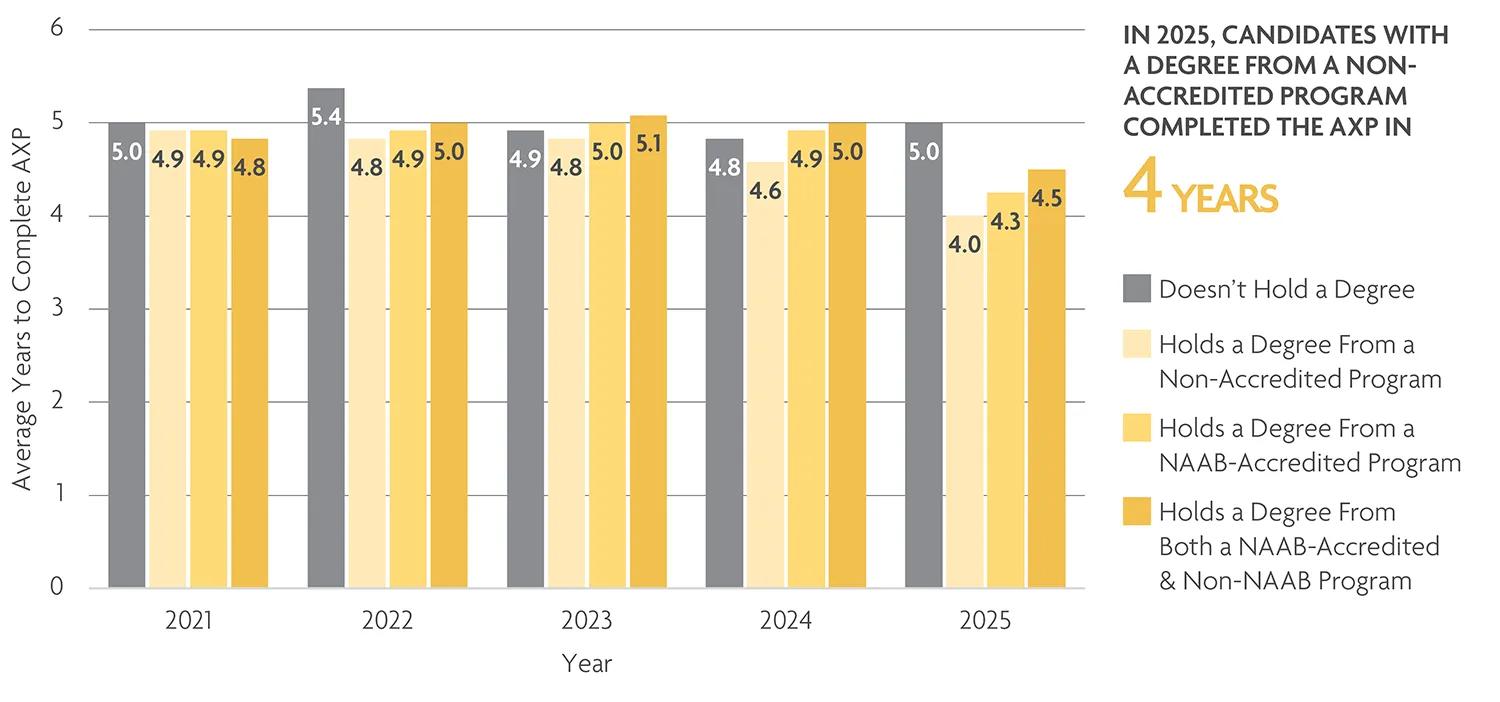
For the past several years, licensure candidates with a degree from a program not accredited by the NAAB have consistently completed the AXP several months faster than their peers. In 2025, graduates of non-accredited programs completed the AXP in an average 4 years, approximately 6 months faster than candidates who hold degrees from both accredited and non-accredited programs, and 3 months faster than candidates who only hold a degree from a NAAB-accredited program.
Half of candidates complete the AXP in less than 4.3 years.
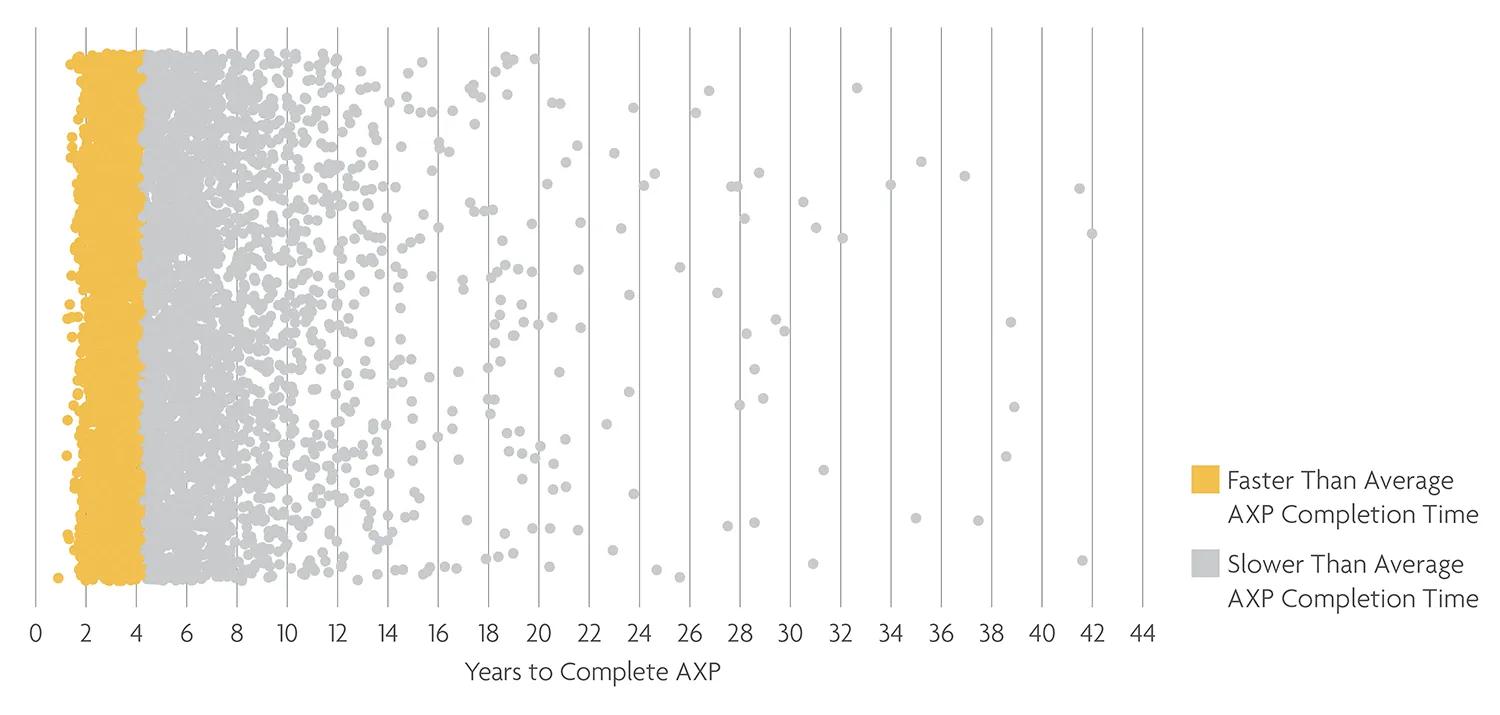
The median time to complete the AXP in 2025 was 4.3 years—meaning that half of all candidates completing the program finished in less time, and half finished in more time.
While many candidates are finishing the program in 4.3 years or less, those who take longer to complete the program are more distributed. Over 200 candidates completed the AXP in less than 2 years in 2025; nearly 20 candidates took more than 30 years.
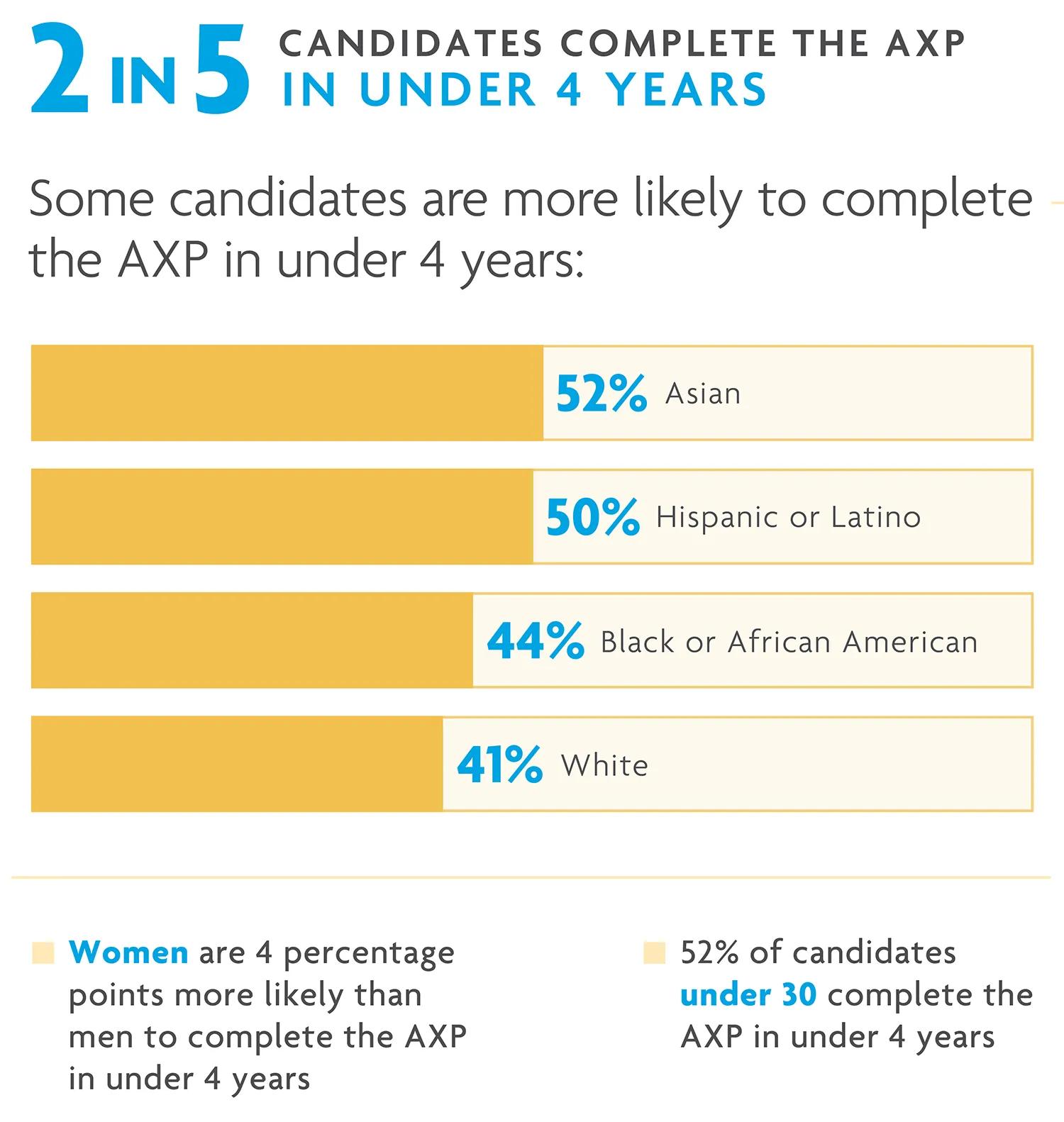
Typically, women and people of color are more likely to complete the AXP in a shorter time frame compared to their peers. Men and white candidates are more likely to begin reporting experience younger (often while in school), which creates a period of slow progress because they aren’t working full-time.
HOW TO READ THIS CHART: Each dot on this chart represents a candidate who completed the AXP in 2025. Because NCARB uses median—the mid-point—to measure average time to completion, half of the dots are below the 4.3 years mark and half are above.
Over 20,000 candidates received positive AXP credit as a result of reporting policy changes.
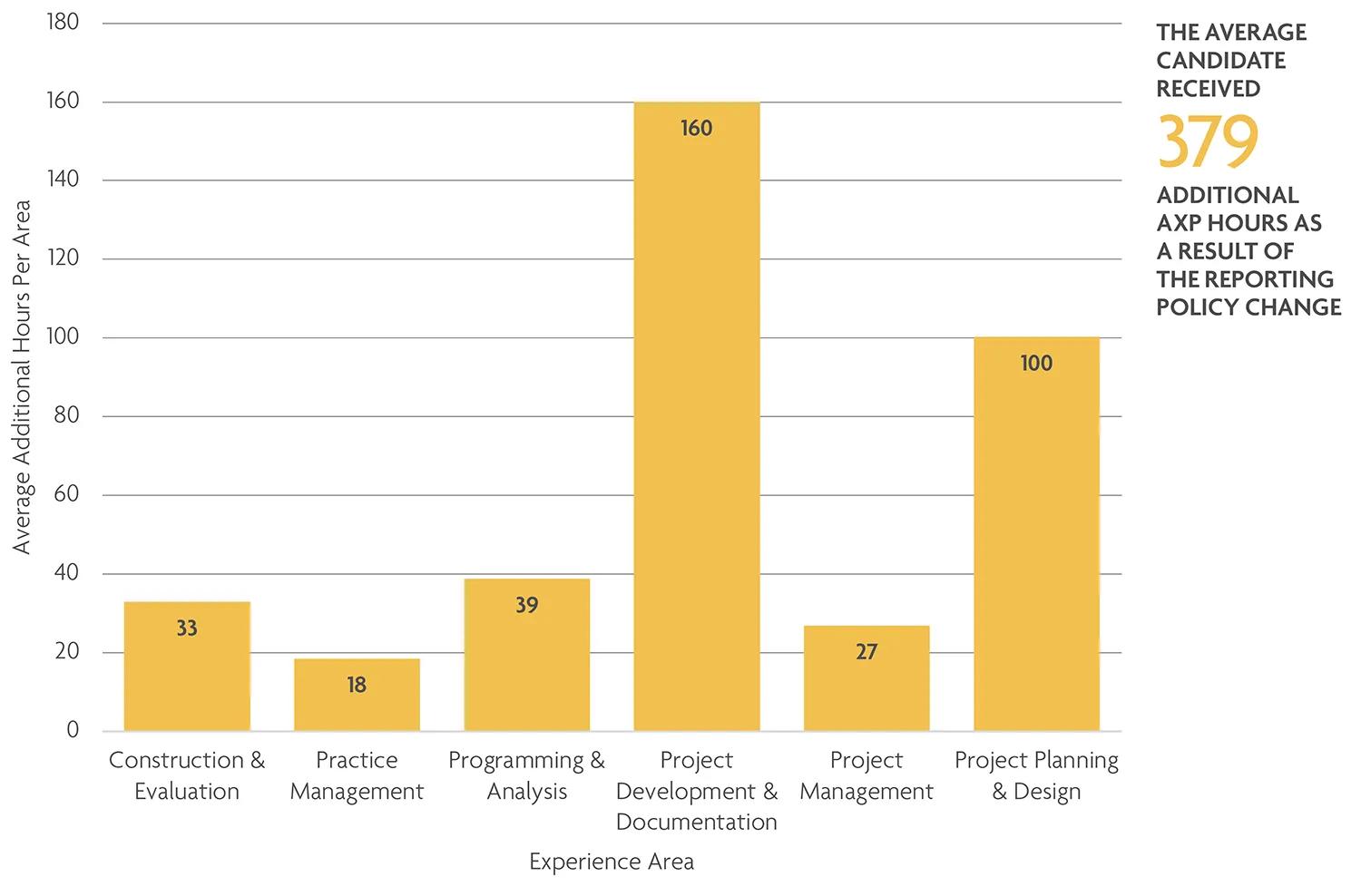
When the updated reporting policy was implemented in November 2025, NCARB automatically increased AXP credit for previously approved reports that were impacted by the previous reporting requirement. As a result, over 20,000 candidates received additional AXP credit, averaging nearly 380 hours per candidate.
Under the new reporting policy, candidates can earn 100% credit for experience up to a year old. Experience older than one year is worth 75% credit, with no limitation on how old that experience can be. Previously, candidates were required to report all experience within eight months of earning it for 100% credit, and within five years for 50% credit; any experience older than five years did not receive any credit.
The number of AXP supervisors fell by 2% in 2025.
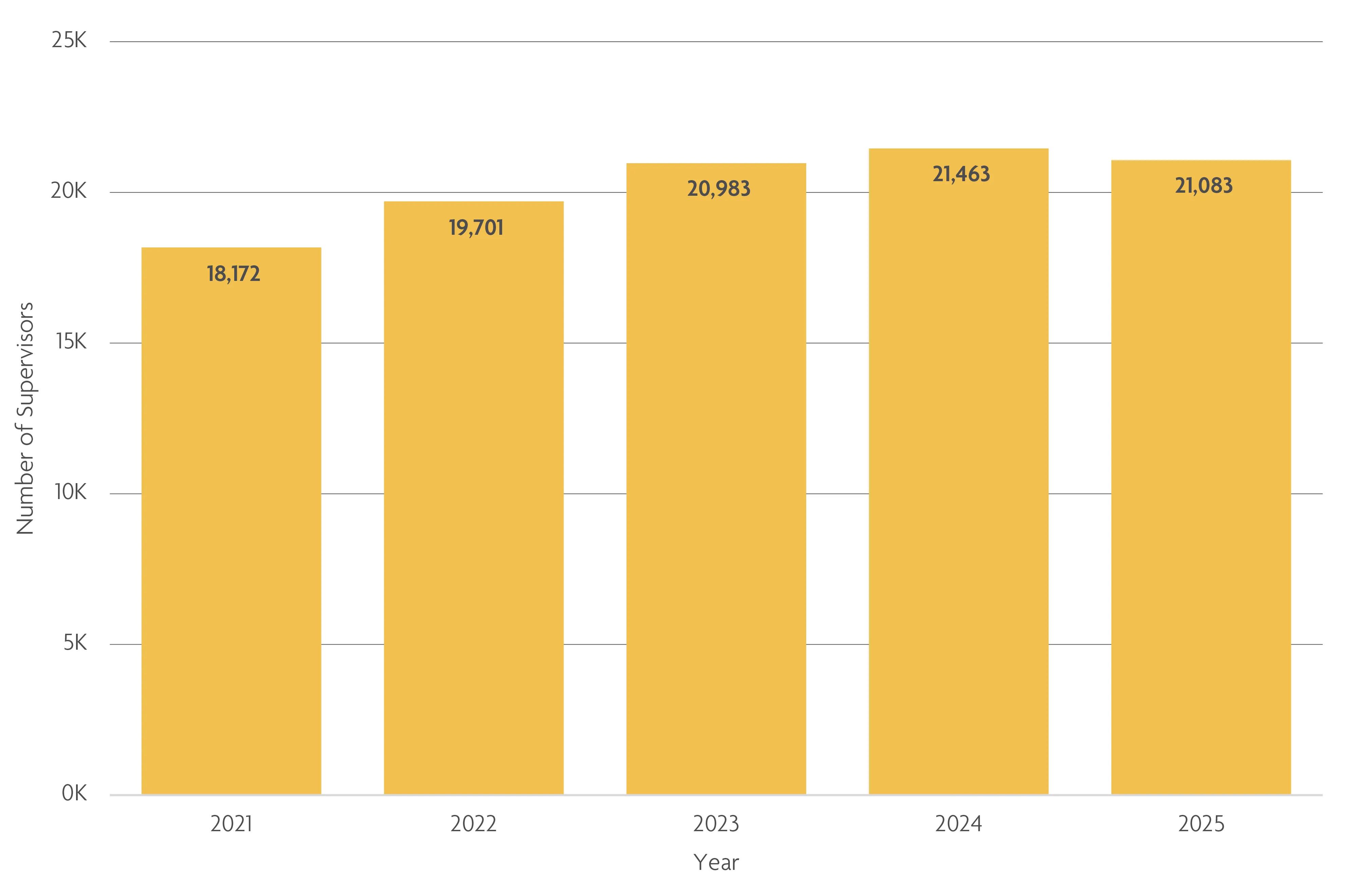
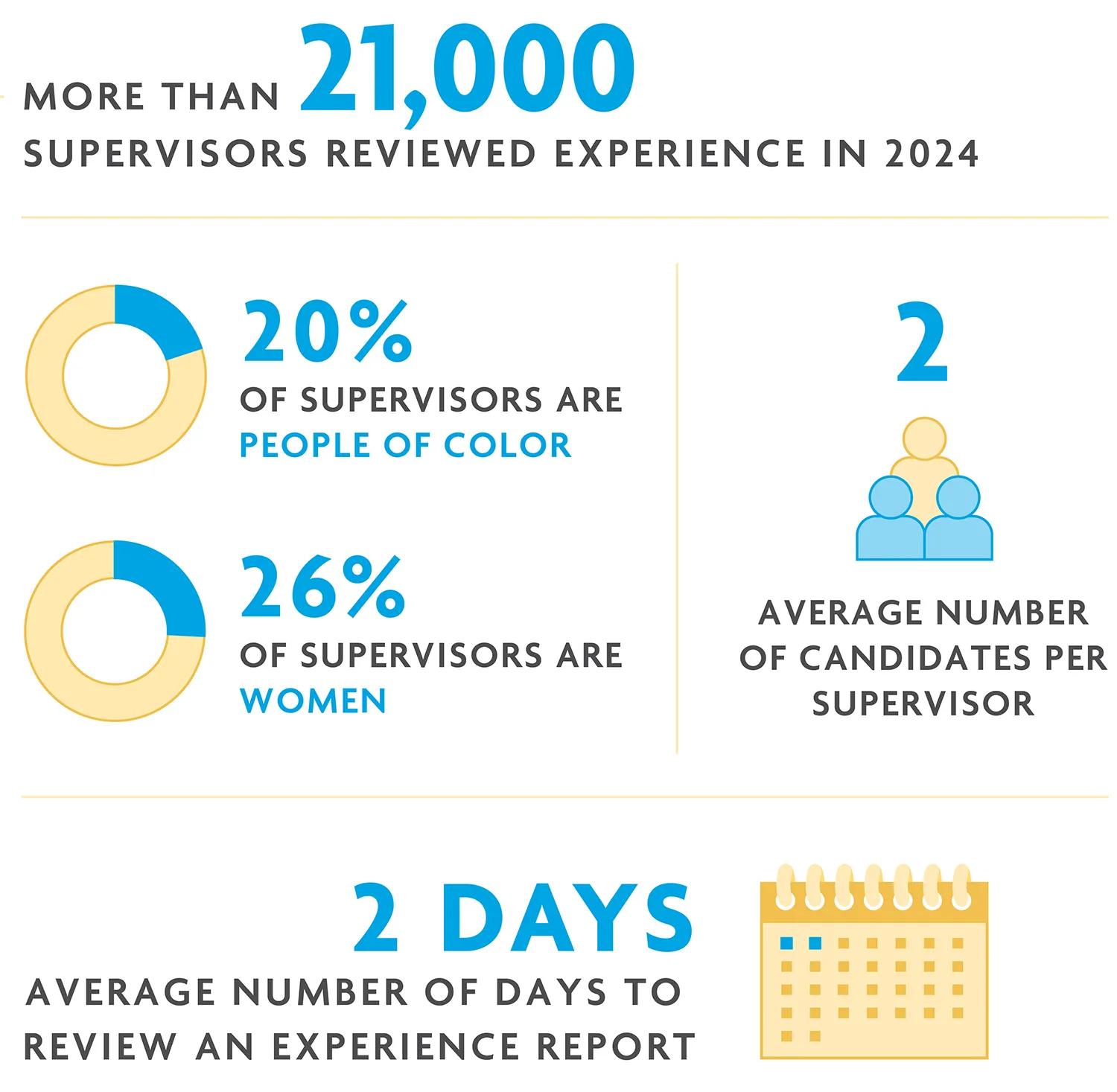
Licensure candidates are required to have an AXP supervisor who is responsible for guiding them through the process of gaining professional experience. Over 26,000 candidates submitted experience reports in 2025 to over 21,000 supervisors—a 2% decrease in the total number of supervisors.
Many candidates report experience to more than 1 supervisor within a given year, whether because they are changing roles or because they are gaining experience outside of their main job through one of the AXP’s setting O opportunities.